The Hidden Cost of Manual Classroom Disinfection — And Why Vacuum Robots Are Solving It for US Schools

School facilities teams carry a responsibility that rarely gets discussed in budget meetings: keeping hundreds of high-contact surfaces consistently clean across dozens of classrooms, often with staff stretched thin and schedules that leave little room for error. Manual disinfection routines have served as the default for generations, but the assumption that they work well enough is increasingly difficult to defend. The gaps are not always visible in real time — they show up in illness rates, staff turnover, and the slow accumulation of deferred cleaning that compounds over a school year. Understanding where manual processes fall short is the first step toward making a genuinely informed decision about what should replace them.
Why Manual Disinfection Creates Structural Problems in School Environments
Manual classroom disinfection is labor-intensive by design. It depends on individual custodians moving through rooms in a set sequence, applying products by hand, and making judgment calls about which surfaces need attention on any given day. The problem is not that custodial staff lack skill — most are experienced and conscientious. The problem is that the method itself introduces variability that is difficult to manage at scale. When a school has thirty classrooms and a two-hour cleaning window after dismissal, the margin for thorough work in each space is narrow.
The growing interest in deploying a vacuum robot for school classroom disinfection reflects a practical response to these structural limitations. Automated systems do not get fatigued, do not skip steps under time pressure, and do not vary their approach based on the end of a shift. For facilities directors evaluating cleaning consistency across a large campus, that reliability has real operational value.
The Problem of Inconsistent Coverage
In a manual cleaning workflow, inconsistency is almost inevitable. Different custodians prioritize different areas. High-traffic zones near doors and desks may receive attention while corners, low surfaces, and spaces beneath furniture are overlooked. Over time, this uneven coverage creates conditions where pathogen load builds in areas that appear clean to the naked eye but have not been disinfected thoroughly or recently.
This matters more in school environments than in most commercial settings because classrooms concentrate children in shared spaces for extended periods. The combination of close contact, shared materials, and developing immune systems means that gaps in disinfection have a measurable downstream effect on student attendance and health outcomes. A cleaning method that works adequately on average is not the same as one that works consistently every time.
Labor Constraints Are Not a Temporary Condition
Schools across the United States have faced custodial staffing shortages that predated the pandemic and have continued since. These are not problems that resolve with a wage increase or a recruitment campaign. The custodial workforce in education is aging, the work is physically demanding, and the pay scale in many districts does not support long-term retention. When experienced custodians leave, institutional knowledge about cleaning protocols goes with them, and the consistency of cleaning operations declines further.
Facilities managers who have operated under these conditions understand that adding headcount is rarely the answer. The actual question is how to maintain a reliable standard of cleanliness with the staff that is realistically available. That framing shifts the evaluation criteria significantly — away from cost-per-hour comparisons and toward consistency-per-outcome assessments.
What Automated Vacuum Robots Actually Do in a Classroom Setting
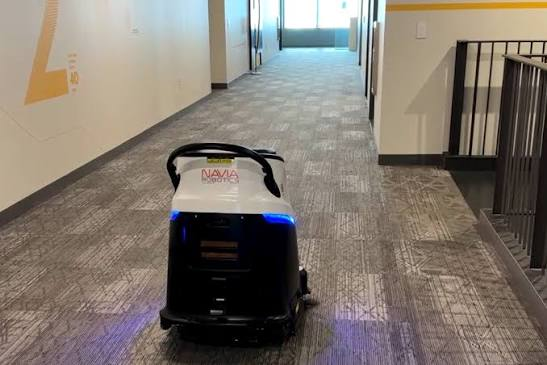
Automated cleaning systems designed for school environments combine floor cleaning with disinfection functions in a way that operates independently of custodial scheduling. Rather than replacing human staff entirely, these systems handle the repetitive, high-frequency cleaning tasks that consume the most time in a manual routine. Custodians can then focus on the tasks that genuinely require human judgment — deep cleaning, surface disinfection of desks and whiteboards, restroom maintenance, and responding to spills or specific incidents.
The operational model works because robot systems can run during non-school hours without supervision. A robot deployed in a classroom at seven in the evening completes its cleaning pass, docks, and is ready to report results before the morning bell. The facilities team receives data confirming the pass was completed, and the room opens for students without anyone needing to verify the work manually.
Reliability as an Operational Asset
The value of an automated system in a school context is not primarily about the technology itself — it is about what reliability enables downstream. When facilities managers can confirm that floor disinfection in every classroom has been completed to a consistent standard each night, they can allocate custodial time differently. Preventive maintenance cycles become more predictable. Documentation for health and safety audits becomes easier to produce. And the risk of a disinfection failure going unnoticed until a health complaint surfaces is materially reduced.
This kind of operational certainty is worth more than it might initially appear. Schools operate under public scrutiny on health and safety matters, and administrators who can demonstrate documented, consistent cleaning protocols are better positioned when questions arise from parents, health departments, or school boards.
Integration With Existing Custodial Workflows
One concern that facilities managers often raise about automated cleaning systems is whether they disrupt existing workflows or require significant retraining. In practice, the integration model is more straightforward than many expect. Automated systems are generally scheduled around existing cleaning windows and do not require staff to change how they handle manual tasks. The adjustment is primarily logistical — mapping the robot’s path through each classroom, confirming dock placements, and reviewing the reporting data that the system generates.
Over time, the workflow shifts rather than changes entirely. Custodial roles evolve toward oversight and quality control rather than repetitive manual passes, which can actually improve job satisfaction and reduce physical strain on staff. That secondary benefit matters in an environment where retention is already difficult.
The Real Cost Calculation Schools Are Missing
Budget conversations about cleaning technology in schools tend to focus on the upfront cost of the equipment. That framing is understandable but incomplete. The actual cost of manual disinfection includes the labor hours spent on repetitive tasks, the cost of absenteeism tied to illness spread through inadequately cleaned environments, the administrative time spent managing custodial staff turnover, and the reputational exposure that follows a well-publicized health incident at a school.
None of these costs appear on a line item labeled “cleaning.” They show up in substitute teacher budgets, in nurse visit records, in parent complaints, and in the time administrators spend managing situations that effective disinfection could have prevented. When those costs are accounted for honestly, the economics of automated disinfection look different than a simple equipment-versus-labor comparison would suggest.
Measuring Outcomes Rather Than Activities
A manual cleaning log tells you that a custodian completed a room. It does not tell you how thoroughly the work was done, which surfaces were covered, or whether the disinfectant had adequate contact time before being wiped away. Automated systems generate data that is more specific and more useful for operational decision-making — not because the data is inherently more accurate, but because the process it documents is more standardized.
According to guidance published by the Centers for Disease Control and Prevention, consistent environmental cleaning is a foundational element of infection prevention in shared spaces. That standard applies directly to school classrooms, where surfaces are touched repeatedly by many different individuals throughout the day. Meeting that standard reliably requires a process that is consistent by design, not by effort alone.
The Compounding Effect of Deferred Cleaning
Schools that rely entirely on manual disinfection often develop informal habits of prioritization that make operational sense under time pressure but create cumulative risk. A custodian who has twelve classrooms to clean and ninety minutes to do it will inevitably make trade-offs. Those trade-offs are reasonable in isolation but problematic when they happen every night for a full school year. The result is a facility that has never been systematically disinfected — only selectively cleaned on a rotating basis.
Automated vacuum robots designed for school classroom disinfection address this pattern by removing the need for custodians to make those trade-offs in the first place. The robot covers the same ground every cycle, at the same thoroughness, regardless of what else is happening in the building. That consistency is not a luxury — it is the baseline that effective disinfection requires.
What Schools Should Consider Before Transitioning to Automated Disinfection
Moving from a manual cleaning model to one that incorporates vacuum robot technology for school classroom disinfection is a facilities decision, not a technology decision. The equipment functions as intended when the operational context supports it — when scheduling is structured around robot deployment windows, when custodial roles are clearly redefined, and when administrators understand what the system does and does not replace.
Schools that approach this transition as a plug-and-play solution tend to underutilize the technology. Those that treat it as a workflow redesign — with clear protocols, staff buy-in, and defined success metrics — tend to see meaningful improvements in both cleaning consistency and custodial efficiency. The difference is in how the decision is framed and implemented, not in the equipment itself.
Closing Thoughts
Manual disinfection in schools is not failing because custodians are doing poor work. It is failing because the model was designed for a different era — one with more stable staffing, more time per room, and lower expectations around documentation and accountability. The conditions that once made manual cleaning adequate no longer exist in most US school districts.
Vacuum robot systems designed for school classroom disinfection represent a practical response to a structural problem. They do not eliminate the need for custodial staff, and they do not solve every cleaning challenge a school faces. What they do is provide a consistent, documentable baseline of floor disinfection that manual methods cannot reliably match at scale. For facilities teams managing large campuses under real constraints, that consistency is the foundation everything else depends on. Getting that foundation right is not optional — it is operational necessity.