Article summary
- Front-end body panels were the most sought-after BMW parts in 2026, with doors, rear bumpers and quarter panels not far behind.
- Complete engines, headlights and control modules sold just as quickly, largely because they cost so much new.
- A record year for pothole searches kept suspension parts and alloy wheels in steady demand, not least in South Wales.
Genuine BMW parts aren’t cheap, especially from a main dealer. A replacement LED headlight, a complete engine or a set of body panels can turn a routine repair into a very expensive afternoon, and on an older car the bill can easily outrun the car’s value. So what are BMW owners actually looking for when the inevitable happens?
To find out, we looked at 2026 sales and search figures from sources online, including popular BMW dismantler, MT Auto Parts. The company specialises in 2012-onwards F, G and U-generation BMWs, which covers most of the cars on British roads today. In other words, its figures are a fairly good snapshot of what owners and independent garages need when they order BMW parts.
Front Ends Were The Biggest Sellers
Bodywork came out on top, and front-end parts led the way. Bumpers, bonnets, wings, headlights and slam panels were MT Auto Parts’ best sellers in 2026, which isn’t particularly surprising. A modest knock on a modern BMW rarely stops at the bumper. The bonnet creases, a wing picks up a dent, a headlight cracks, and whatever sits behind the bumper gets pushed out of shape.
Take the slam panel, for example. It’s the front carrier that holds the radiator, air-con condenser, bonnet catch and headlight mounts, and it’s exactly the sort of part that gets overlooked when a repair is first priced up. Plenty of buyers now take the whole front assembly from a donor car, radiator pack included. It’s quicker than hunting down every bracket separately, and bodyshops tend to appreciate it.
“Front-end parts are what we see the most demand for. When a BMW comes in with front-end damage, owners often need the bumper, bonnet, headlight and slam panel together. But we also sell plenty of complete engines and electrical components. These can be very expensive to buy new, so a genuine used part is often a much more affordable option.”
Ziggy, co-founder of MT Auto Parts
There’s an interesting twist on the supply side, too. Many BMWs that arrive at breakers were written off because of accident damage, not mechanical failure. The front end might be beyond saving, but the engine, gearbox and electronics are often perfectly healthy, with plenty of life left in them.
Doors, Rear Bumpers And Quarter Panels Weren’t Far Behind
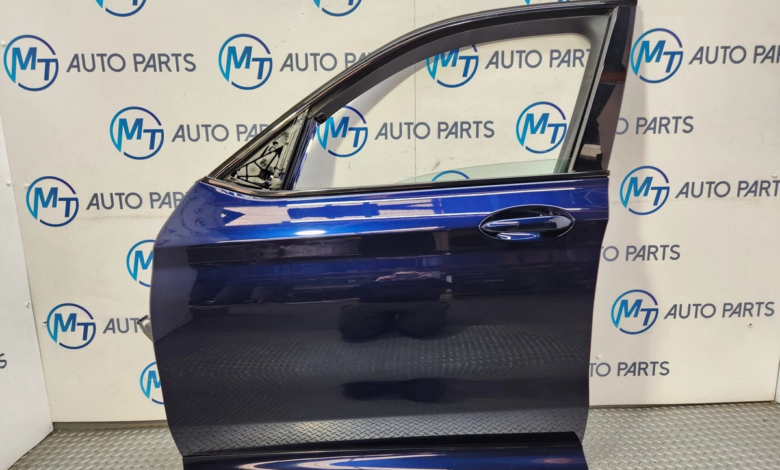
If front ends are the result of a proper knock, doors and rear panels are what supermarket car parks do to a BMW. Doors were among the most requested parts this year, along with rear bumpers and quarter panels.
Buying a used door isn’t quite as simple as it sounds. Some come as bare shells, while others arrive with the glass, window regulator, wiring and trim already fitted. The latter saves a fair bit of work, as long as the spec matches your car. Rear bumpers have their own catch. Many carry parking sensors and brackets, and an M Sport bumper won’t simply swap for a standard one, even on the same model.
Quarter panels are a different story altogether. They’re part of the body shell, so they have to be cut out and welded in. Definitely not a driveway job, but a genuine panel from a compatible donor car is the right starting point for a proper repair.
A Used Engine Often Makes More Sense Than A Rebuild
Few parts come with a bill quite like a complete engine. When one suffers serious internal damage, a rebuild isn’t always the sensible option, and that’s where the used market comes into its own.
MT Auto Parts estimates that independent garage labour for an engine swap runs to between £1,000 and £2,500. Its used N57 3.0-litre diesels have been listed at £3,799.99 to £4,899.99, depending on mileage and spec. That’s still a considerable sum, but a good deal less than most new-engine options.
Predictably, the engines people search for most are the ones with a reputation. The N47 2.0-litre diesel, fitted to various 1, 3 and 5 Series models and the X1, is probably the best-known example. Its timing chain sits at the back of the engine, where it’s known for stretching, and replacing it is a labour-intensive job. The B47 that followed fixed most of that and has proved far more reliable.
Then there’s the N57, a 3.0-litre diesel found in everything from the 330d and 530d to the 730d and X5. It’s a strong engine with plenty of fans, but it isn’t flawless. Swirl flaps, EGR coolers and DPF problems are all worth checking on higher-mileage examples, and MT Auto Parts covers them in its guide to BMW N57 engine problems. EGR coolers also triggered DVSA recall R/2018/151, which covered around 320,000 UK cars, so it’s worth running any used BMW through the government’s vehicle recall checker.
One more thing: the badge on the boot doesn’t tell you enough. Two cars wearing the same badge can have different engines, depending on production date and spec. Always go by the engine code (N57D30A or B47D20, for example) and ask about the donor car’s mileage.
Headlights Are Expensive To Replace, And Popular Used
BMW headlights have become rather complicated over the years. Simple halogen units are long gone on most newer models, and while LED and adaptive LED systems light the road far better, they also make accident repairs a lot more expensive.
That’s where a genuine used unit earns its keep. MT Auto Parts has listed a G01/G02 X3 LED headlight at £379.99, for instance. Not pocket change, but a fraction of what a new one costs from a dealer.
There’s also plenty of interest in upgrading halogen headlights to LED. It’s a tempting modification, but there’s a catch. Fitting an LED bulb into a halogen housing isn’t automatically legal in the UK. Since 14 October 2026, ECE-approved LEDr bulbs can be used in compatible halogen units, provided the approval markings are fitted and visible. The other route is a complete genuine BMW LED headlight made for your model generation, although it’ll usually need coding to work properly. MT Auto Parts explains both options in its guide to BMW halogen to LED headlight conversions on its blog blog.mtautoparts.com.
Control Modules Are Pricey New
Electrical faults can be among the most frustrating problems on a modern BMW. Sometimes the symptoms are obvious; other times a warning light appears and the diagnosis becomes a good deal more involved.
Body control modules are a regular request at MT Auto Parts. F-generation cars use the Front Electronic Module (FEM), while G-generation models use the Body Domain Controller (BDC), and both look after lighting, central locking and a long list of comfort features. Engine control units (DMEs) are another popular search, usually after water damage or an internal fault. Electric water pumps, sensors and wiring looms crop up regularly too. On certain models, fault code 2E81 points to the electric coolant pump, although the code alone doesn’t necessarily mean the pump needs replacing.
The catch with used modules is fitting. Many need coding or programming to the new car, and simply plugging one in won’t always do the job. It’s worth speaking to a BMW specialist before ordering.
Potholes Kept Suspension Parts Busy
British drivers hardly need reminding about potholes. Back in May, one source warned garages to expect more suspension work after Google Trends data showed that searches in the UK, about pothole damage had hit a record high. BMWs on large alloys and low-profile run-flat tyres are particularly vulnerable.
Drivers in South Wales will know the problem all too well. Uneven surfaces and neglected roads take their toll, and front control arms, bushes, anti-roll bar drop links, coil springs and track rod ends are usually the first to suffer.
Alloy wheels don’t escape either. A deep pothole can bend a wheel or crack it outright, and sometimes the only clue is a vibration at speed or a tyre that slowly loses pressure. One study of eBay searches found that wheels were the most sought-after used part for 77.7% of the car models it looked at, with BMW 3 Series wheels topping the list for that model. If you’re buying replacements, remember that looks are only half of it. Diameter, width, offset and bolt pattern all need to match.
Why More Owners Are Choosing Used Genuine Parts
The popularity of used BMW spares isn’t hard to explain. Mintel’s UK Car Aftermarket research found that rising parts and repair costs are pushing 72% of car owners towards more affordable ways of keeping their cars running. With BMW dealer prices where they are, that’s hardly surprising.
Genuine used parts come from original BMWs and keep the factory design and specification. MT Auto Parts reports savings of up to 90% on new genuine BMW parts prices, with the biggest differences on headlights, engines and electronic modules.
Still, not every used part is worth buying. Condition matters, especially on safety-critical components and anything with moving parts, and it’s always worth checking the warranty and asking about the donor car’s history.
Getting The Right Part First Time
BMW has a habit of making compatibility more complicated than it needs to be. Two cars wearing the same badge can need different parts depending on production date, engine, equipment and whether they’ve been facelifted.
The part number is the best place to start, as it’s usually printed or stamped on the old component. Failing that, a specialist can confirm fitment from the last seven characters of the VIN. Body panels need the right paint code (BMW has several very similar shades), and it’s worth knowing whether your car is pre- or post-LCI, since those updates changed headlights, bumpers, grilles and electronics. For engines, the engine code always beats the model name.
MT Auto Parts specialises in genuine used BMW car parts for 2012-onwards F, G and U-generation models, from body panels and complete engines to headlights and electrical components. It delivers across the UK in 2 working days and can check compatibility against a car’s VIN before an order is placed.
The Most Popular BMW Parts Of 2026
Front-end bodywork led the way in 2026, with doors and rear panels close behind. Engines and electrical modules stayed in demand because they cost so much new, and potholes made sure suspension parts and alloy wheels had a busy year too.
The reason behind it all is simple enough. Owners want to keep their BMWs on the road without paying new-part prices for every repair, and with so many accident-damaged cars still carrying perfectly usable engines and electronics, breakers have become an important source of original parts. The trick is getting the right one. Check the part number, confirm the spec, and don’t assume a part from a similar-looking BMW will fit yours.