
7 Field Service Management Tools Cleaning Companies Need to Run a Tighter Operation

You run a cleaning business. Every day starts the same: a list of jobs, a crew that needs to know where to go, and clients expecting everything to be perfect when they walk in.
Sounds manageable. Until someone calls in sick, a client reschedules at the last minute, and by noon, you’re fielding texts instead of running your operation.
That’s the reality for most cleaning companies. The work itself isn’t the hard part. The coordination is.
Software made for cleaning businesses can fix exactly that. It puts your schedule, crew location, billing, and client info all in one place.
Here are 7 tools cleaning companies use to stop piecing things together with spreadsheets and group chats.
1. Job Scheduling and Assignment Software
The Problem
On any given week, you might have 40 recurring cleans, 8 one-offs, and 3 move-in/move-out jobs. Managing all of that in a spreadsheet or a group chat is a full-time job in itself.
What It Does
Good job scheduling software lets you see your whole team’s availability on one screen, drag and drop jobs onto the calendar, and send automatic confirmations to clients and cleaners at the same time. No more double-bookings. No more back-and-forth texts.
What to Look For
Recurring job support is a must. Cleaning is a repeat business. You shouldn’t have to re-enter the same information every two weeks, clean from scratch each time. A good scheduler handles that automatically once you set it up.
2. Work Order Management
The Problem
Without a system, important job details live in someone’s head. What needs to be cleaned, what supplies to bring, and whether the client has a dog that needs to be locked up first. When that person quits, it all disappears with them.
What It Does
A good work order system turns every job into a simple record that the whole team can see. Cleaners know exactly what to do before they walk in. Managers have a clear record when clients ask questions later.
Why It Matters
For business contracts, this kind of record-keeping isn’t optional. It’s the difference between winning a renewal and watching a competitor take your account.
3. Mobile Apps for Cleaning Crews
The Problem
Your crew is never at a desk. They’re in apartments, offices, and vacation homes. If your software only works well on a laptop, it doesn’t really work for them.
What It Does
The best apps give cleaners everything they need on their phone: job details, client notes, room-by-room checklists, and before-and-after photo uploads right from the job site.
Why It Matters
When a client claims an area wasn’t cleaned, a time-stamped photo settles it right away. Mobile access also means your crew stops calling the office for basic information. The answers are already in their pocket.
4. GPS Tracking and Route Planning
The Problem
Without visibility, you find out a cleaner is running 45 minutes late when the client calls to complain. By then, the damage is done.
What It Does
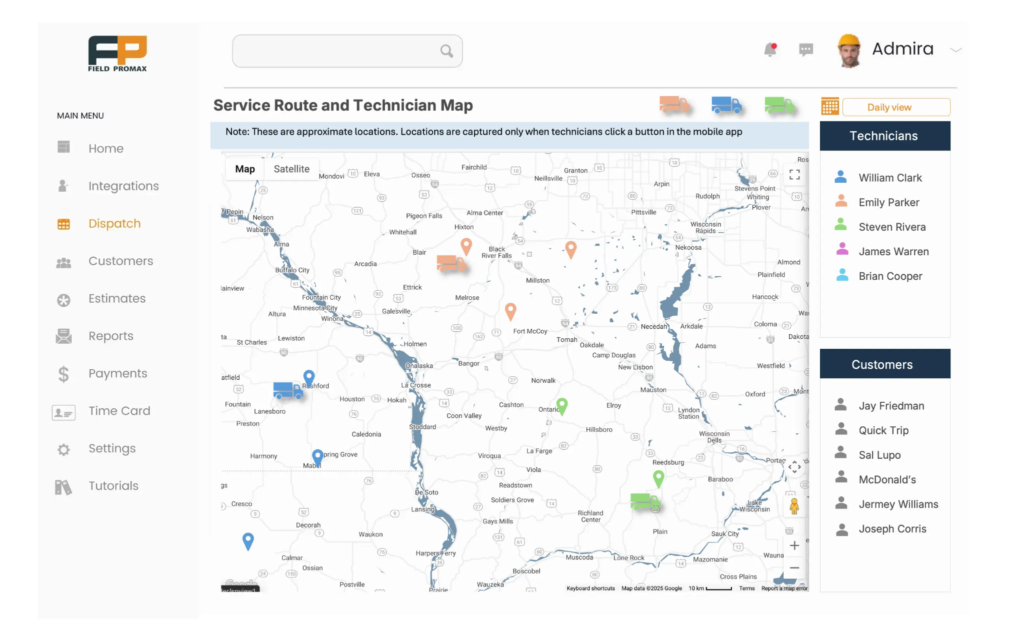
GPS tracking shows you where every crew member is in real time. Route planning groups jobs by location so your team isn’t driving back and forth across town between stops. Tools like Field Promax let managers assign jobs by location from a single screen, reducing unnecessary travel time.
Why It Matters
For growing cleaning companies taking on business contracts, route planning directly affects how many jobs fit in a day. Tighter routes mean more revenue without adding more staff.
5. Invoicing and Payment Tools
The Problem
Cleaning companies lose real money every year to slow billing and forgotten follow-ups. A job gets done, the invoice goes out three days later, and the client pays 45 days after that. Meanwhile, your money situation suffers.
What It Does
A good scheduling tool sends the invoice the moment a job is marked complete and fires a payment reminder if nothing comes in within 7 days. For recurring clients, bulk invoicing processes 30 invoices in a single run instead of one at a time.
Why It Matters
Faster invoicing equals faster payments. For cleaning businesses operating on tight budgets, closing the gap between job completion and payment is one of the best moves you can make.
6. Customer Management and Communication
The Problem
One client wants a text the morning of. Another hates being contacted unless something changes. A third has an alarm code that expires every 90 days. Getting these details wrong, even once, costs you the account.
What It Does
A customer record system built into your software keeps everything on a single client page. Job history, communication preferences, entry instructions, recurring schedule, and payment notes all in one place. Anyone on your team can pull it up and know exactly what that client expects.
Why It Matters
Keeping clients is cheaper than finding new ones. When clients feel like your company actually remembers their preferences, they don’t go looking for someone else. In the cleaning industry, where referrals drive growth and losing clients is common, keeping existing clients happy is the whole game.
See more amazing Information visit Fact News


