A security program without governance is just a bunch of tools and people trying their best with no mandate. When conditions are stable, it may have produced decent results but under pressure, it drifts and when competing priorities emerge, decisions go haywire and no outside party is able to see whether you are doing anything at all. Cybersecurity Governance: the framework that transforms a security program into an enterprise function with direction and accountability.
Now, getting governance right has become even more consequential. Governance over cyber risk has now been defined as a requisite by regulators in public company board disclosure guidelines. A demonstrated security posture is the basis for decisions by investors and customers. And governance failures such as a late response to incidents and a lack of escalation paths continue to recur in investigations into high-profile breaches of the law.
What Cybersecurity Governance Actually Covers
Cybersecurity governance is different from cybersecurity operations. Operations covers the Security Teams’ day-to-day work: monitoring, incident response, vulnerability management, and configuration control. Governance sets the direction for these efforts—including when to engage third-party penetration testing services to independently validate defense mechanisms—and determines how the organization assigns accountability and resources to manage those findings, who is responsible for doing it and the resources that are allocated to it, and whether or not it is successful.
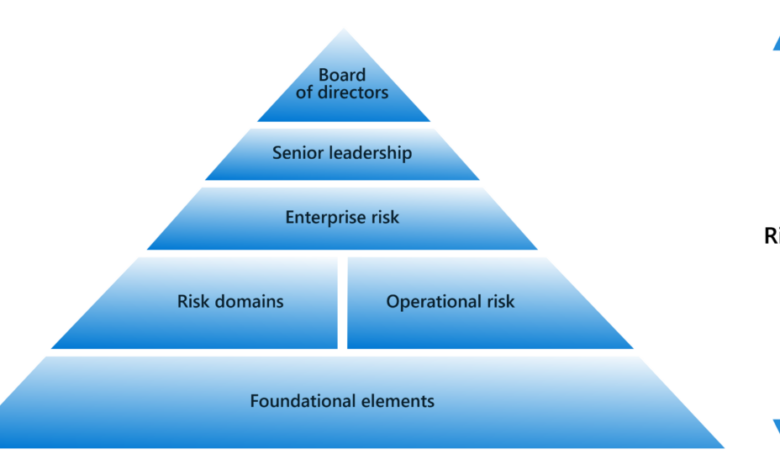
Cybersecurity governance for enterprise risk explains how cybersecurity fits within the broader enterprise risk management structure and how organizations translate security risk into board-level language and executive accountability.
Cybersecurity governance is composed of four primary building blocks: the policies and standards that articulate how the organization manages security risk, organizational structure detailing who is accountable for those policies, reporting cadence keeping leadership informed regarding security posture, and a statement defining what level of cyber risk the organization will tolerate to achieve business objectives (risk appetite statement). Neither of these aspects is technical.
The Board Has an Accidentally Different Primary Role
Historically, the board’s role in enterprise cybersecurity was largely theoretical. The CISO occasionally briefed boards, but the board approved its security budget as part of a bigger budget for IT and relied on management to handle the details. That model is long-outdated, and in many places it no longer complies with the law.
The NACD 2026 Director’s Handbook on Cyber-Risk Oversight organizes the board-level responsibility for cybersecurity around six principles, it makes the point that cyber risk is a board level issue and worthy of engagement just like financial, operational and strategic risk. The handbook also cites survey research indicating that 34 percent of public company directors believe enhancing their cybersecurity expertise is very or extremely important.
Boards now should know the four or five cyber risks that will have the biggest impact on their business; be updated regularly about security posture; make sure that management has erected an enterprise-wide cyber risk management framework, and approve a risk appetite what dollar loss it is prepared to suffer in order to accept how much cyber risk. They are not supposed to be cognizant of the technical nitty-gritty. They are expected to make someone competent culpable for doing so.
What the SEC Wants From Public Companies
New Regulatory Expectations for Board-Level Cybersecurity Governance of Publicly Traded Companies in the United States In July 2023, the SEC’s new rules for cybersecurity disclosure (to be effective December 2023) require public companies to disclose material cybersecurity incidents within four business days of formulating a materiality determination and annual disclosures addressing their enterprise-wide policies regarding cybersecurity risk management, strategy, and governance.
In particular, the governance disclosure requirement is critical. Companies must describe how their board monitors cybersecurity risk, identify the committee with oversight responsibility and outline how management keeps the board apprised. It turns cybersecurity governance from a best practice into a disclosure obligation with legal and reputational penalties at play if implemented poorly.
The Relationship and Function of the Chief Information Security Officer
The Chief Information Security Officer is the individual executive responsible for cybersecurity at most organizations, but their effectiveness largely depends upon where they sit in the organizational hierarchy.
CISOs who report directly to the CEO or board have the ability to elevate material risks without filtering through executives who might be misaligned with CISOs vision. CISOs reporting into the CIO work within a hierarchy where security interests may be trumped by time lines for technology delivery, or budget imperatives. And third, governance decisions around report generation shape what data reaches leaders and how soon.
A CISO engages in many core functions of governance, including translating risk into business language for executive and board audiences, creating and maintaining security policies, budgeting for risk-reduction outcomes, and liaising with legal & compliance on regulatory requirements.
Enterprise Risk Management and its connection with Cyber Risk
Mature cybersecurity governance programs consider cyber risk a subset of enterprise risk management, not a standalone technical function. Cyber risk looks like a financial, operational, or strategic risk: if it shows up in the enterprise risk register with those risks — same reporting cadence and risk committee oversight are applied.
Risk quantification puts cyber risk in terms and functional silos that non-technical risk professionals can understand, evaluate, and rank against other risk leaders across the enterprise already managing with a quantitative cost/benefit analysis.
Metrics and Reporting Cadence
Governance without measurement is aspiration. A key aspect of a strong cybersecurity governance program is to have a detailed set of metrics provided to leadership on an ongoing schedule, including coverage for critical assets; detection and response performance, vulnerability remediation rates; security program maturity vs. defined benchmark.
The board metrics should be outcome-based rather than activity-based. A metric that indicates what percentage of the critical vulnerabilities are remediated within the timeline set by the program gives the board an indication of whether risk is being managed appropriately. A figure on how many scans have been carried out informs them about whether there is a lot of action.
Creating a Governance Structure that Grows with the Risk
Cybersecurity governance that is effective at one scale may not work as an organization expands, pursues M&A opportunities, or moves into new regulatory jurisdictions. To bootstrap scaling governance structures requires formal policy management processes, committees with a clearly defined charter and articulated membership guidelines, documented escalation pathways for material risks and review cycles that periodically refresh the governance framework as the risk landscape evolves.
The best-performing organizations in cybersecurity are rarely those that own the best technical tools. They are ones whose governance structures make certain that security is given the right levels of effort, resources, and accountability from the board level down to the individual team.
Frequently Asked Questions
Should the CISO report to the CIO or should they report directly to the CEO?
There is no one-size-fits-all answer, but reporting directly to the CEO or to an independent line to the board helps ensure that material risks are filtered from other operational updates so they can get through to leadership. In organizations where the governance maturity is more developed, the CISO typically reports to the CEO or CFO and has a dotted-line reporting relationship to either the audit or risk committee of the board.
What should be the key responsibility for a particular board committee with respect to cybersecurity oversight?
It varies according to organization and sector in practice. Audit committees are often the primary oversight as they already have a risk-oversight mandate in place. In some cases, dedicated technology or risk committees are established by organizations. More important than which particular committee you have is that the charter, expertise and reporting cadence are clearly defined.
How often does the board need an update on cybersecurity?
At least quarterly, plus any briefings as determined by major events and/or at times when the risk environment changes substantively. The pace should be sufficient that the board can monitor whether the security program is successfully improving against well-defined metrics, rather than merely getting episodic reviews after incidents.