
The Complete Equip Asset Management Guide for US Construction and Field Service Companies

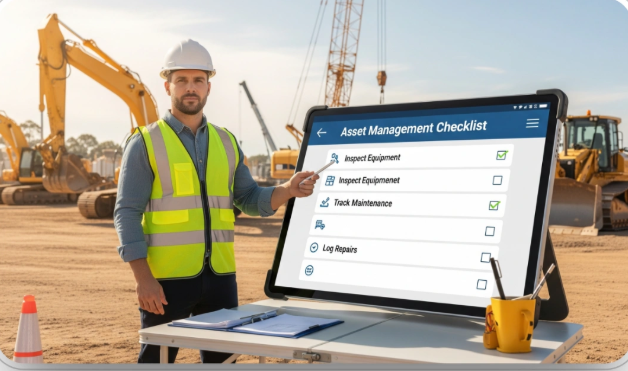
Construction and field service companies in the United States operate with one persistent challenge that rarely gets resolved cleanly: keeping equipment where it needs to be, in the condition it needs to be in, at the time it needs to be there. This is not a technology problem. It is an operational discipline problem that technology can support—but only when the underlying processes are well defined.
For companies running mixed fleets of heavy equipment, light-duty vehicles, trailers, and specialized tools across multiple job sites, asset visibility is a daily concern. Jobs get delayed because equipment is unavailable. Maintenance gets skipped because scheduling is reactive. Equipment leaves a site and no one tracks where it goes. These patterns are common, and they carry measurable cost consequences in labor, fuel, project timelines, and capital expenditure decisions.
This guide addresses how US construction and field service companies can build a structured approach to managing physical assets—from acquisition and deployment through maintenance and eventual replacement. The goal is not to introduce new systems for their own sake. The goal is operational consistency.
What Equip Asset Management Actually Means in Field Operations
Asset management in the context of construction and field service work is not simply tracking where equipment is located. It encompasses the full operational lifecycle of every piece of equipment a company owns, rents, or is responsible for—from the point it enters your fleet to the point it leaves. This includes utilization, maintenance scheduling, condition monitoring, cost tracking, compliance documentation, and replacement planning.
For teams looking to build this discipline methodically, an Equip Asset Management guide provides a practical reference for understanding how these elements connect across construction and field service environments. The goal is not just knowing where an asset is but understanding how it is performing, what it costs to operate, and when it should be serviced or retired.
In field service work, this matters because equipment failures do not happen in isolation. A compressor that goes down mid-job affects crew productivity, customer commitments, and scheduling for every subsequent job that week. When asset oversight is reactive—managed only when something breaks or goes missing—the operational impact compounds across the organization.
The Difference Between Tracking and Managing
Many companies believe they are managing their equipment when they are actually only tracking it. Tracking tells you where an asset is. Management tells you whether that asset is costing more to operate than it should, whether it is being used to its productive capacity, and whether it is likely to fail before its next scheduled maintenance window.
The distinction matters practically. A GPS device on a piece of equipment gives you location data. Asset management gives you context around that data—how many hours it has run this month, when its last service occurred, which technician used it last, and whether its current deployment is justified by the project’s revenue profile. Without that context, location data alone does not help operations managers make better decisions.
Why Field Service Companies Often Underinvest Here
Field service companies, particularly those in HVAC, electrical, plumbing, and general contracting, tend to underinvest in asset management compared to larger construction firms. The common assumption is that asset management systems are built for fleets, not for service vans and handheld tools. That assumption is increasingly outdated.
As service companies grow and their equipment inventories expand, informal tracking methods—spreadsheets, verbal check-ins, whiteboard schedules—break down. The cost of that breakdown is often absorbed silently through delayed jobs, redundant equipment purchases, and increased emergency repair spending. Building structured asset oversight earlier in a company’s growth reduces that cost significantly.
The Core Components of a Functional Asset Management System
A functional asset management system is not a single piece of software. It is a combination of process, data capture, and accountability that runs consistently across an organization. When these components are in place and maintained, companies gain the operational clarity needed to deploy equipment efficiently, reduce downtime, and make informed capital decisions.
Asset Inventory and Classification
Before any system can be managed, it must first be catalogued. This means creating a complete record of every asset the company owns or is responsible for—each piece of equipment, vehicle, trailer, and tool above a defined value threshold. Each asset entry should include its identification information, acquisition date, current condition, assigned location or project, and maintenance history.
Classification matters here. Not all assets carry the same operational risk or replacement cost. Heavy equipment—excavators, cranes, compactors—requires different oversight than light service vehicles or power tools. Grouping assets by type, criticality, and replacement cost helps operations teams prioritize their management attention and allocate maintenance budgets appropriately.
Maintenance Scheduling and Compliance Records
Reactive maintenance is one of the most consistent drivers of unnecessary cost in construction and field service companies. When maintenance happens only in response to failure, companies pay more for parts, more for emergency labor, and more for project delays caused by equipment downtime. Proactive scheduling based on usage hours, calendar intervals, or condition indicators changes that pattern.
Maintenance records also carry compliance implications. According to the Occupational Safety and Health Administration, equipment operators are required to work with machinery that has been properly maintained and inspected. Documentation gaps can create liability exposure during incident investigations, insurance reviews, or regulatory audits. A consistent maintenance log is both an operational tool and a risk management record.
Utilization Monitoring and Cost Per Asset
Understanding how heavily each piece of equipment is being used—and what it costs to operate—gives companies the data they need to make rational deployment and replacement decisions. An asset that sits idle at a yard for weeks while a project team rents equivalent equipment is a sign of a visibility problem, not a capacity problem.
Utilization data also informs purchasing decisions. When companies can see actual usage patterns across their fleet, they can identify which equipment is overworked and which is underdeployed. Over time, this reduces the tendency to over-acquire equipment based on perceived need rather than documented demand.
Deployment Challenges Specific to Multi-Site Construction Operations
Construction companies managing multiple active job sites face asset management challenges that single-location businesses do not encounter in the same way. Equipment moves between sites frequently, often without centralized coordination. Chain-of-custody breaks down. Assets get assigned to a project and never formally returned to the general pool. Over time, this creates what many project managers describe as ghost inventory—equipment that exists on paper but cannot be located when needed.
Inter-Site Transfer Accountability
When equipment moves from one job site to another, the transfer needs to be documented in a way that updates the central inventory record in real time, or as close to it as the system allows. This means whoever is responsible for the transfer—a foreman, a dispatcher, a site supervisor—needs a clear process for logging the movement, including the receiving party and the expected return date or next deployment point.
Without this accountability layer, companies spend significant labor hours each week searching for equipment, making calls between site supervisors, and trying to reconcile physical reality with what the asset log says. That time is expensive and avoidable.
Rental vs. Owned Equipment Integration
Most mid-sized construction companies operate with a mix of owned and rented equipment at any given time. Managing these two categories together is important because the cost implications and return obligations differ. Rented equipment carries daily or weekly charges that continue whether it is being used or not. Owned equipment carries maintenance and depreciation costs that are less visible but equally real.
Integrating both categories into a single tracking system gives project managers a clearer picture of total equipment cost per job, which feeds directly into more accurate project estimating and profit margin analysis.
How Asset Data Connects to Broader Business Decisions
Asset management data is not only an operational tool. When collected consistently over time, it provides the foundation for strategic decisions that affect the entire company—capital planning, insurance negotiations, workforce scheduling, and client commitments.
Capital Planning and Equipment Replacement Cycles
Equipment replacement decisions are often made based on age or visible deterioration, rather than actual cost performance. A piece of equipment that is relatively new but has been poorly maintained may be costing far more per operational hour than older equipment that has been serviced consistently. Without usage and maintenance cost data, companies cannot make this comparison accurately.
Data-informed replacement planning also reduces the risk of over-retaining equipment that has passed its productive value. Holding aging equipment to avoid capital expenditure is a rational instinct, but it often results in higher total costs when repair bills, downtime, and project disruptions are factored in.
Insurance and Risk Documentation
Insurers assess construction and field service fleets based in part on the risk controls a company has in place. Companies that can demonstrate consistent maintenance records, location tracking, and documented transfer procedures are in a stronger position when negotiating premiums or filing claims. Asset management documentation also supports theft recovery by providing a clear record of where equipment was assigned and when it was last confirmed at that location.
Building the Discipline Before the Technology
One of the most common mistakes companies make when approaching asset management is selecting a software platform before defining their processes. Technology can only systematize what is already well understood. If the company does not have clear ownership of who logs asset movements, who schedules maintenance, or who reviews utilization reports, a software tool will not create that clarity on its own.
The sequence that works most reliably is to start with process definition—who is responsible for what, at what interval, using what information—and then identify tools that support those processes. This approach also makes onboarding simpler because team members understand what the system is doing and why, rather than treating it as an administrative requirement with no operational connection.
Closing Thoughts
Effective asset management in construction and field service is ultimately about operational consistency. It is not about having the most sophisticated system or the most granular data. It is about knowing, at any given time, where your equipment is, whether it is working as expected, what it is costing to operate, and when it needs attention. Companies that maintain this clarity make better decisions—faster, with less waste, and with fewer disruptions to the teams and clients who depend on them.
Building this discipline takes time and requires commitment from operations leadership, site supervisors, and the teams who interact with equipment daily. But the return on that investment is visible in project reliability, reduced maintenance spend, more accurate estimating, and a fleet that is genuinely supporting the business rather than quietly draining it.
For US construction and field service companies looking to move from informal tracking toward structured asset oversight, the starting point is always the same: get clear on what you own, where it is, and what it costs you to keep it running. Everything else follows from that clarity.


