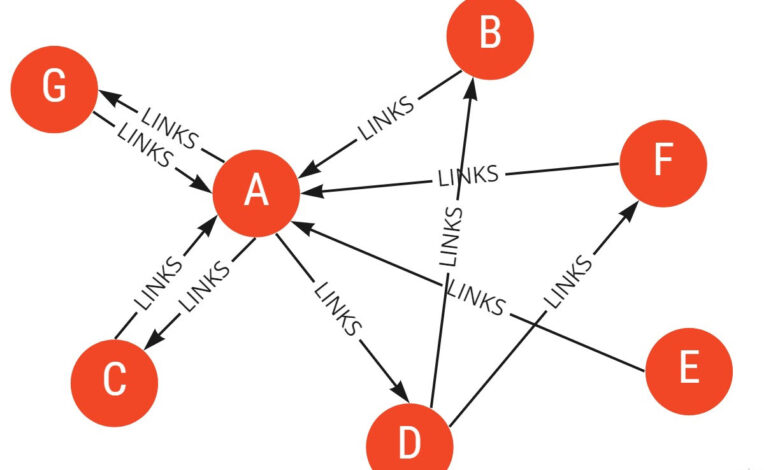
There is a need for search engines to have a sound method of determining which pages should appear first when a number of pages respond to the same query. One of the most influential approaches to this issue is the PageRank algorithm, which views the web as a huge graph and uses links as indications of importance. Since PageRank is a basic concept, if you are studying search engines, graph analytics, or even enrolling in data science classes in Bangalore, it illustrates how rankings can be obtained from structure alone (that is, from knowing who links to whom).
Why Links Can Signal Authority
A hyperlink goes beyond simply providing navigation since it also amounts to a kind of endorsement; if a number of pages have a link to a particular page then that page might be useful, authoritative, or commonly referenced. Yet not all links are equally informative and a link coming from a respected page should be given more weight than one from an unknown or poor-quality page.
What made PageRank so special was this fundamental idea: rather than simply counting the number of inbound links, it looked at the pages those links originated from. In terms of graph theory, web pages are represented as nodes, hyperlinks as directed edges, and “importance” as a score that travels around the network.
The Core Idea Behind PageRank
PageRank is usually illustrated by means of the “random surfer” model. Picture a user who begins on a random page and then repeatedly carries out one of two actions:
- Clicks a random outgoing link from the current page
- Jumps to a random page on the web (a “teleport”)
The damping factor is what determines the probability of teleporting, and in most cases it is set at about 0.85. It stops the model being trapped in “dead ends” (that is, pages with no outgoing links) or in tight loops, and it also makes sure that the mathematics converge reliably.
Simply put, the PageRank of a page goes up when it is linked to by other pages that have a high PageRank. The score is calculated iteratively: you begin by assigning each page an initial score (the scores being often the same), and then continuously redistribute the scores among the outgoing links until the scores stabilize.
For students of data science in Bangalore, the key point is that PageRank is a typical example of an iterative algorithm used on graphs, something that is closely connected with eigenvectors and Markov chains, even though it can be understood without needing advanced mathematics.
A Small Worked Example (Intuition Without Heavy Maths)
Look at three pages: A, B, and C.
- A links to B
- B links to C
- C links to B
Page B gets links from both A and C, and C has a link coming only from B. Even though both B and C have inbound links, B is in a better position since C links back to B, which sets up a reinforcing loop between B and C. As a result of the repeated iterations, B ends up with more importance than C because it receives endorsement from two sources of traffic, one of which is C and that one repeatedly passes on importance back to B.
This illustrates two practicaThe way pages are linked is important, particularly when influential pages link to you either directly or indirectly.pecially when influential pages point to you, directly or indirectly.
In real web graphs which have billions of pages the same principle holds — only on a much larger scale, using efficient sparse-matrix computations and distributed processing.
How PageRank Is Used (and What It Does Not Do)
In the past, PageRank was useful for early search engines in enabling them to tell the difference between pages that were genuinely authoritative and those that simply repeated keywords. Nowadays, the ranking systems are much more complicated. Today’s search engines make use of a number of factors beyond just link structure—such as the content of the page, how fresh it is, user intent, language, location, and various measures of quality and trust. Yet PageRank is still a strong conceptual tool and can be employed as one element within wider ranking systems.
It’s also widely used outside web search:
- Citation analysis: ranking research papers based on who cites whom
- Recommendation systems: identifying influential items in networks
- Fraud and anomaly detection: spotting suspicious link patterns in graphs
- Knowledge graphs: ranking entities by connectivity and authority
In data science classes held in Bangalore when dealing with graph problems, these use cases are useful since they illustrate PageRank as a general method for determining ‘importance’ in any directed network—not merely for web pages.
What PageRank does not do well on its own:
- It is unable to judge if the content is correct, useful, or safe.
- It can be manipulateIt can place too much emphasis on hubs that have many connections even if their relevance to a particular query is low.onnected hubs even when relevance to a specific query is low.
It is better to regard PageRank as a structural baseline rather than as a full ranking solution.
Implementing PageRank in Practice
A practical PageRank implementation usually follows these steps:
- Construct a directed graph using your link data (given in the form of an adjacency list or as a sparse matrix).
- Deal with dangling nodes (that is, pages with no outgoing links) by either redistributing their score over all the pages or by using the teleport rule.
- Select a damping factor and set the scores.
- Update the score of each page by taking into account the inbound contributions.
- Halt the process when convergence is reached: that is, when the changes in score become very small or after the maximum number of iterations has been reached.
For learning or prototyping, libraries like NetworkX can compute PageRank quickly on smaller graphs. For large graphs, implementations rely on efficient sparse operations and often distributed frameworks. The main engineering challenges are memory efficiency, convergence speed, and cleThe PageRank algorithm is a groundbreaking concept since it turns the web’s link structure into a measure of authority by having “importance” pass through a directed graph. Although today’s search rankings go well beyond what PageRank can do, the algorithm is still essential when it comes to understanding graph-based ranking, influence propagation, and iterative scoring techniques. Whenever you are looking into search systems or graph analytics—say, as part of data science courses in Bangalore—PageRank provides a clear example of how structure on its own can generate quite strong indications of what is important in a network.risingly strong signals about what matters in a network.