Instrumentation Systems vs. SCADA: Understanding the Real Differences for US Process Engineers

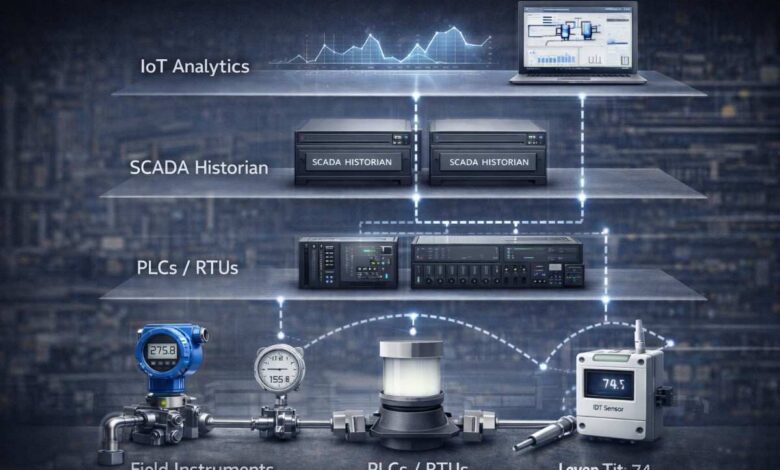
In process-heavy industries across the United States — refining, water treatment, pharmaceuticals, food processing, and power generation — two terms appear constantly in engineering conversations: instrumentation systems and SCADA. They are often used interchangeably, sometimes in the same sentence, as though they describe the same thing with different names. They do not. Confusing the two leads to poorly scoped projects, misaligned procurement decisions, and gaps in how a facility monitors and controls its operations.
The distinction matters most when a plant is expanding capacity, upgrading aging infrastructure, or commissioning a new process line. Engineers and operations managers who understand where one ends and the other begins are better positioned to ask the right questions, select appropriate vendors, and design systems that actually hold up under production conditions. This article walks through the functional differences, the relationship between the two, and where each applies in real-world US process environments.
What Instrumentation Systems Actually Are
At their most fundamental level, instrumentation systems are the physical and electrical infrastructure that measures process variables and converts those measurements into signals that other systems can use. Temperature, pressure, flow, level, pH, vibration — these are conditions that exist in the real world, and instrumentation is the mechanism by which they become data. Sensors, transmitters, analyzers, and their associated wiring, signal conditioning equipment, and junction boxes all fall within this category.
The role of instrumentation is inherently close to the process. A transmitter mounted on a pipe is not making decisions. It is observing a condition and reporting it. That output — whether it is a standardized current signal, a digital fieldbus transmission, or a wireless packet — travels upstream to something else that can interpret and act on it. Instrumentation does not control. It measures. Control may happen as a consequence of that measurement, but the instrument itself is not the controlling agent.
Field Instruments and Signal Integrity
One of the more persistent challenges in industrial instrumentation is maintaining signal integrity between the field device and the control room. Signals can degrade over long cable runs, pick up electrical interference from motors and variable frequency drives, or drift over time as sensors age or environmental conditions change. These are not abstract risks. In a large chemical plant or a water treatment facility spread across several acres, cable runs of significant length are common, and signal degradation becomes a practical engineering problem that has to be addressed during design.
The choice of signal standard — whether traditional analog transmission, HART protocol, FOUNDATION Fieldbus, or PROFIBUS — directly affects how much diagnostic information is available from the field device, how the device can be calibrated remotely, and how failures manifest in the control environment. This is why instrumentation design is not simply about selecting a sensor with the right measurement range. It involves understanding how signal data will travel, how it will be received, and what information might be lost or distorted in transit.
Calibration, Maintenance, and Instrument Lifecycle
Instrumentation requires ongoing maintenance in a way that software-based control layers often do not. Physical sensors drift. Seals degrade. Impulse lines plug. Transmitters exposed to harsh chemical environments or extreme temperatures have finite service lives. A well-run instrumentation program includes scheduled calibration, predictive replacement cycles, and documentation of each device’s performance history.
In regulated industries such as pharmaceuticals and food production, calibration records are not optional. They are part of compliance documentation reviewed during audits. A missed calibration interval on a critical temperature or flow sensor can invalidate a batch record or trigger a regulatory finding. This operational reality is one reason that instrumentation management is treated as a discipline in its own right, separate from control system administration, even when the two are closely integrated.
What SCADA Is and What It Is Not
SCADA — Supervisory Control and Data Acquisition — is a software and communication architecture that sits above the field level. It collects data from multiple points across a process or facility, presents that data to operators in a usable visual format, stores historical records, and in many configurations, sends control commands back to field devices or controllers. SCADA is primarily a supervisory layer. The word “supervisory” in its name is not incidental.
The core function of a SCADA system is visibility and coordination at a higher level than individual controllers or instruments can provide on their own. A water utility managing a distribution network across dozens of pump stations relies on SCADA to see what is happening at each station simultaneously, respond to alarm conditions, and log data for regulatory reporting. No single instrument or local controller can provide that integrated picture. SCADA assembles the picture from many sources.
The Communication Architecture That SCADA Depends On
SCADA does not gather data directly from field instruments in most configurations. It communicates with intermediate controllers — programmable logic controllers (PLCs) or remote terminal units (RTUs) — that in turn interface with the instrumentation layer. This tiered structure exists because SCADA systems are generally not designed to poll thousands of individual field devices at the scan rates required for real-time process control. PLCs and RTUs handle the fast, deterministic control logic locally, while SCADA collects summarized or sampled data at a higher level for operator visibility and record-keeping.
This architecture has direct implications for how facilities are designed and how failures propagate. If the SCADA network goes offline, the PLCs and RTUs typically continue operating on their last instructions or fall back to predefined safe states. The process does not necessarily stop because operators temporarily lose their supervisory view. This is an important distinction from the instrumentation layer, where a failed sensor can directly cause a control loop to lose its feedback signal and behave unpredictably.
Cybersecurity Considerations in SCADA Environments
As noted by the Cybersecurity and Infrastructure Security Agency, industrial control systems including SCADA are increasingly targeted by cyber threats, and the consequences of a successful attack on a SCADA system in a critical infrastructure facility can be severe. This is a concern that did not exist in the same form when most SCADA systems were isolated, proprietary, and air-gapped from corporate networks. The shift toward connected, IP-based SCADA architectures over the past two decades has introduced exposure that operators in water, energy, and chemical sectors must actively manage.
Instrumentation at the field level is generally less exposed to cybersecurity threats, though wireless field devices and those connected via industrial Ethernet are not entirely immune. The primary cybersecurity surface in most facilities exists at the SCADA and historian level, where network connectivity is most extensive. Engineers who understand this separation can make more informed decisions about where to invest in network segmentation, authentication controls, and monitoring.
Where the Two Systems Interact — and Where They Diverge
The practical relationship between instrumentation and SCADA is that instrumentation generates the data and SCADA consumes and presents it. But the boundary between them is not always clean, and in smaller facilities or simpler processes, the layers can blur. A compact SCADA installation at a small pump station might interface directly with transmitters through a limited set of I/O points, with no intermediate PLC required. In a large refinery, the distance between the field instrument and the SCADA display screen involves multiple communication layers, protocol conversions, and data aggregation steps.
Understanding where one system’s responsibility ends and another’s begins matters for troubleshooting. When an operator sees an incorrect value on the SCADA display, the fault could lie with the field instrument itself, with the signal wiring, with the PLC’s I/O card, with the communication link to the SCADA server, or with the SCADA configuration itself. An engineer who treats these as one undifferentiated system will struggle to isolate the fault efficiently. One who understands the distinct layers can systematically work through each stage of the signal path.
Specification and Procurement Implications
When facilities issue specifications for a new project, clear separation between instrumentation scope and SCADA scope is important for managing vendor responsibilities. Instrumentation procurement typically involves instrument data sheets, loop diagrams, and calibration requirements. SCADA procurement involves communication protocols, server architecture, historian configuration, and human-machine interface design. Combining these into a single undifferentiated scope can create ambiguity about which vendor owns which deliverable and who is responsible when integration problems emerge during commissioning.
In practice, many US engineering firms maintain separate instrumentation and controls groups, with the instrumentation group responsible for field device selection, loop design, and wiring, while the controls group handles PLC programming and SCADA configuration. This division reflects the genuine difference in the engineering disciplines involved, and it reinforces why treating the two as synonymous creates real problems at the project level.
Applying the Distinction in Everyday Operations
For process engineers working in operations rather than capital projects, the distinction between instrumentation and SCADA shows up most clearly during troubleshooting, maintenance planning, and process optimization efforts. When a control loop is behaving erratically, the first question is whether the problem is in the measurement — the instrumentation layer — or in the logic and display — the control and supervisory layer. That question determines which team responds, what tools are needed, and how quickly the problem can be resolved.
Operators who rely on SCADA displays for process decisions need to understand that the accuracy of what they see depends entirely on the health of the instrumentation feeding that display. A SCADA system showing clean, stable data is only as reliable as the sensors and transmitters connected to it. This dependency is easy to overlook when systems are running well, but it becomes obvious when a faulty instrument quietly feeds incorrect data to a control loop for hours before someone notices an anomaly in the product or process output.
Conclusion
The difference between instrumentation systems and SCADA is not a matter of terminology. It reflects a genuine functional and architectural distinction that has real consequences for how facilities are designed, maintained, and operated. Instrumentation exists at the point of measurement — in the field, close to the process, generating the signals on which everything else depends. SCADA exists at the supervisory level, assembling those signals into a coherent operational picture and enabling coordinated oversight across complex or geographically distributed processes.
For US process engineers, keeping this distinction clear leads to better project scoping, more effective troubleshooting, and more informed conversations with vendors and integrators. It also supports better maintenance planning, since the two layers have different failure modes, different maintenance requirements, and different risk profiles. Neither is more important than the other — a sophisticated SCADA system built on unreliable instrumentation will produce unreliable results, and accurate instrumentation without effective supervisory visibility limits how well operators can manage a complex process. The two work together, but they are not the same thing, and treating them as such is a shortcut that tends to produce problems downstream.