
Dubai has become one of the first places UK entrepreneurs look when they start thinking beyond their home market. Zero personal income tax, a stable currency pegged to the US dollar, and a government that has spent a decade courting foreign founders make it an easy pitch.
Add an international population, direct flights to London, and a business culture that moves fast, and it is easy to see why Dubai lands on almost every shortlist for British founders weighing their options against the UK’s own tax and cost base.
But the founders who get the most out of a Dubai expansion are rarely the ones who moved fastest. They are the ones who understood the structure before they signed anything.
Dubai rewards founders who plan for residency, banking, and compliance as one connected decision. It quietly punishes those who treat incorporation as a box to tick before moving on to the parts of the business they actually care about. Here is what actually matters before you commit.
Free Zone or Mainland Is the First Real Decision
Every Dubai company setup starts with this choice, and it shapes almost everything that follows, from ownership structure to where you can actually do business.
A Dubai Free Zone company is the more familiar route for foreign founders. Ownership is 100 percent foreign in nearly every case, setup is fast, and many zones are built around a specific industry such as media, technology, logistics, or financial services.
Each Free Zone runs under its own authority, so the paperwork, licence categories, and visa allocations differ from one to the next. Some suit solo founders with flexi-desk arrangements and no office requirement. Others are built for larger operations with warehousing or manufacturing needs.
The trade-off is that a Free Zone entity traditionally cannot trade directly inside the UAE mainland market without extra licensing or a local distributor arrangement.
A Mainland company can trade anywhere in the UAE and bid on government contracts. Recent reforms have opened full foreign ownership across most commercial activities, removing the local sponsor requirement that once applied to most Mainland businesses.
Mainland suits businesses selling to UAE-based customers rather than serving clients abroad, such as a retail brand, a restaurant group, or a services firm targeting local corporate clients directly.
Neither option is universally better. A SaaS founder billing international clients has different needs than an e-commerce operator who wants a physical shop, and a consultancy chasing government clients different needs again. The right answer depends on where your revenue will actually come from, not on which structure sounds more prestigious.
One more thing: some activities need extra approvals whatever your status. Healthcare, education, financial services, and anything touching food safety or regulated imports usually require sign-off from a federal or emirate authority on top of the trade licence. Expect a longer timeline in these categories, and factor it into any launch date you promise investors.
Setting Realistic Timelines
Marketing materials advertise same-day or 48-hour formation, and for the licence itself that is often accurate. What those numbers leave out is everything that happens after the licence is issued.
Opening a working bank account, securing visas, registering for corporate tax and VAT, and setting up a registered office or flexi-desk typically takes several weeks beyond incorporation. Founders who plan around a two-day timeline and book flights to match are often the ones scrambling later when the bank account still has not cleared compliance.
UK founders in particular should recalibrate. Incorporating at Companies House is same-day and cheap, so the instinct is to assume Dubai works the same way. A more realistic horizon runs four to eight weeks from start to a fully operational entity, banking included. Still fast, but a meaningfully different number than the headlines suggest.
Residency Is Not Automatic, and Not All Visas Are Equal
Setting up a company does not by itself grant you the right to live in the UAE. A trade licence comes with eligibility for a small number of investor or employee visas, depending on the Free Zone you choose and, in some cases, the size of your office.
For a longer-term move, the UAE’s Golden Visa offers renewable residency, generally 10 years, to qualifying investors, entrepreneurs, and skilled professionals. Check the current thresholds directly, since criteria and minimums have shifted more than once, and different pathways exist for property investors, business owners, and specialists.
For UK founders there is a further point people miss, and it has nothing to do with the UAE side. Forming a Dubai company, and even moving there, does not automatically end your UK tax residency.
HMRC applies the Statutory Residence Test, which weighs days spent in the UK against a set of ties. It is entirely possible to run a Dubai entity while still being treated as UK tax resident if the move is not structured and evidenced properly.
Anyone relocating should take UK tax advice on the Statutory Residence Test, split-year treatment, and the UK-UAE double tax arrangement before assuming a clean break. Some founders keep a Dubai entity purely for banking while still living in the UK, which is legitimate, but only if the residency position is accounted for rather than assumed.
Banking Takes Longer Than People Expect, and Choice of Bank Matters
This is the step that catches most first-time founders off guard. UAE banks have tightened compliance considerably, partly under international pressure around anti-money-laundering standards, and a business account is no longer a same-week formality.
Banks want a clear business plan, proof of source of funds, and often a physical presence or track record. Founders arriving with a shell company and no documentation are frequently declined, sometimes at more than one bank before finding the right fit.
Digital-first and traditional UAE banks also differ in onboarding speed, minimum balances, and appetite for specific industries, so the choice of which to approach first is not trivial.
This is where an advisor with relationships across multiple banks pays off. Firms that handle Dubai company setup end to end, such as GenZone, tend to know which banks are actively onboarding a given business and what each expects, which can shorten weeks of trial and error. It rarely happens overnight regardless, so budget for it from day one.
Free Zone Choice Affects Cost More Than People Assume
There are many Free Zones within Dubai alone, and pricing varies widely by licence type, number of visas, and whether you need physical office space or can run on a flexi-desk.
Some zones are built for low-cost digital businesses, others for regulated financial activity, and the compliance burden differs accordingly. Regulated zones carry substantially higher setup and ongoing costs than a standard trading or consultancy licence.
Renewal costs are where founders get an unpleasant surprise. A cheap year-one fee can hide a steeper annual renewal once visa fees, office leases, and audit costs are added. Ask for the full multi-year picture, and specifically what the licence, visas, and any mandatory insurance or audit will cost in year two and beyond.
Some Dubai Free Zones require an annual audit regardless of size, while others only require one above a revenue threshold. This rarely shows up in initial comparisons but can add a real recurring cost, especially for smaller companies that assumed audits only applied to bigger businesses.
Compliance Does Not End at Incorporation
The UAE introduced federal corporate tax in 2023, with a standard rate above a set profit threshold and a 0 percent rate on qualifying income below it, plus specific rules for Free Zone entities that qualify for preferential treatment. VAT has applied since 2018 above the relevant turnover threshold.
Neither existed a decade ago, and both mean ongoing filings, not a one-time registration.
Economic substance rules, beneficial ownership registers, and annual licence renewals are also part of staying compliant. Missing a deadline can bring penalties or complications renewing the trade licence itself.
None of this is unusual by international standards, and a UK founder used to Companies House and HMRC deadlines will recognise the rhythm. It stays considerably lighter than the UK, just not as light as the reputation suggests, and it rewards founders who build a compliance calendar from the start.
One trap in particular: corporate tax registration is mandatory even for companies expecting to fall entirely within the 0 percent threshold, and failing to register on time carries a penalty whether or not any tax is owed. The registration requirement exists independently of whether tax is due, so build it into the calendar from the day the licence is issued.
The Dual Structure That Is Becoming More Common
A growing number of founders are not choosing between Dubai and another jurisdiction. They pair a Dubai entity for residency, banking, and personal tax efficiency with a separate entity elsewhere for operational reasons.
Most often that second entity is a US LLC, for founders who invoice US customers, rely on US payment infrastructure such as Stripe, or need a US entity to satisfy larger enterprise clients.
This dual-structure approach is now a standard part of the international founder playbook. It is one reason advisors with experience across more than one jurisdiction, rather than UAE formation alone, have become more relevant.
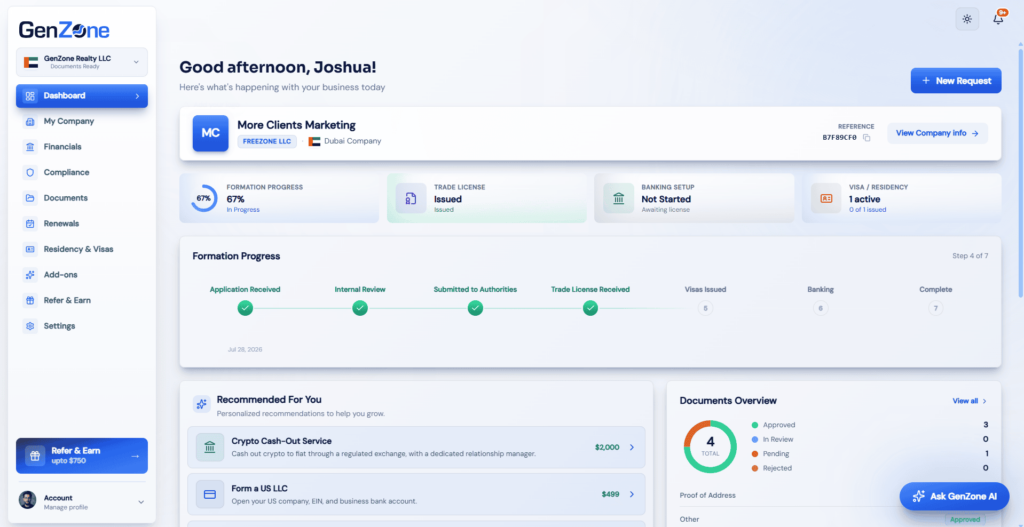
The risk is coordination. A founder running a Dubai entity and a US LLC through two unrelated advisors is often the one who misses a deadline on one side because nobody tracked both calendars together. GenZone handles both sides under a single relationship, with an all-in-one platform where you manage documents, compliance deadlines, and banking status for both entities end to end rather than juggling providers who do not talk to each other.
Adding a US LLC: What It Involves and How Fast It Can Move
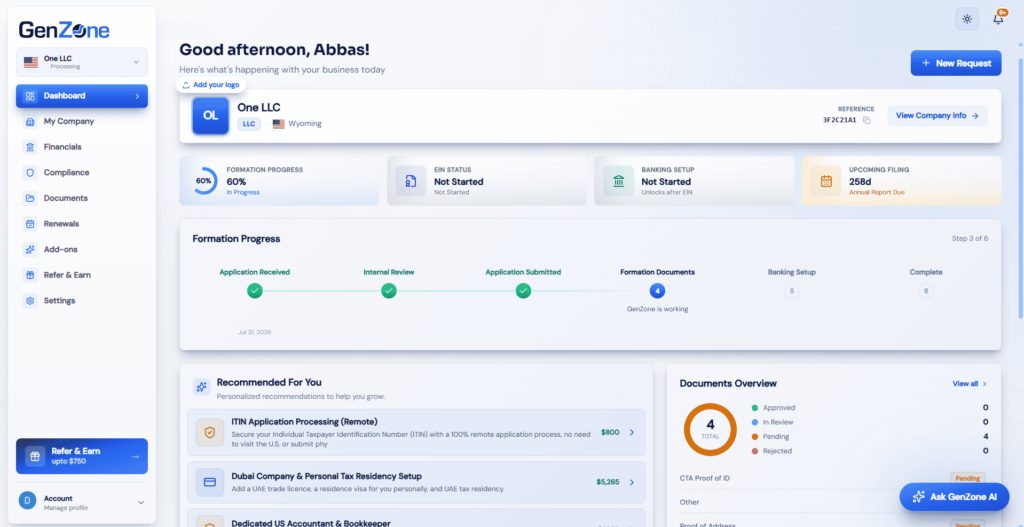
For UK founders selling into the US, or simply relying on US payment rails, a US LLC is often the piece that makes a Dubai base work in practice. It gives you a US-facing entity that American customers and platforms recognise, while your Dubai company handles residency and personal tax efficiency.
The practical bottleneck is usually the EIN, the federal tax number the LLC needs before it can open US banking, connect to Stripe, or invoice properly. Standard processing can drag on for weeks, and longer for a non-US founder without a Social Security Number, which is exactly where a launch stalls.
That is where GenZone’s US LLC service is built to move: it turns EIN processing around in three to five days, which it positions as the fastest in the market, so the entity is usable in days rather than weeks.
Handled alongside the Dubai side, that lets a UK founder stand up both entities in parallel, the Dubai company for residency and banking and the US LLC for US-facing revenue, without stitching two providers together.
Common Mistakes First-Time Founders Make

A few patterns show up again and again among founders who move too quickly.
Incorporating before confirming which Dubai Free Zone actually fits the business activity, then finding the licence does not cover a service they need to offer. Underestimating how long banking takes and arriving with a travel window too tight for delays.
Assuming a Dubai company automatically changes personal tax residency, when for a UK founder it does not, since HMRC’s Statutory Residence Test still has to be satisfied. And treating the marketed setup fee as the full first-year cost, without accounting for visas, office costs, and renewals.
None of these are hard to avoid. But they require treating the decision as a structuring exercise rather than a transaction, and asking the right questions before signing rather than after.
Hiring, Payroll, and Building a Team
Once the company is operational, hiring in the UAE has its own learning curve. Employment contracts must be registered with the relevant labour authority, and employee visas are tied to the company’s licence, so the number available is often capped by office size or licence category until the business shows enough activity to justify more.
Payroll has also become more structured through the Wage Protection System, which requires salaries to be paid through approved channels and reported to the authority. It is straightforward once set up, but founders who run informal payroll early often have to formalise contracts and records retroactively, which takes longer than doing it right the first time.
For distributed teams, note that hiring someone in the UAE generally requires a UAE work visa tied to a UAE entity, unless they are engaged as a contractor based outside the country. Businesses wanting both UAE staff and remote contractors elsewhere, including in the UK, should think this through early, since it affects payroll and tax withholding.
The Bottom Line

Dubai genuinely delivers on the tax and lifestyle advantages it is known for. But the founders who benefit most treat setup as a structural decision, not a formality.
Get the Free Zone or Mainland choice right, budget realistic time for banking, understand your ongoing compliance obligations, keep your UK tax residency position front of mind, and decide whether a US LLC is genuinely part of your model before you incorporate.
Approached that way, Dubai can be exactly the base it is marketed as. The difference between a smooth setup and a frustrating one usually comes down to how much of this groundwork was done before the paperwork was filed rather than after.