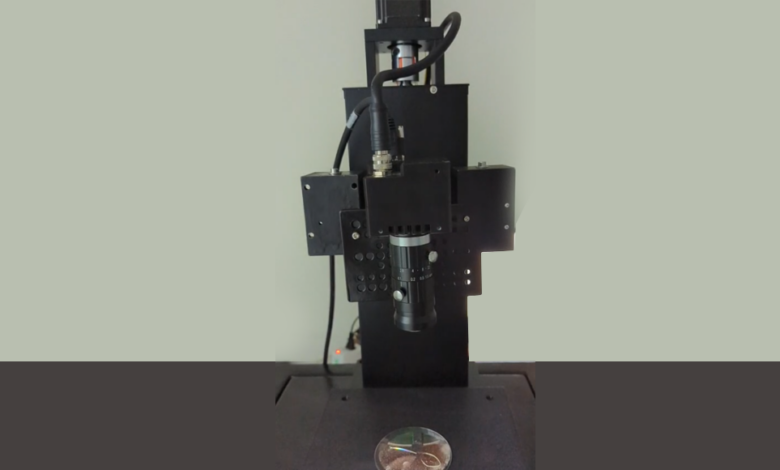
The optics and imaging industry is evolving rapidly, and manufacturers across California are under increasing pressure to deliver flawless lens products with high precision and consistency. From smartphone cameras and automotive imaging systems to medical devices and industrial sensors, optical lenses play a critical role in modern technology. Even the smallest defect in a lens can impact product performance, customer satisfaction, and brand reputation.
To overcome these challenges, manufacturers are adopting advanced lens inspection automation systems powered by artificial intelligence and machine vision technologies. Automated inspection is helping companies improve product quality, reduce production costs, and achieve faster inspection cycles without compromising accuracy.
As California continues to lead innovation in semiconductor, medical, automotive, and electronics manufacturing, automated optical inspection systems are becoming essential for maintaining competitive advantage.
Growing Demand for Precision Lens Manufacturing
Modern optical lenses require extremely high manufacturing precision. Industries such as autonomous vehicles, medical imaging, aerospace, and consumer electronics demand lenses that are free from scratches, bubbles, cracks, contamination, coating defects, and dimensional inaccuracies.
Traditional manual inspection methods often struggle to keep up with the speed and precision required in today’s production environments. Human inspectors can miss microscopic defects, become fatigued during repetitive inspections, and create inconsistencies in quality control processes.
This is where lens inspection automation provides a major advantage. Automated systems use high-resolution industrial cameras, advanced lighting technologies, and AI-driven software algorithms to inspect every lens with unmatched consistency and accuracy.
What is Lens Inspection Automation?
Lens inspection automation refers to the use of machine vision systems and artificial intelligence to automatically inspect optical lenses during manufacturing. These systems can identify surface defects, dimensional variations, coating irregularities, and contamination in real time.
An automated lens inspection setup typically includes:
- High-resolution industrial cameras
- Precision optical lenses
- Controlled illumination systems
- AI-powered image processing software
- Automated handling mechanisms
- Real-time defect classification algorithms
These systems capture detailed images of the lens surface and analyze them instantly to identify defects that may not be visible to the human eye.
The ability to perform fast and accurate defect detection in lens manufacturing significantly improves production efficiency while ensuring strict quality standards.
Importance of Defect Detection in Lens Manufacturing
Even microscopic defects in an optical lens can lead to serious performance issues. A small scratch or coating defect may distort images, reduce clarity, or compromise sensor accuracy.
Effective defect detection in lens manufacturing is critical for several industries:
Consumer Electronics
Smartphones, tablets, webcams, and digital cameras rely heavily on high-quality optical components. Any lens imperfection can affect image quality and customer experience.
Automotive Industry
Advanced Driver Assistance Systems (ADAS), autonomous vehicles, and parking cameras require flawless optical performance. Defective lenses can compromise vehicle safety systems.
Medical Devices
Medical imaging systems, endoscopes, and diagnostic equipment require ultra-clear optical lenses for accurate diagnosis and treatment.
Semiconductor and Industrial Automation
Machine vision systems used in factories and semiconductor inspection rely on precision optics for accurate measurements and defect analysis.
By implementing automated inspection systems, manufacturers can detect defects early in the production cycle, minimizing waste and reducing costly recalls.
Key Benefits of Lens Inspection Automation
Improved Inspection Accuracy
Automated inspection systems eliminate human subjectivity and provide highly repeatable inspection results. AI-driven algorithms can identify even the smallest defects with remarkable precision.
Faster Production Speed
Manual inspection is time-consuming and difficult to scale. Automated systems can inspect lenses continuously at high speed, helping manufacturers meet growing production demands.
Reduced Manufacturing Costs
Detecting defects early reduces scrap, rework, and product returns. Automated systems also reduce labor dependency and operational costs over time.
Real-Time Quality Monitoring
Modern inspection systems provide real-time monitoring and data analytics, enabling manufacturers to identify production issues immediately and optimize process efficiency.
Enhanced Product Consistency
Consistency is essential in precision optics manufacturing. Automated inspection ensures that every lens meets the same strict quality standards.
AI-Powered Machine Vision for Lens Inspection
Artificial intelligence is revolutionizing optical inspection technologies. Traditional rule-based inspection systems often struggle with complex or unpredictable defects. AI-powered systems can learn from large datasets and continuously improve defect detection accuracy.
Machine learning algorithms can classify defects based on:
- Size
- Shape
- Surface texture
- Contrast variations
- Pattern irregularities
This allows manufacturers to achieve more reliable defect detection in lens applications, especially in high-volume production environments.
AI-driven systems can also reduce false rejection rates, improving overall production efficiency and reducing unnecessary waste.
California’s Leadership in Advanced Manufacturing
California has become a major hub for advanced manufacturing technologies, including semiconductor production, robotics, aerospace, and medical device manufacturing. The state’s strong focus on innovation has accelerated the adoption of smart factory solutions and industrial automation.
Manufacturers in California are increasingly investing in lens inspection automation to maintain high quality standards while scaling production capacity.
Several factors are driving this adoption:
- Rising demand for precision optics
- Growth of AI and machine vision technologies
- Increasing labor costs
- Need for faster production cycles
- Strict quality compliance requirements
As Industry 4.0 continues to evolve, automated inspection technologies are becoming an essential component of modern manufacturing operations.
Future of Automated Lens Inspection
The future of lens inspection is moving toward fully integrated smart manufacturing environments. Emerging technologies such as deep learning, edge computing, and 3D imaging are enabling even more advanced inspection capabilities.
Future inspection systems may include:
- Real-time adaptive AI learning
- Predictive maintenance analytics
- 3D defect mapping
- Cloud-based quality monitoring
- Robotic handling integration
- Fully autonomous inspection cells
These advancements will help manufacturers achieve even greater levels of accuracy, efficiency, and scalability.
The increasing complexity of optical products will continue to drive demand for intelligent inspection solutions capable of handling ultra-precision manufacturing requirements.
As the demand for high-performance optical products continues to grow, manufacturers can no longer rely solely on manual quality control processes. Advanced lens inspection automation systems are transforming the way lenses are inspected, helping companies improve quality, increase efficiency, and reduce operational costs.
AI-powered machine vision technologies are enabling faster and more accurate defect detection in lens manufacturing across industries such as automotive, medical devices, consumer electronics, and industrial automation.
For manufacturers in California, adopting automated optical inspection solutions is becoming a strategic necessity to stay competitive in an increasingly technology-driven market. Companies that invest in intelligent inspection systems today will be better positioned to meet future production demands while maintaining the highest quality standards.