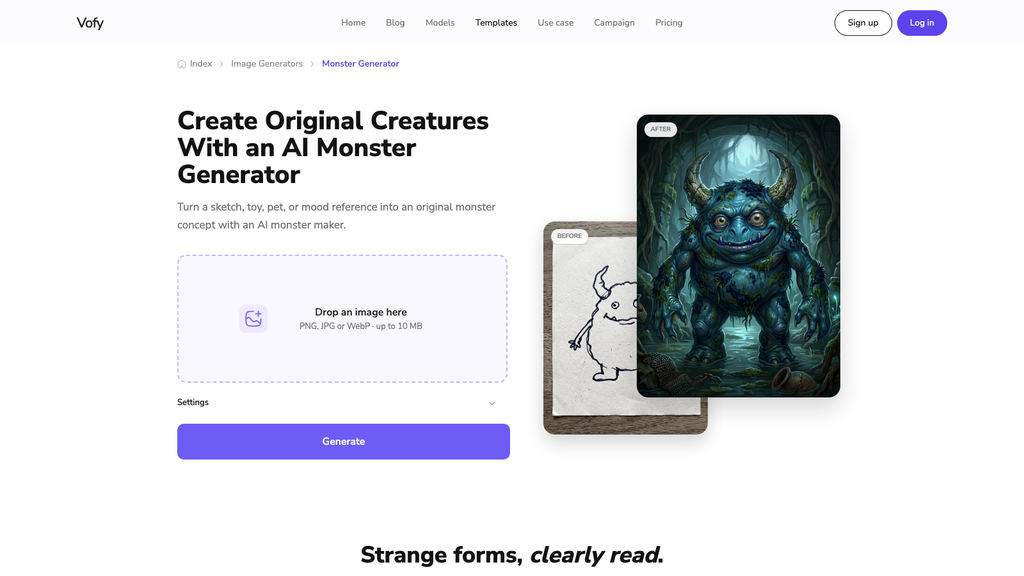
A game master preparing an encounter is solving two problems that quietly get filed as one. The first is mechanical: how hard the thing hits, how much punishment it absorbs, and whether the fight is survivable at the level the players have actually reached. The second is visual: what walks into the room when the fight starts. vofy works on the second one a monster generator that turns a written description into a creature you can put in front of the group. That is a different job from the one a stat-block calculator does, and the two are rarely interchangeable.
Ask a group three rounds into a fight what they are fighting and you will often get the same answer: “the big one.” Not because the encounter was dull and not because the numbers were wrong, but because nobody at the table ever formed a picture of it. A stat block describes how a creature behaves in combat, not what it looks like. The distance between those two things is where a lot of otherwise well-built sessions quietly go flat.
The numbers are the half you can verify
The mechanical half has become genuinely reliable, and it is worth being precise about why. cros.land, a generator that produces 5e stat blocks, describes its core plainly in its own documentation: “A math engine sets the numbers: Armor Class, hit points, attack bonuses, save DCs, and damage all derive from the Challenge Rating you pick, on curves calibrated against every monster in the 5e SRD.”
That last clause is the important one. These are not random values rolled until something plausible appears. They are derived from a curve fitted to the official monster list, which is why a CR 12 skirmisher from cros.land is meant to hit like an official CR 12 skirmisher. The language model in that pipeline stays on the periphery by design: it “names the creature, writes its lore, and proposes a signature ability that the tool fits to the closest shape, all around numbers it cannot change.”
cros.land’s documentation also shows how much the numbers still move underneath a fixed Challenge Rating. A brute “trades a point of AC for about 30% more hit points and harder single hits.” Two creatures of identical CR built for different roles are, in its words, “very different fights that award the same XP.” Damage budgets behave the same way: a multiattack splits the total across several strikes, an area-effect ability is typically built to take about half of it, and a single dramatic ability can spend most of the budget at once.
None of that tells you what the creature looks like. It tells you how the evening ends if the players fight it.
What a face actually does at the table
The visual half is doing a different kind of work, and the craft language around it is older than the software. starryai’s guide to creature concept art traces the tradition of concept sketching back to the 1930s Disney production work on *Snow White* (1937), where sketches existed to settle the forests, cottages, and animal forms before anything was animated.
The questions those sketches answered are the same ones a table needs answered, and that guide states them in almost exactly the terms a game master would: whether the anatomy supported the story, whether the silhouette read clearly, and whether the creature felt dangerous, gentle, comic, or mysterious — all decided before a final asset was made.
Read that list as a game master rather than an art director and it becomes a checklist for the session. Does the silhouette read clearly? That is the difference between a player pointing at the handout and saying “the tall one with the lantern” and a player saying “the monster.” Does the anatomy support the story? That is what keeps a creature’s body from contradicting the tactics you wrote for it. Does it feel dangerous, gentle, comic, or mysterious? That is tone, and tone is what makes a fight memorable a week later.
An image is also the only shared reference the table has. Players describe what they can picture, and a room of four people picturing four different things is a room that will start negotiating over what the creature can do instead of fighting it. The stat block resolves those arguments eventually. A picture prevents most of them.
The order you prepare in changes what you get
Here is the part that is easy to miss, because both halves are individually fine and the damage comes from the sequence.
Prepare stats first and the numbers will be sound. What you tend to get alongside them is a creature that reads as generic, because a stat block has no opinion about appearance and the words you reach for at the table default to type and damage. The fight runs correctly and nobody remembers it. Worse, the players’ descriptions drift into arithmetic — “the thing that did the poison damage” — and once a creature is a mechanic, it stays one.
Prepare the image first and the same session goes differently, because the visual constraint forces mechanical decisions early. A creature with four arms and no eyes probably does not use tools, so its attacks should be physical, and physical attacks under a fixed Challenge Rating are exactly where a multiattack that splits the damage budget across several strikes belongs. The picture did not pick the numbers. It told you which of the valid shapes you were building.
starryai’s guide makes that order explicit: “Write the brief before opening the generator.” For a table, the brief is not a style wish. It is the answer to what this creature is for — where it lives, how it feeds, and what the players are supposed to feel when it appears.
Two more habits from the same guide translate directly. Reference material needs a stated job rather than a vibe: “For a desert scavenger, collect a bird reference for the forward tilt of the head, a reptile reference for dry skin and heat management, and a hyena or vulture reference for feeding behavior.” And posture is a design decision, not an afterthought — “a stalking predator and a burrowing grazer shouldn’t share the same posture.”
For a creature you plan to reuse across a campaign, the counter-example is the useful tool. Instructions in the form “use beetle plating, but avoid a symmetrical shell” push the result away from the stock shape it would otherwise settle into. Handed a creature halfway between a familiar animal and something worse, players fill the gap themselves, and what they invent is usually more unsettling than anything you would have printed.
Two rulebooks, and the half that keeps moving
There is a timing detail that makes the split between the two halves more than a matter of taste. Dungeons & Dragons currently has two rule versions running in parallel, and cros.land advertises both: complete monsters “in the classic 2014 layout or the new 2024 style.”
Crucially, “the 2024 rules mostly changed how monsters are written.” The formulas underneath are stable; the presentation is not. So the numeric half of encounter preparation is genuinely version-sensitive work — same numbers, two layouts, and a tool that has to know which one you are playing. The visual half is not. A creature’s silhouette does not change when a new printing rearranges a stat block.
That asymmetry is worth holding on to, because it is where the two halves are heading. AI game-master tooling has already moved past asset generation and into running the fight: rpgstack describes its AI game master as one that “runs monsters in combat, and adjusts” as the encounter develops. Which means the picture is no longer the whole product. It is one station in a pipeline where the numbers are increasingly handled for you and the only thing still missing from most sessions is something the group can see.
The takeaway
Two problems, two solutions, and they do not substitute for each other. The numbers answer whether the fight is fair; the face answers what the group is actually looking at, and the image is the only version of that answer everyone at the table shares. Preparation order decides which one you end up with: start from the stat block and you get a fight that works but reads as a mechanic, start from the picture and the mechanics get easier to choose because the creature has already narrowed the options for you. Write the brief, give the references a job, and make the face on purpose the encounter was never the part that was missing.