When Should an Enterprise Move From an Internal IT Team to a Managed Services Model

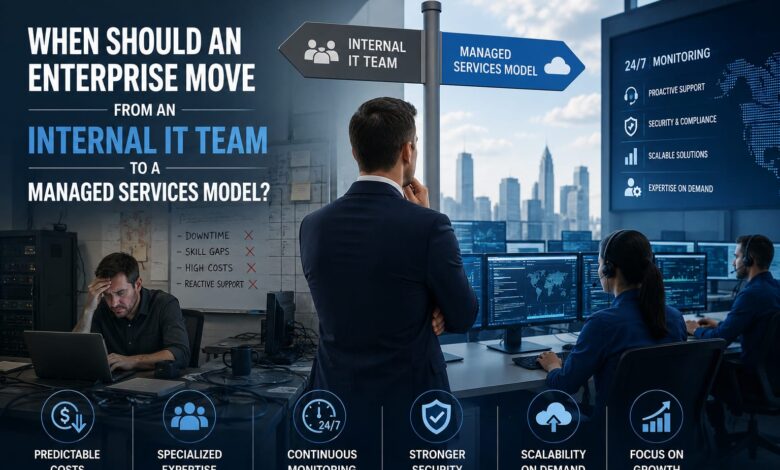
For most enterprises, the internal IT team was built to support a specific stage of growth. As the organization scales, adds infrastructure, enters new markets, or faces stricter compliance obligations, that same team is often expected to absorb increasing complexity without a proportional increase in resources. The result is a widening gap between what the business needs from technology and what the internal function can realistically deliver.
The decision to shift toward a managed services model is rarely made overnight. It is typically the outcome of accumulated operational strain, rising costs, and a growing recognition that IT has shifted from a support function to a strategic dependency. This article outlines the specific conditions under which that shift becomes a business necessity, and how enterprise leaders can evaluate the transition with the same rigor applied to any major operational decision.
Why This Decision Belongs at the Leadership Level
IT sourcing decisions are frequently treated as departmental matters, handled by IT leadership in isolation. At the enterprise level, this is a mistake. The structure of IT delivery directly affects business continuity, regulatory exposure, customer experience, and capital allocation. When downtime interrupts revenue generating systems, when a compliance gap creates legal exposure, or when infrastructure limitations slow a product launch, the impact is felt well beyond the IT department.
Framing this decision as an enterprise risk and capacity planning question, rather than a staffing question, produces a more accurate and defensible outcome.
Operational Signals That Indicate the Internal Model Has Reached Its Limit
Recurring downtime and extended resolution windows A pattern of repeated outages, particularly on business critical systems, is rarely a one time technical failure. It usually reflects a team operating beyond sustainable capacity, without the redundancy needed to maintain uptime standards expected at enterprise scale.
Inconsistent coverage across time zones and business hours Enterprises with distributed operations, global customers, or continuous production environments cannot depend on support that is only available during standard working hours. Gaps in after hours coverage introduce risk that compounds with every hour of unmonitored infrastructure.
Specialized skill gaps in cloud, security, and compliance Cloud architecture, advanced threat detection, and regulatory compliance now require depth of expertise that is difficult and expensive to build internally, particularly for organizations where IT is not the core business.
IT spend increasing without a corresponding gain in output or reliability When budget allocated to IT grows year over year while system performance, uptime, and delivery timelines remain flat or decline, the model itself, not the team, is usually the underlying issue.
Internal teams spending disproportionate time on maintenance rather than strategic initiatives If skilled internal staff are consistently pulled into break fix work, patching, and routine monitoring, the organization is not extracting strategic value from that talent.
Business Triggers That Accelerate the Need for Managed Services
Accelerated growth or market expansion Rapid scaling, new office locations, or entry into new markets often outpaces the internal team’s ability to hire, train, and deploy infrastructure at the required speed.
Heightened regulatory and compliance requirements Sectors such as healthcare, financial services, and legal services operate under continuously evolving compliance frameworks. Meeting these requirements without dedicated, current expertise increases audit risk and potential liability.
Mergers, acquisitions, or infrastructure consolidation Integrating multiple IT environments during a merger is a specialized, high stakes undertaking. Most internal teams encounter this scenario infrequently, if ever, and lack the process maturity that dedicated providers bring to these projects.
A strategic decision to redirect internal talent toward core business priorities As enterprises mature, leadership increasingly wants internal technical talent focused on product development, innovation, and competitive differentiation, not infrastructure upkeep.
Cybersecurity incidents or near misses A breach, attempted intrusion, or audit finding often serves as the catalyst that moves this decision from a future consideration to an immediate priority.
What Changes When an Enterprise Adopts a Managed Services Model
Predictable financial structure Managed IT services providers typically replace unpredictable capital expenditure and emergency spending with consistent, contract based operational costs, improving budget accuracy and financial planning.
Expanded access to specialized expertise Rather than depending on a small number of generalists, enterprises gain access to teams with deep, current expertise across networking, cloud infrastructure, cybersecurity, and compliance.
Continuous monitoring and proactive issue resolution Managed providers rely on around the clock monitoring systems designed to identify and resolve issues before they affect end users, shifting the operating model from reactive to preventive.
Stronger security posture Enterprise grade threat detection, patch management, and incident response protocols are difficult to replicate with an internal team of limited size, particularly as attack methods continue to evolve.
Faster adoption of new technology Established frameworks for cloud migration, automation, and infrastructure modernization allow managed providers to compress implementation timelines that would otherwise take internal teams significantly longer.
Improved internal focus With operational and maintenance responsibilities absorbed by the provider, internal teams are freed to concentrate on initiatives directly tied to business growth and innovation.
Internal IT Versus Managed Services: A Structured Comparison
| Evaluation Criteria | Internal IT Team | Managed Services Model |
| Cost structure | Fixed salaries, benefits, hardware, training | Predictable contract based or subscription pricing |
| Coverage | Typically limited to business hours | 24×7 monitoring and incident response |
| Expertise depth | Generalized, constrained by team size | Specialized across multiple technical domains |
| Scalability | Requires hiring, onboarding, ramp up time | Scales on demand with business requirements |
| Security capability | Dependent on internal investment and staffing | Enterprise grade tools and threat intelligence |
| Compliance readiness | Requires dedicated internal ownership | Built in expertise across regulatory frameworks |
| Strategic focus | Divided between maintenance and innovation | Concentrated on business critical initiatives |
A Practical Framework for Making the Transition
Begin with a co-managed model rather than a full handoff Many enterprises reduce transition risk by starting with a co-managed IT approach, where the provider supports specific functions such as network monitoring, cybersecurity, or cloud infrastructure while internal staff retain ownership of core systems and institutional knowledge.
Conduct a comprehensive infrastructure audit before engaging a provider A clear inventory of current systems, dependencies, and known pain points ensures the transition is built around actual operational needs rather than assumptions.
Establish measurable service level agreements from day one Defined expectations around response times, uptime guarantees, escalation procedures, and reporting cadence create accountability and make performance easy to evaluate.
Manage the internal communication process deliberately Employees and stakeholders should understand that the shift is designed to improve service delivery and reduce risk, not to diminish the role of internal IT staff.
Set a formal review period A structured 90 to 180 day review allows leadership to assess performance against agreed metrics before expanding the scope of the engagement.
Evaluating a Managed Services Provider
Provider quality varies significantly, and the wrong selection can introduce the same risks the transition was meant to solve. Enterprise buyers should assess:
- Demonstrated experience within the relevant industry and its compliance requirements
- A verifiable track record with organizations of similar size and technical complexity
- Transparent pricing with no undisclosed fees or scope ambiguity
- Documented security certifications and a tested incident response process
- The flexibility to scale services up or down as business conditions change
Frequently Asked Questions
Is a managed services model only suitable for smaller organizations without an IT department? No. Many enterprises with established internal IT teams adopt a co-managed model, using external providers to extend capacity and expertise rather than replace internal staff entirely.
Does moving to managed services mean losing control over IT decisions? Not when the engagement is structured correctly. Clear governance, defined SLAs, and regular reporting ensure enterprise leadership retains full visibility and decision making authority.
How long does a transition to managed services typically take? Timelines vary based on infrastructure complexity, but most enterprises complete an initial infrastructure audit and phased onboarding within 60 to 120 days.
Conclusion
There is no fixed timeline that applies uniformly across enterprises when it comes to shifting from an internal IT team to a managed services model. The right timing depends on growth trajectory, regulatory exposure, budget performance, and the strategic priorities set by leadership. However, when downtime becomes routine, security risk increases, compliance requirements outpace internal expertise, or IT spending rises without a corresponding gain in reliability, these are consistent, well documented indicators that a managed services model can provide the scalability, expertise, and operational stability required to support long term enterprise growth.