Most of us don’t think twice about food safety until something goes wrong. Maybe you’ve had a bout of food poisoning that left you miserable for days, or you’ve seen a news story about a restaurant shut down after an inspection. Suddenly, the question hits differently: how do we actually know the food we eat is safe?
Food safety isn’t just a set of rules pinned to the wall of a commercial kitchen. It’s a daily practice that touches everyone — from the parent packing school lunches to the line worker in a processing plant. And while it might sound straightforward, there’s more to it than most people realise.
So, What Exactly Is Food Safety?
In plain terms, food safety covers everything we do to make sure food doesn’t make people sick. That includes how we handle it, store it, cook it, and serve it. It also includes how we label it, transport it, and clean up after preparing it.
The reason it matters so much comes down to numbers that are hard to ignore. The World Health Organisation puts the figure at roughly 600 million people falling ill from contaminated food each year, with hundreds of thousands of deaths globally. And these aren’t problems confined to faraway places. Outbreaks of salmonella, listeria, and E. coli pop up regularly right here in the UK. Behind every single one of those cases, something went wrong in the way food was handled.
The Basics That Actually Matter
You’ll often hear food safety boiled down to four ideas: clean, separate, cook, and chill. That might sound like a poster in a school canteen, but honestly, getting these right prevents the vast majority of problems.
Cleaning goes beyond giving a surface a quick wipe. It means washing your hands properly — with soap, for at least twenty seconds — before you touch food and again every time you switch tasks. It means sanitising chopping boards, knives, and countertops, not just rinsing them under the tap.
Separating is about keeping raw and ready-to-eat foods away from each other. Raw chicken sitting on a shelf above an open salad in the fridge is an accident waiting to happen. Bacteria from raw meat, poultry, and seafood transfer easily, and they don’t need much encouragement.
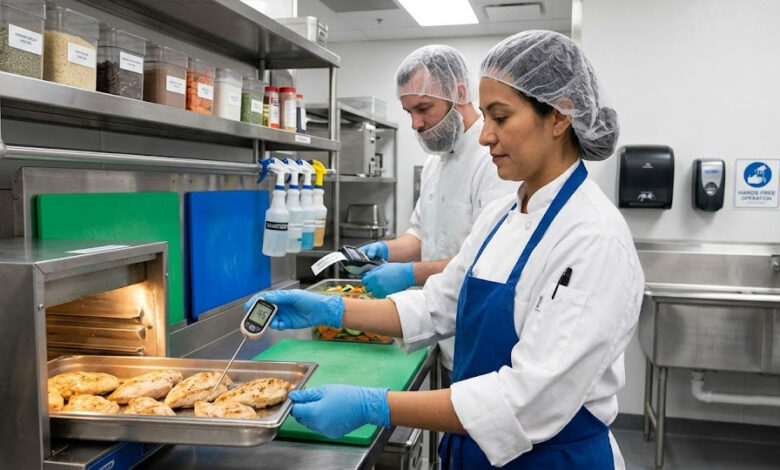
Cooking to the right temperature is what actually kills harmful bacteria. Poultry needs to hit at least 75°C internally. You can’t tell by cutting into it and checking the colour — that’s a myth that refuses to die. A food thermometer takes the guesswork out entirely.
Chilling keeps bacteria from multiplying. Your fridge should be running at 5°C or below, and perishable food shouldn’t sit out at room temperature for more than a couple of hours. Defrosting meat on the kitchen counter overnight? That’s one of the most common mistakes people make, and one of the riskiest.
The Allergen Question
There’s another side of food safety that’s become impossible to ignore: allergens. For someone with a severe food allergy, eating the wrong thing isn’t just unpleasant — it can be life-threatening. The UK learned this lesson painfully after the death of Natasha Ednan-Laperouse, a teenager who suffered a fatal allergic reaction to a mislabelled baguette. The law that followed, known as Natasha’s Law, now requires full ingredient labelling on pre-packed food made on-site.
If you work anywhere in the food chain, understanding the fourteen legally recognised allergens — things like nuts, gluten, milk, eggs, and shellfish — isn’t optional. It’s part of the job. A food allergen course is a practical way to get up to speed, especially if you’re new to the industry or need a refresher on how to handle allergen information correctly and communicate it to customers.
What Changes in a Professional Setting
At home, the consequences of a food safety slip-up might mean a rough night. In a professional kitchen, a factory, or a hospital canteen, the consequences can be far more serious — both for the people eating the food and for the business itself. Fines, closures, and reputational damage are all on the table.
In the UK, every food business has to register with their local authority and put a food safety management system in place. Most of these systems are based on HACCP — Hazard Analysis and Critical Control Points — which is essentially a structured way of looking at every step of food production and asking, “What could go wrong here, and how do we prevent it?”
Staff training is part of this. It’s not just good practice; it’s a legal requirement. The level of training someone needs depends on their role and the environment they work in. And that’s an important distinction, because a café kitchen and a food manufacturing plant are very different worlds. In manufacturing, you’re dealing with production lines, bulk ingredients, packaging processes, and a whole set of hazards that don’t exist in smaller settings. That’s why something like a level 2 food hygiene and safety for manufacturing qualification exists — it’s built specifically around the realities of working in that kind of environment.
Things People Get Wrong
A few food safety myths are stubbornly persistent. The biggest one is probably the idea that if food looks fine and smells fine, it is fine. It isn’t, necessarily. Plenty of the nastiest pathogens leave no trace you can detect with your senses.
Another common belief is that freezing kills bacteria. It doesn’t. It just puts them on pause. The moment food thaws, those bacteria pick up right where they left off.
And then there’s the “danger zone” — the temperature range between 8°C and 63°C where bacteria thrive. Food left sitting in that range for too long becomes a problem, no matter how fresh it was when you started.
Why Any of This Matters to You
Whether you’re thinking about a career in food or you simply want to be more confident in your own kitchen, understanding food safety is genuinely worthwhile. It’s not glamorous knowledge, but it’s the kind that protects people.
The landscape keeps shifting, too. New regulations come in, allergen rules tighten, and our understanding of foodborne risks evolves. Staying informed isn’t a one-and-done thing — it’s ongoing.
At the end of the day, food safety is a shared responsibility. Every person who touches food along the journey from farm to fork plays a part. And the more people who understand the basics, the safer we all are.