Shipping hazardous powders and granules requires packaging that can withstand more than the weight of its contents. A damaged lifting loop, torn fabric or failed closure can release dangerous substances during loading, transport or unloading. For companies handling materials classified as dangerous goods, choosing un certified bulk bags is an important part of controlling these risks and meeting applicable transport requirements.
UN-approved flexible intermediate bulk containers (FIBCs) are tested against defined performance requirements. Their identification codes describe the packaging construction, while their markings indicate the performance level achieved. Understanding these details helps shippers distinguish between an ordinary industrial bulk bag and a design approved for specified dangerous goods.
Why Do Dangerous Goods Need Special Packaging?
The United Nations Recommendations on the Transport of Dangerous Goods provide a framework for classifying hazardous materials and establishing appropriate packaging, marking and transport requirements. Their purpose is to reduce accidents, protect people involved in transportation and limit damage to the environment.
These recommendations form the basis for dangerous goods regulations used across different transport modes and jurisdictions. They address risks arising from the characteristics of the substances being transported rather than treating every industrial material in the same way.
Hazardous powders can present several problems. Certain substances are toxic, corrosive, oxidizing or otherwise dangerous. Fine particles may escape through damaged seams or unsuitable closures, while handling operations can expose packaging to impact, abrasion and concentrated lifting forces.
A UN-approved FIBC provides evidence that a particular packaging design has passed specified tests. However, certification does not automatically make that design suitable for every hazardous substance. The material classification, applicable packing instruction and conditions of carriage must also permit its use.
The Six Tests Behind UN Bulk Bag Approval
UN packaging requirements use performance testing to assess whether a flexible bulk container can withstand defined handling and transport stresses. Six tests are particularly relevant to approved FIBC designs.
- Top lift test: Examines whether the bag and its lifting devices can support the prescribed test load when suspended. This assesses the strength of lifting loops, their attachments and the supporting structure.
- Drop test: Evaluates the packaging after a controlled fall onto a specified surface. The test examines whether impact causes unacceptable loss of contents or compromises containment.
- Tilt or topple test: Assesses the container when it falls onto its upper section from a prescribed position and height. It addresses the risk of material escaping if a loaded bag overturns.
- Righting test: Evaluates whether a filled bag can be returned to an upright position using designated lifting devices without damage that makes it unsafe. This is also described as a realignment test.
- Stacking test: Examines whether a container designed for stacking can withstand a specified superimposed load without unacceptable deformation or loss of contents.
- Tear resistance test: Measures the behavior of the woven fabric when subjected to a controlled tear. The objective is to establish whether damage propagates beyond acceptable limits.
These tests evaluate different failure mechanisms. A bag that performs adequately during lifting might still fail under impact or fabric tearing. Approval therefore depends on the relevant test program rather than one demonstration of strength.
Tests are conducted on representative packaging designs under prescribed conditions. Successful qualification applies to the approved design and its specified characteristics. Changes to fabric construction, dimensions, lifting arrangements or other critical components may require additional assessment.
What Do the 13H1 to 13H4 Codes Mean?
UN identification codes distinguish flexible bulk containers by material and construction. For woven plastic FIBCs, the four codes from 13H1 through 13H4 identify whether the packaging has a coating, an internal liner or both.
| UN code | Packaging construction | Coating | Inner liner |
| 13H1 | Woven plastic FIBC without coating or liner | No | No |
| 13H2 | Woven plastic FIBC with coating | Yes | No |
| 13H3 | Woven plastic FIBC with liner | No | Yes |
| 13H4 | Woven plastic FIBC with coating and liner | Yes | Yes |
A coating is applied to the woven material, while an internal liner forms a separate layer inside the bag. Both can contribute to containment, but they serve different construction functions and are not interchangeable.
For fine powders, preventing particles from escaping through fabric openings, seams and closures is an important consideration. The appropriate construction depends on the substance and its required containment properties.
The identification code does not independently establish chemical compatibility, dust-tightness or approval for a particular dangerous good. Those questions must be assessed against the complete packaging specification and applicable transport instructions.
How Do X Y and Z Markings Relate to Packing Groups?
Dangerous goods assigned to packing groups are categorized according to their degree of danger. Packing Group I represents high danger, Packing Group II medium danger and Packing Group III low danger within this classification system.
UN packaging performance markings use the letters X, Y and Z to identify the packing group levels for which a packaging design has been qualified.
| Packing group | Degree of danger | Corresponding performance mark | Maximum FIBC volume |
| I | High | X | 1.5 m³ |
| II | Medium | Y | 3.0 m³ |
| III | Low | Z | 3.0 m³ |
An X-rated packaging design meets the relevant performance level for Packing Group I and may also satisfy the performance requirements for Groups II and III. A Y-rated design covers Groups II and III, while a Z-rated design covers Group III only.
The maximum volumes shown are regulatory capacity ceilings for the relevant categories of flexible intermediate bulk containers, not a statement that every certified bag has that capacity. Actual permissible filling quantities also depend on the approved maximum gross mass and other applicable conditions.
Importantly, an X marking is not permission to ship every Packing Group I substance in an FIBC. The substance-specific packing instruction must authorize the packaging, and additional restrictions may apply. Flexible containers are intended for suitable solid materials, not unrestricted transport of liquids or solids likely to become liquid during carriage.
Why Do Certificates and Bag Markings Matter?
A certification document connects a tested packaging design to its approved characteristics. Without that connection, buyers may struggle to establish whether the bag delivered matches the design qualified for dangerous goods transport.
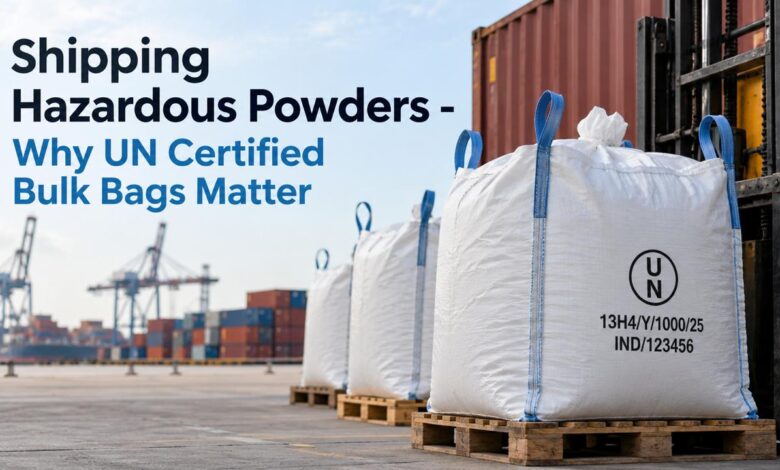
UN markings provide essential identification and performance information. Depending on the applicable requirements, these markings identify the packaging type, performance level, manufacture details, approval information, maximum permissible gross mass and stacking capability.
For example, a marking beginning with 13H4/Y identifies a woven plastic flexible container with coating and liner that has achieved the Packing Group II performance level. It does not, by itself, confirm that every hazardous powder can be shipped inside it.
Manufacturers and shippers should verify that the certificate corresponds to the exact packaging configuration being used. A design approved with particular fabric, lifting components and liner arrangements should not be assumed to cover modified combinations.
Clear identification also supports inspections and document checks. Transport operators can compare the physical packaging and its markings against the relevant shipping requirements before a consignment moves.
Does UN Certification Address Electrostatic Hazards?
UN packaging approval and electrostatic safety address different risks. A bag may pass mechanical transport tests while still requiring additional measures when handling combustible dusts or materials in potentially flammable atmospheres.
Type C FIBCs use conductive materials and must be properly grounded during filling and discharge. Type D FIBCs are designed to dissipate static electricity without grounding, subject to their specified conditions of use.
Neither electrostatic classification automatically establishes UN dangerous goods approval. Where both hazards are relevant, the packaging must satisfy the applicable transport requirements and the necessary electrostatic safety conditions.
How Cegy Plastics Supports Hazardous Powder Packaging
Cegy Plastics manufactures FIBCs and bulk packaging products in 10th of Ramadan City, Egypt. The company’s factory combines polypropylene extrusion, weaving, coating, cutting, sewing, liner welding and laboratory testing within its manufacturing operations.
For its UN-approved bulk bag range, Cegy Plastics subjects packaging designs to the appropriate tests and provides customers with UN certificates issued by independent international testing bodies. The company also marks the relevant certificate information clearly on each approved bag.
This approach connects manufacturing, performance verification and product identification. It enables customers to review the technical characteristics of a certified packaging design before determining whether it meets their particular shipping requirements.
When discussing hazardous powder packaging with the company’s team, customers can specify the material classification, intended filling mass, required bag construction and expected handling conditions. These details help establish which packaging characteristics need to be evaluated.
A Practical Check Before Every Hazardous Shipment
The safest packaging decision begins with the substance rather than the bag. Shippers should establish the correct dangerous goods classification, confirm the applicable packing instruction and check that the proposed FIBC design is authorized.
They should then review the UN identification code, performance marking, certified configuration, permitted gross mass and relevant handling limitations. Bag condition, closure integrity and any electrostatic controls also deserve attention before filling and dispatch.
UN certification is an important safeguard because it demonstrates that a defined packaging design has undergone specified performance testing. When combined with correct material classification, suitable construction and disciplined handling, it provides a practical foundation for transporting hazardous powders and granules responsibly.