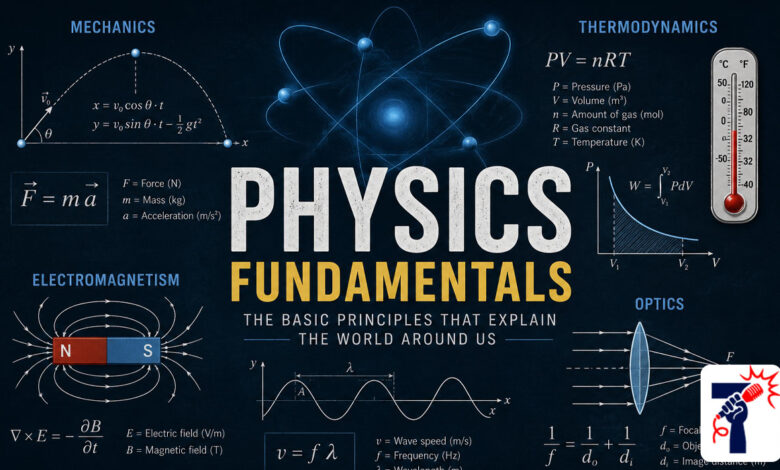
Physics fundamentals are the basic ideas that explain how everything around you works. They answer simple questions like why a ball falls, why ice melts, and why a car needs more fuel to go faster. You do not need a science degree to understand these ideas. This guide explains the core concepts of physics in plain language, so you can see the science behind everyday life. By the end, you will understand matter, energy, force, and motion in a clear and simple way.
What Is Physics?
Physics is the science that studies matter, energy, and how they interact with each other. It tries to answer big questions about the universe, from why the sky is blue to why planets stay in orbit. The word “physics” comes from the Greek word physis, which means nature. This shows that physics is really the study of the natural world around us.
You see physics in action every single day. When you ride a bike, drive a car, or use your phone, physics is working behind the scenes. It is also the foundation for other sciences like chemistry, biology, and engineering. Without physics, we would not understand how machines, electricity, or even the human body work.
Matter and Energy: The Building Blocks
Matter is anything that takes up space and has mass. It includes everything you can touch, like a chair, water, or air. All matter is made of tiny particles called atoms, which join together to form different materials.
Energy is the ability to do work or cause change. It comes in many forms, such as kinetic energy for motion, potential energy for stored energy, thermal energy for heat, and electrical energy. One of the most important rules in physics is the law of conservation of energy. It states that energy cannot be created or destroyed, only changed from one form to another.
Newton’s Laws of Motion
Sir Isaac Newton created three laws that explain how objects move. The first law says an object stays still or keeps moving at the same speed unless a force acts on it. This idea is also called inertia. The second law connects force, mass, and acceleration with a simple formula, force equals mass times acceleration.
The third law states that for every action, there is an equal and opposite reaction. You can see this when you push off the ground while walking or when a rocket launches into space. These three laws explain almost every type of movement you see in daily life, from a rolling ball to a flying airplane.
The Main Branches of Physics
Physics is divided into different branches that each focus on a specific topic. Classical mechanics studies the motion of objects, like cars and planets. Thermodynamics looks at heat, temperature, and energy transfer, while electromagnetism explains electricity, magnets, and light.
There are also more advanced branches, such as quantum mechanics, which studies tiny particles like atoms and electrons, and relativity, which explains how space and time are connected. Each branch helps scientists explain a different part of how our universe works, from the smallest particle to the largest galaxy.
Why Physics Fundamentals Matter in Daily Life
Learning physics fundamentals helps you understand the world in a deeper way. It explains why your coffee cools down, why seatbelts keep you safe, and why airplanes can fly. This knowledge is also useful for students who want to study engineering, medicine, or technology later in life.
Beyond school and careers, physics fundamentals build strong thinking skills. They teach you to ask questions, look for patterns, and solve problems step by step. These skills help in almost every part of life, not just in a science class.
Conclusion
Physics fundamentals give you the tools to understand how the world truly works. From matter and energy to Newton’s laws, these ideas explain the science behind everyday moments. Once you learn the basics, the world around you starts to make a lot more sense.
Frequently Asked Questions
1. What are physics fundamentals?
Physics fundamentals are the basic laws and ideas that explain matter, energy, force, and motion in the universe.
2. Do I need math to understand physics fundamentals?
Basic math helps, but most fundamental ideas can be understood through logic and simple examples first.
3. What are the three laws of motion?
Newton’s three laws explain inertia, the link between force and acceleration, and action-reaction pairs.
4. What is the difference between matter and energy?
Matter takes up space and has mass, while energy is the ability to do work or create change.
5. Why should I learn physics fundamentals?
They help you understand daily life, build problem-solving skills, and prepare you for careers in science and technology.
See more amazing Information visit Fact News