Remember raising your hand and waiting?
Kids barely do that anymore. Walk into a classroom today, and you’ll see it right away: someone’s asking a chatbot a question and getting an answer before the teacher even notices. The whole “wait for help” model just doesn’t hold up the way it used to. It can be found as a tutor, a study buddy, or an additional set of hands for a busy teacher in schools, colleges, and even corporate training rooms. No one is being replaced by it. However, it is reshaping the classroom experience.
What does this signify for you, then? This article describes conversational AI, how it is now being used in classrooms, and its potential.
What Is Conversational AI?
Self – Generated
AI that can comprehend language and react similarly to a human is known as conversational AI. This includes chatbots, virtual assistants, and AI tutors based on big language models. In addition to text-to-speech and voice agent capabilities, platforms like Murf now provide conversational AI voice tools, providing creators and organizations with more than a one-use tool.
How It Differs From Traditional Educational Software
Older learning software followed a fixed script. When you provide an incorrect response, it consistently displays the same hint. That is not how conversational AI operates. It recognizes context. Its tone shifts. It will try another explanation if the first one doesn’t work. It can respond to your follow-up inquiries and state “I’m not sure” rather than speculating.
What Makes It Actually Useful for Learning
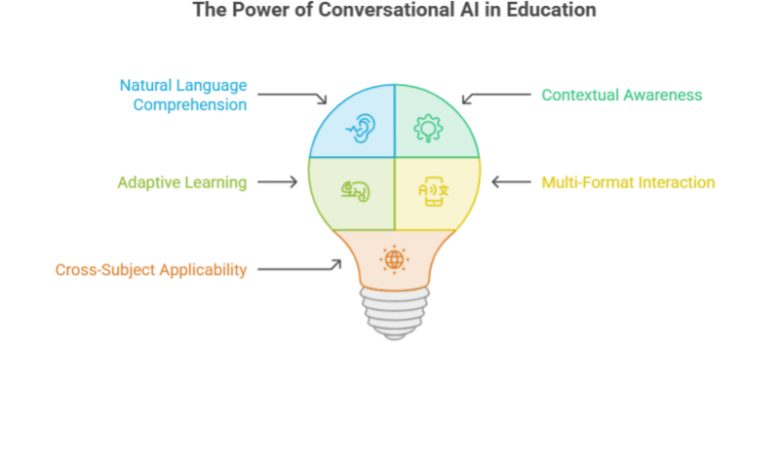
A few key traits explain why this technology fits so well in a classroom setting:
- It is able to comprehend normal language. You don’t have to ask a particular question. Ask it the same way you would a buddy.
- It recalls the exchange. You don’t have to repeat yourself in every communication because it keeps a note of what you’ve already asked.
- It adjusts to your skill level. Ask it to explain something, “like I’m twelve,” and it’ll simplify the answer. Ask for more depth, and it’ll go further.
- It works in multiple formats. Text, voice, and sometimes images, so you can learn in whatever way suits you best.
- It works across subjects. The same tool that helps with algebra can also help you practice French or review a history essay.
That’s the reason it’s found such a comfortable spot in education.
Why Schools Need Conversational AI
Although every child learns differently, the majority of classes are created with the average student in mind. Education has never truly been able to address this issue. One teacher cannot possibly provide each of the thirty kids with the individualized attention they require. AI website builders also contribute to modern education by enabling students, teachers, and educational institutions to create websites for portfolios, class projects, online learning resources, and school events without requiring coding skills. This makes it easier to share knowledge, showcase student work, and build engaging digital learning experiences.
Conversational AI is never bored. If you ask the same question five times, the fifth response will be as patient as the first. Because of its patience, it functions just as well outside of a schedule as it does inside. Just as a traveler planning the Annapurna Circuit climb keeps asking questions until the route makes sense, a student researching a geography project on high-altitude terrain can keep asking questions until the notion lands.
Combined with AI website builders, conversational AI helps educators create interactive educational websites where students can access lessons, ask questions, and receive personalized support anytime. It cannot take the place of a qualified instructor. Conversational AI, however, covers a lot of ground that a single teacher is just unable to cover.
Real Ways Students and Teachers Are Using Conversational AI Today
Self – Generated
This occurs not only in commercial text but also in daily life. If you speak with a teacher who has used these tools for a month, they will tell you the same thing: it’s a series of minor adjustments that gradually pile up rather than a single, significant change.
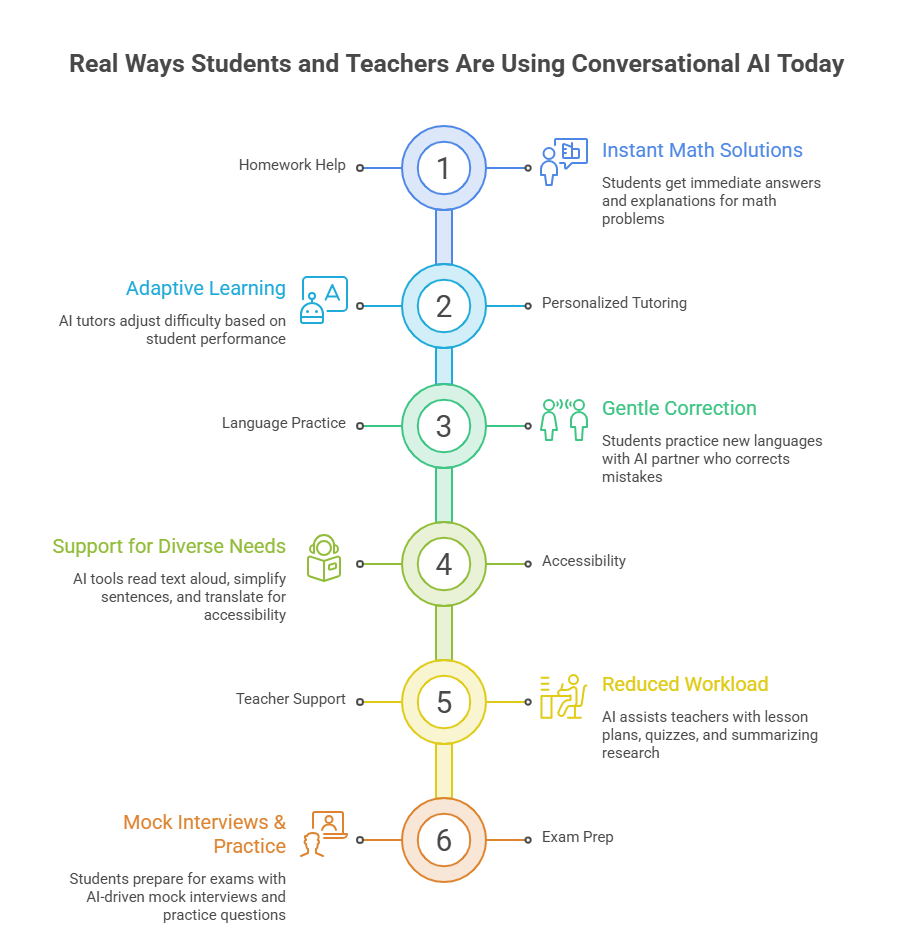
- Homework help. Stuck on a math problem? Ask a chatbot to walk you through it and get a clear answer right away, instead of waiting until tomorrow’s class.
- Personalized tutoring. AI tutors adjust the difficulty based on how you’re doing. More practice where you’re weak, faster pace where you’ve already got it down.
- Language practice. You get to speak or write in a new language with a partner who corrects your mistakes gently and never rolls their eyes at a repeated error.
- Accessibility. Got a learning difficulty or a hearing impairment? AI tools can read text aloud, simplify a dense sentence, or translate something on the spot.
- Teacher support. Lesson plans, quiz questions, summarizing a long research paper, answering the same student question for the fifth time, AI takes a chunk of that off a teacher’s plate.
- Exam prep. Mock interviews and practice questions with instant feedback, instead of waiting weeks for a scheduled test slot.
Old-School Learning vs. AI-Assisted Learning, Side by Side
A quick side-by-side look at how the two approaches stack up on the things that matter most.
| Aspect | Traditional Learning | AI-Assisted Learning |
| Availability | Fixed class hours | Available 24/7 |
| Pace | Same speed for everyone | Adjusts to each student |
| Feedback | Often delayed (graded later) | Instant, in real time |
| Repetition | Limited teacher time for repeats | Unlimited patience for repeats |
| Personalization | Hard to scale in large classrooms | Built into the system |
| Human connection | Strong emotional and social support | Limited, needs human backup |
Neither side wins here. The table just shows you that traditional teaching and AI solve two different problems. That’s exactly why mixing them works better than picking one over the other.
Picture it this way. A good classroom still needs a teacher who notices when you’re struggling before you even say anything. But that same classroom can also lean on a tool that will repeat a concept for the fifth time without getting annoyed. One doesn’t cancel out the other. They just work better as a pair.
What Students and Teachers Actually Gain From Conversational AI
Here are five examples of how this change is already beneficial in actual classrooms rather than only in theory.
Self – Generated
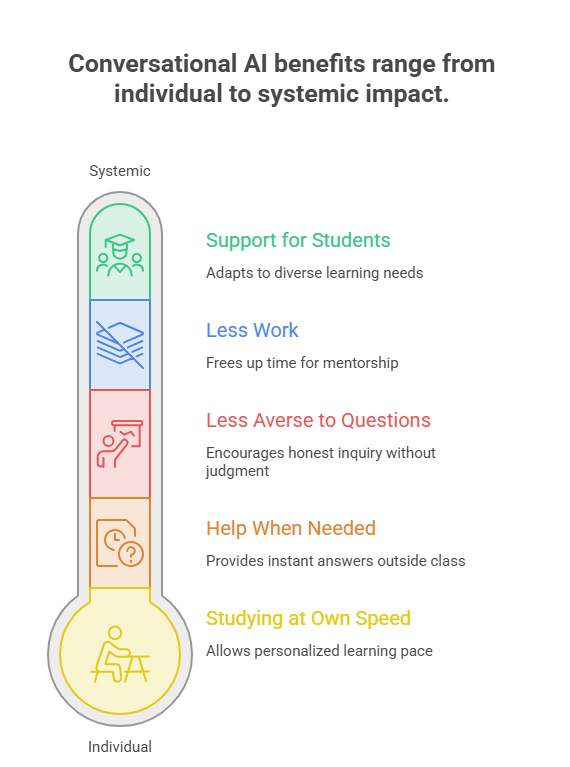
1. Studying at Your Own Speed
Some concepts require three explanations before they make sense to you. You can ask the same question more than once without feeling guilty, thanks to conversational rate AI. A learner who picks things up faster, on the other hand, might skip forward rather than sit through material they already understand.
2. Help When You Actually Need It
A nine-to-three timetable is rarely followed when studying. Before an exam, are you studying at midnight? Instead of writing down the query and forgetting it in the morning, you can get an answer right away.
3. Feel Less Averse to Posing a “Simple” Question
Many students avoid speaking during class because they fear that a simple inquiry will make them appear unprepared. When you remove that audience, you tend to ask more and more honest questions, which typically indicates that you have a deeper understanding of the subject.
4. Less Work for Teachers
Creating practice worksheets, marking easy tests, and responding to the same question five times a day can quickly add up. Teachers will have more time for real mentorship and conversation if they delegate some of that to AI. This is the aspect of teaching that a computer cannot perform.
5. Support for Different Kinds of Students
You might be learning a second language. Maybe you have dyslexia, or maybe you just need things conveyed a little more carefully. It’s actually challenging to continually switch up your approach as quickly as conversational AI can when you have thirty different students in one session.
The Risks and Downsides Worth Knowing About
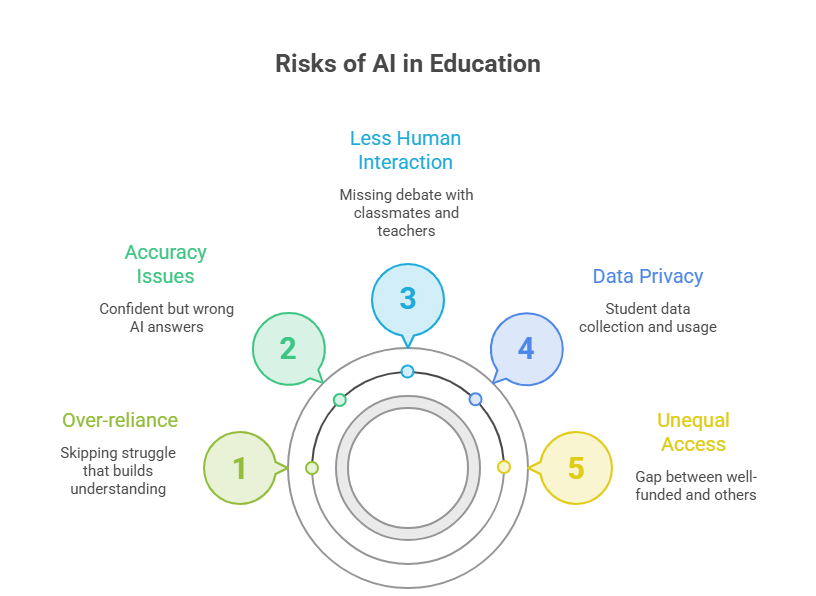
None of this comes free, though. Here’s what’s worth keeping an eye on.
- Over-reliance. Lean on a chatbot for every answer, and you skip the struggle that actually builds understanding in the first place.
- Accuracy issues. AI tools can sound completely confident while being flat-out wrong, and without enough background knowledge, you might not catch it.
- Less human interaction. Learning isn’t only about facts. It’s also the back-and-forth debate you get from real classmates and teachers.
- Data privacy. Schools need to know exactly what student data gets collected, and how AI platforms store and use it. It’s a bit like the standards question that comes up in other industries, for instance, food and nutraceutical producers adopting GMP standards to prove they meet a consistent bar of quality and safety. Education is heading toward needing that same kind of accountability for AI tools.
- Unequal access. Not every student has a personal device or a dependable internet connection. If these instruments are used recklessly, the gap between well-funded schools and everyone else will grow.
- Losing the messy first draft. When answers come this easily, it’s tempting to skip the rough, uncertain stage of working through an idea. That messy stage is usually where the real learning happens.
None of this means you should steer clear of conversational AI entirely. It means using it with some limits and real guidance from your teachers. A school that advises students to “use AI for practice, not for your final essay” typically retains the majority of the benefits without the majority of the drawbacks.
Self – Generated
What Could Happen in the Next Few Years
Even though nobody can foresee the future, some trends are already becoming apparent.
| Trend | What It Means for Learning |
| AI + human hybrid classrooms | Teachers use AI for practice and repetition, while focusing class time on discussion and critical thinking |
| Emotionally aware AI tutors | Systems that can sense frustration or confusion and adjust their tone or pace accordingly |
| Voice-based learning | More students interacting with AI through speech, especially useful for younger learners and accessibility |
| Skill-based micro-learning | Short, targeted AI-guided classes as opposed to lengthy, universally applicable courses |
| Better data protection standards | Stricter rules on how student data collected by AI tools is stored and used |
Conversational AI in education isn’t some passing fad. It’s becoming a fixture, plain and simple. Schools that figure out how to weave it into normal teaching, instead of treating it like a replacement for teachers, are probably going to come out ahead.
None of this is set in stone, of course. Classroom technology has a habit of surprising everyone, teachers included. Still, these are the patterns worth watching.
How to Use Conversational AI Without Overusing It
When schools do this well, they don’t give AI all of the work. Additionally, they are not explicitly prohibiting it. Instead of using technology in place of a good instructor, they are treating it as a truly helpful tool that is best used in conjunction with one.
At nine o’clock at night, practicing mathematics with an AI tutor? It’s a smart use of technology. Never bothering to consider a problem since AI will solve it for you? That’s a red flag. To be honest, there is nothing more complicated than how you utilize it. The stakes here are real: student use of AI for homework rose from 48% to 62% between May and December 2025, and 67% of students now believe that heavier AI use is harming their critical-thinking skills, according to RAND. fe
To develop positive habits around this, you don’t have to be an expert in technology. These little routines maintain the tool’s position as a support rather than a shortcut.
What Conversational AI Changes, and What It Never Will
Conversational AI has already changed education in ways that would’ve looked strange just a few years back. You’ve got a patient learning partner available whenever you need one. Teachers get help with the repetitive parts of their job. And schools are having to rethink what personalized learning even means once it’s no longer limited by how many hours are in a teacher’s day.
Still, no technology makes you educated on its own. Curiosity does that. Effort does that. Sincere discussions with competent educators do that. Conversational AI functions best when it supports those concepts rather than attempting to replace them.
The future of learning isn’t humans versus AI. It’s the two figuring things out together, trying to make education a little more accessible, a little more personal, and still recognizably human, even with a machine sitting in the room.
Want more stories on how technology is reshaping everyday life? Head over toFact News for the latest.