Large Language Models (LLMs) are impressive, but they become valuable only when they understand how people actually speak and type. In India, that means multiple scripts, frequent code-mixing, and local expressions that rarely appear in generic training corpora. Hyderabad’s AI teams are adapting Llama 3 with curated local data so the model handles Telugu, Urdu, and Hinglish prompts more reliably in support, search, and knowledge workflows. Many professionals first connect these ideas to practical delivery skills through an artificial intelligence course in hyderabad.
Why Local Fine-Tuning Matters for Vernacular Use Cases
A general-purpose model can produce fluent text yet still fail at practical tasks. The issue is usually intent and context, not grammar. A user may start in English, add details in Telugu, and end with an Urdu phrase typed in Latin characters. If the model has not seen these patterns, it may misread the request, answer the wrong question, or guess missing details.
Where it shows up in products
Hyderabad teams often build systems used across India, so vernacular behaviour appears quickly:
- Support chat and agent-assist, where language switches happen mid-conversation.
- Transactional flows like refunds and cancellations, where small mistakes create high costs.
- Search and local discovery, where users mix scripts and “sound-based” spellings.
Local fine-tuning aims to improve task success, reduce escalations, and ensure responses comply with product rules.
Building the Right Local Dataset
Fine-tuning quality depends more on data than on training tricks. “Local data” should be representative, permitted to use, and handled carefully. The best datasets capture real user behaviour without carrying sensitive identifiers.
What local data typically includes
Teams usually combine a few reliable sources:
- Anonymised chat logs and tickets (after removing names, phone numbers, and account identifiers).
- FAQs, policies, and manuals, including regional language variants and common user questions.
- Licensed or public-domain text that reflects everyday usage (short messages, informal phrasing).
- Human-written examples for high-risk or rare intents (disputes, grievances, ambiguous requests).
Cleaning steps that improve behaviour
Three steps consistently raise quality:
- De-duplication and leakage control: Remove repeated templates and keep evaluation data fully separate.
- Code-mix normalisation: Preserve genuine mixing, but standardise obvious spelling variants so the model learns stable mappings.
- Instruction formatting: Turn content into instruction–response pairs, including “ask a clarifying question” examples when inputs are incomplete.
A smaller, high-quality dataset often beats a larger, noisier one.
Fine-Tuning Llama 3 Without Overfitting
Most teams avoid full fine-tuning because it increases cost and can reduce general capability. Instead, they use parameter-efficient methods that target improvements while keeping the base model broadly competent.
Practical training and evaluation
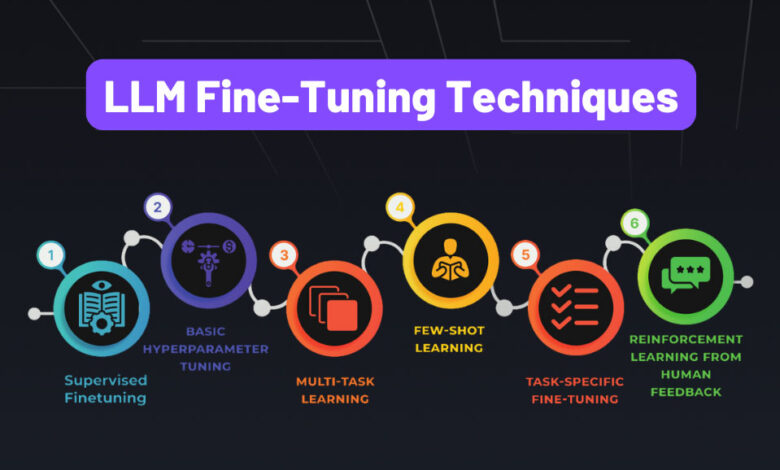
Common approaches include Supervised Fine-Tuning (SFT) on curated pairs and LoRA/QLoRA adapters to reduce GPU needs. To avoid overfitting to a single writing style, teams often blend local prompts with a portion of general prompts and keep a small “policy and safety” set to ensure refusals and cautions remain consistent after tuning.
Evaluation should reflect real inputs:
- Coverage across scripts (native script, transliteration, and mixed-script prompts).
- Task success on high-impact intents (refunds, cancellations, eligibility, status checks).
- Hallucination checks for facts that must be correct (fees, dates, policy conditions).
Human review remains important because automated scores can miss meaningful errors in code-mixed text.
Deploying and Improving the Model in Real Products
A tuned model is only valuable if it performs reliably in production, under real latency and cost constraints.
Cost, grounding, and monitoring
Teams often run smaller variants for routine conversations and reserve larger capacity for complex cases. Retrieval-augmented generation (RAG) can ground answers in approved documents and reduce invented details, especially for policy-heavy questions. Operational controls such as access restrictions, audit logs, and minimal retention of raw user text help reduce risk when training and evaluating.
After launch, teams track language drift (new slang, new product terms), cluster failures by intent and language, and add targeted examples to the next tuning cycle. This is where strong fundamentals—reinforced in an artificial intelligence course in hyderabad or through hands-on MLOps practice—help teams move from one-off experiments to a repeatable improvement loop with benchmarks and quality gates.
Conclusion
Fine-tuning Llama 3 on local data is a practical way to handle Indian vernacular realities: code-switching, mixed scripts, and regional context. Hyderabad’s data scientists achieve the best results when they invest in representative datasets, use parameter-efficient tuning, evaluate on real writing styles, and continuously monitor performance. Done well, local fine-tuning improves user experience, reduces operational load, and builds trust in language systems that must work for everyone.