With Anthropic’s newly released Claude Sonnet 5 now generally available, every team running its flagship Opus 4.8 faces the same fresh question: switch, stay, or split? This used to be an easy call — Opus for quality, Sonnet for cost, pick your poison. Sonnet 5’s launch broke that logic. It delivers near-Opus results on the work that fills most production pipelines — coding, agents, extraction — at a much lower price, which means paying flagship rates for everything is, for the first time, clearly wasteful. But Opus 4.8 hasn’t been dethroned either: on the hardest reasoning and the longest autonomous runs it remains the stronger model. The honest answer to “which one?” is “both, routed well” — and that’s far easier to set up than it sounds.
The setup is a single endpoint. With OrcaRouter, an LLM router that fronts 200+ models, Sonnet 5 and Opus 4.8 are two model strings behind the same OpenAI-compatible API — so routing each task to the right one is configuration, not engineering. Here’s exactly where each model wins, what the price gap really means, and the routing rule most teams land on.
Quick recommendation
- Choose Claude Sonnet 5 if… your workload is coding, agents, summarization, extraction, or anything high-volume — you’ll get near-flagship quality at roughly 40% lower per-token cost
- Choose Claude Opus 4.8 if… the task is frontier-hard: deep multi-step reasoning, long-horizon autonomous work, or high-stakes analysis where the last few points of quality justify the price
- Use both if… you run real production traffic — route the volume to Sonnet 5 and escalate the hard minority to Opus 4.8
The two models at a glance
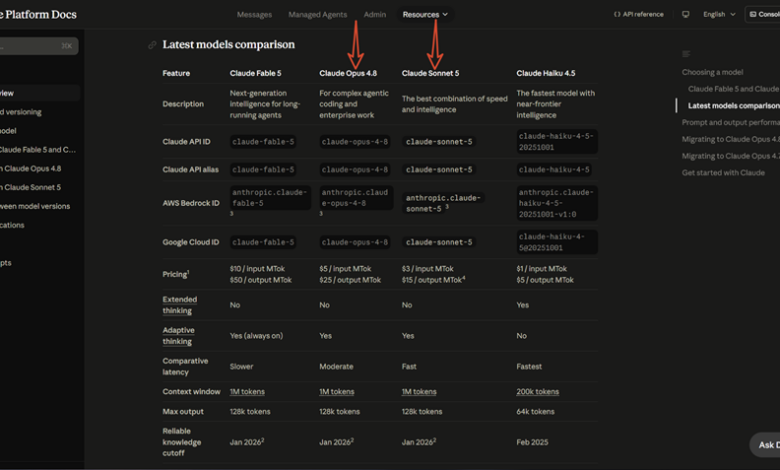
Structurally, the two are more alike than any Sonnet/Opus pair before them. Both offer a 1M-token context window and up to 128K output tokens. Both support adaptive thinking with the full effort range including `xhigh`. Both handle high-resolution vision up to 2576 pixels. And both use the same tokenizer, so token counts are directly comparable when you benchmark them side by side.
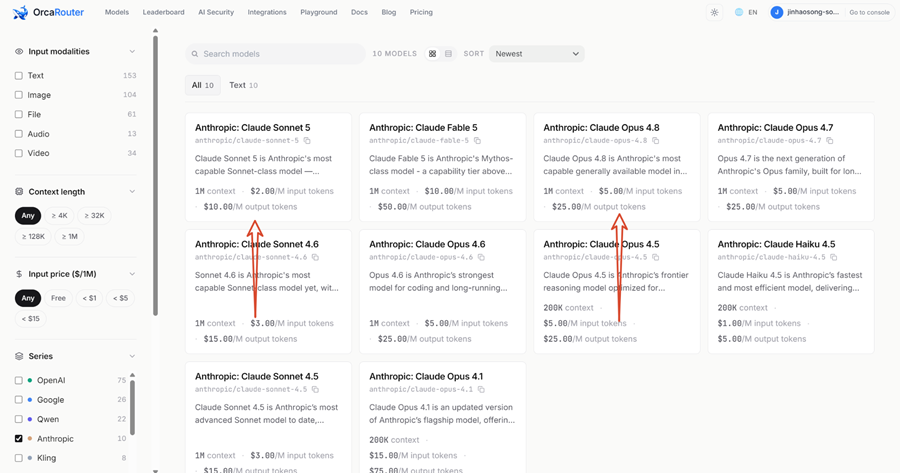
The differences are price and ceiling. Sonnet 5 lists at $3 / $15 per million tokens (with an introductory $2 / $10 rate through August 31, 2026), while Opus 4.8 runs $5 / $25. Opus, in exchange, holds the edge on the hardest reasoning, long-running autonomous agents, and the kind of knowledge work where it can grind through ambiguity for minutes at a time.
Where Sonnet 5 wins
Sonnet 5’s case is economic, and it’s compelling. On everyday coding — writing features, fixing bugs, reviewing diffs — its quality now sits close enough to Opus that most teams can’t justify the price difference for that work. The same goes for agentic pipelines that call tools in a loop, high-volume extraction and classification, customer-facing chat, and long-document processing, where the identical 1M context costs 40% less per token. If your bill is dominated by volume rather than difficulty, Sonnet 5 is where that volume belongs.
Where Opus 4.8 wins
Opus 4.8 earns its premium at the top of the difficulty curve. It’s the stronger model for frontier reasoning — intricate architecture decisions, subtle debugging across a large codebase, research-grade analysis — and it’s markedly better at very long autonomous runs, where it plans, self-corrects, and maintains coherence over extended sessions. It also leads on memory-driven knowledge work, like maintaining and using notes across a long-running task. If a wrong answer is expensive or the task runs unattended for hours, pay for Opus.
What the price gap really means
Per token, Opus 4.8 costs roughly 40% more on input and output alike — and during Sonnet 5’s introductory window the spread is wider still. But the fair comparison is cost per completed task, not per token. For routine work the two models succeed at similar rates, so Sonnet’s discount translates directly into savings. For genuinely hard tasks, Opus’s higher first-try success rate can make it the cheaper option once you count retries. That’s precisely why a blanket choice in either direction leaves money on the table: the split depends on the task, and the only reliable way to find your split is to run both on your real workload and read the numbers.
The smart setup: route, don’t choose
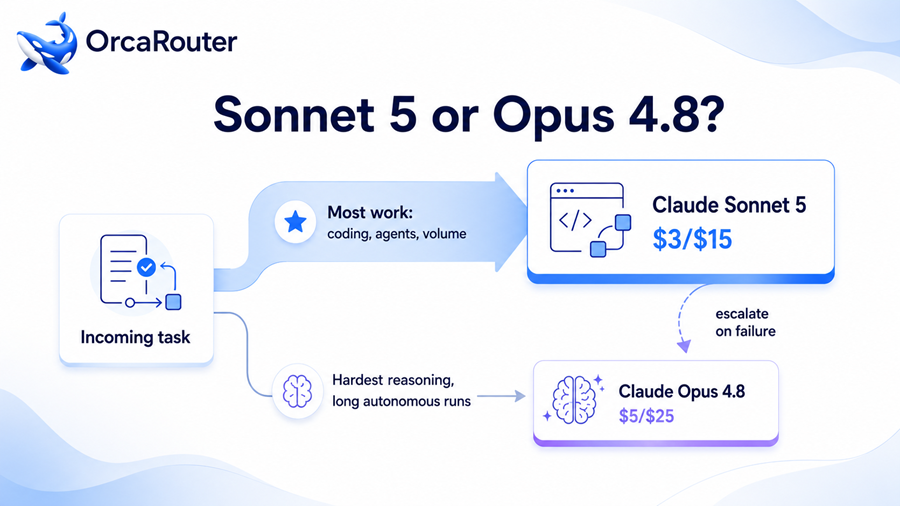
The teams getting the best economics don’t pick a winner — they set a default and an escalation path. Sonnet 5 takes every request first; failures, low-confidence outputs, and tasks flagged as hard escalate to Opus 4.8. Because both models sit behind the same endpoint on a gateway, that policy is a few lines of configuration: same API shape, same tokenizer for comparable budgeting, zero markup on either model, and automatic failover if a provider hiccups. Adopting next year’s models, when they land, is the same one-string change.
How to run both through one endpoint
- Create a free account and generate an API key
- Point your existing OpenAI SDK at the gateway’s base URL
- Set `claude-sonnet-5` as your default model string; keep `claude-opus-4-8` configured for escalation
- Run a week of real traffic, compare cost per completed task on both, and tune the split
The bottom line
Sonnet 5 versus Opus 4.8 isn’t a duel — it’s a division of labor. Sonnet 5 has made flagship-for-everything indefensible, and Opus 4.8 has kept flagship-for-the-hard-stuff essential. Route between them and you stop paying premium prices for routine work without ever giving up the ceiling.
Ready to run both and let the data decide? Start free with OrcaRouter — Claude Sonnet 5, Opus 4.8, and 200+ other models behind one OpenAI-compatible endpoint, with zero markup and automatic failover.
FAQ
Can I switch between Sonnet 5 and Opus 4.8 mid-conversation?
Yes — the API is stateless, so you can send the same conversation history to either model at any turn. The catch is prompt caching: caches are per-model, so each switch re-pays the cache write on the other model. Frequent flip-flopping inside one thread erodes the savings.
Is fast mode available on both models?
No — fast mode (higher output speed at premium pricing) is an Opus-only research preview; Sonnet 5 doesn’t support it. If raw output speed matters more than cost, that’s one scenario where Opus 4.8 pulls further ahead.
Do Sonnet 5 and Opus 4.8 count tokens the same way?
Yes — they share the same tokenizer, so the same prompt produces essentially the same token count on both. That makes side-by-side cost comparisons clean; just remember both count ~30% more tokens than the older Sonnet 4.6 did.