Why Smart UK Warehouses Are Moving Away from CCTV to AI Forklift Safety Systems

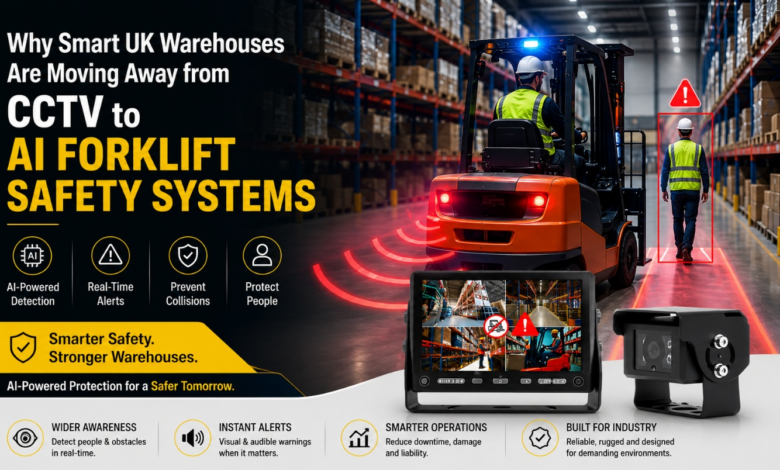
The Warehouse Camera Lie Nobody Talks About
You have cameras in every aisle. Cameras above the loading dock. Cameras covering the main forklift corridor. You can pull up footage from any angle on any screen.
And yet someone got hurt last Tuesday.
Here is the part nobody says out loud: those cameras did not fail. They worked perfectly. They recorded everything.
That is exactly the problem.
CCTV was never designed to stop an accident. It was designed to document one. And in a warehouse where a forklift can cover ground faster than a person can react, documentation after the fact is not a safety system. It is an incident report waiting to be written.
Smart UK warehouses are figuring this out and they are switching fast.
What CCTV Was Actually Built For
Before calling CCTV a failure, it is worth being fair about what it was built to do.
CCTV entered warehouses as an evidence and accountability tool. It answered questions like: Who moved that pallet? Was the door left open? What happened before the incident? For those purposes, it works.
The problem is that warehouse safety has outgrown those questions. The question that matters now is not what happened it is how do we stop this before it happens at all?
CCTV has no answer for that. It was not built to. The cameras on your ceiling are watching. They are not thinking.
The 4 Moments CCTV Always Misses
There are four specific scenarios where traditional CCTV fails warehouse safety not occasionally, but by design.
Moment 1: The Blind Corner
A worker steps out from behind a stack of pallets. A forklift rounds the corner at speed. The ceiling camera catches the whole thing in perfect clarity. The CCTV did its job. The worker is on the floor.
Fixed cameras cannot see around racking, inside loading bays, or through high-stacked inventory. These are not edge cases they are the most common locations for forklift-pedestrian conflicts.
Moment 2: The 3-Second Window
Research shows that in a typical forklift-pedestrian near-miss, the window between recognition and potential impact is under three seconds. A camera recording footage to a server provides zero intervention in that window. None.
Moment 3: The Distracted Operator
An operator glances at their phone. Looks away for two seconds. Nothing in a CCTV setup detects, flags, or alerts anyone in real time. That footage might be reviewed in a weekly safety meeting days after the near-miss that, this time, did not end in injury. Next time, it might.
Moment 4: The Pattern Nobody Sees
CCTV accumulates footage. It does not synthesise patterns. Nobody is watching 400 hours of warehouse recordings per week to identify which aisle has three near-misses every Tuesday afternoon. That risk is invisible until it becomes visible in the worst possible way.
What AI Forklift Safety Systems Actually Do
This is where the conversation changes completely.
AI forklift safety systems do not watch video. They understand it. Frame by frame, at 30 to 60 frames per second, the system processes live footage and answers one continuous question: Is something about to go wrong?
When the answer starts moving toward yes, the system acts before the operator can react, before the pedestrian can step back, before the moment becomes irreversible.
Here is what active AI detection looks like in practice:
- A worker enters a forklift operating zone. An alert fires at the operator instantly not after review, not after the shift. Instantly.
- A forklift exceeds its set speed limit in a high-pedestrian area. The system flags it, logs it, and notifies the safety manager in real time.
- An operator’s attention pattern shifts looking away from the travel path repeatedly. The system identifies the behavioural signature and flags it for follow-up.
- A blind spot zone activates as the forklift approaches it. The camera mounted on the vehicle not the ceiling sees the dynamic risk as it moves through the space.
This is not surveillance. This is active, intelligent safety infrastructure.
CCTV vs AI Safety: The Honest Side-by-Side
| What You Need | Traditional CCTV | AI Forklift Safety System |
| Alert before a collision | No | Yes — sub-second response |
| Coverage of moving blind spots | No | Yes — vehicle-mounted camera moves with the risk |
| Real-time operator behaviour monitoring | No | Yes — distraction, speed, routing all tracked |
| Near-miss logging and trends | No | Yes — automated, structured, reportable |
| HSE-ready compliance reporting | Basic footage only | Full incident logs, behaviour data, audit trails |
| Pattern detection across shifts | Manual and unreliable | Automatic, consistent, always on |
| ROI visibility | Almost none | Measurable via injury rate, insurance, downtime |
The gap is not subtle. These tools solve fundamentally different problems.
The Numbers Behind the Switch
The shift away from CCTV is not a trend driven by technology enthusiasm. It is driven by data that is hard to argue with.
Forklift-related incidents account for approximately 25% of all warehouse injuries globally. That single statistic makes forklift safety the highest-leverage investment any warehouse safety budget can make.
Facilities that have implemented AI-driven safety monitoring report a 25% reduction in injuries compared to equivalent non-automated operations. Not a marginal improvement. A quarter fewer people getting hurt.
HSE figures for 2024 to 2025 recorded 511,000 workers in the UK with work-related injuries leading to 7.1 million lost working days in a single year. Warehousing and logistics carry a disproportionate share of those numbers.
Deloitte’s 2025 Manufacturing Outlook estimated AI safety system adoption would rise from 6% to 24% in a single year. That is not incremental growth. That is an industry reaching a tipping point.
And the financial case is increasingly straightforward: autonomous safety systems are reaching full ROI payback in as little as 12 months before factoring in insurance premium changes, reduced downtime, or the avoided cost of a single serious injury.
What Smart UK Warehouses Are Deploying Right Now
The most effective implementations combine three things: vehicle-mounted AI cameras, real-time alert systems, and centralised safety dashboards that turn raw events into usable data.
The forklift itself becomes a safety node. It is not just a vehicle being watched from above it is an active participant in the safety system, aware of its environment and communicating with the people around it.
Purpose-built solutions like SharpEagle Forklift Camera Systems and their AI Forklift Camera System are designed specifically for the demands of UK industrial environments. These systems address the core failure points of CCTV directly: vehicle-mounted coverage eliminates static blind spots, AI-driven detection replaces passive recording, and real-time alerts put intervention exactly where it needs to be at the point of risk, not in a review meeting three days later.
The shift from ceiling cameras to intelligent, vehicle-integrated systems is not just a hardware upgrade. It is a change in what safety actually means on the floor.
Ready to see how AI forklift safety systems work in a real warehouse environment? Talk to the SharpEagle team about what a deployment looks like for your specific setup.
The HSE Compliance Angle That Changes Everything
Here is something many warehouse managers do not fully appreciate until they are in front of an HSE inspector: reactive documentation and proactive prevention are treated very differently.
CCTV footage showing exactly what happened in an incident demonstrates that you recorded it. It does not demonstrate that you had systems in place to prevent it.
AI safety systems produce something entirely different: proof of prevention. Logged alerts showing that risks were identified. Near-miss records showing that the system responded. Operator behaviour trends showing that patterns were monitored and addressed before they became incidents.
In an enforcement environment where improvement notices and prohibition notices carry serious operational and reputational consequences, this distinction matters enormously. HSE investigators are increasingly looking for evidence of a proactive safety culture not just a well-labelled filing cabinet of incident reports.
AI safety data gives you that evidence. CCTV footage cannot.
5 Questions to Ask Before Your Next Safety Review
Before your next quarterly safety meeting, run through these five questions honestly.
1. Can your current system intervene before a collision or only document one?
If the answer is “document,” that is your gap. Real-time intervention is the standard AI safety systems are built around.
2. Does your camera coverage move with your forklifts or stay fixed on the ceiling?
Forklifts create dynamic risk. Fixed ceiling cameras create static coverage. The mismatch between the two is where injuries happen.
3. Are you collecting structured safety data or just footage?
Near-miss logs, operator behaviour trends, and alert frequency by zone are the data points that let you manage safety proactively. CCTV does not generate them.
4. Could you demonstrate a proactive safety culture to the HSE today with evidence?
Not “we have cameras.” Evidence. Logs, trends, structured data, documented responses to identified risks.
5. What is one serious forklift injury actually costing your operation?
Direct costs: downtime, investigation, legal, insurance. Indirect costs: morale, operational disruption, reputational damage, HSE scrutiny on everything else. Now compare that to the cost of the system that prevents it.
Most warehouses that run this calculation do not wait for the next budget cycle.
If any of these questions landed uncomfortably your next step is a safety technology audit. Start with your forklift zones. That is where the risk is highest and the upgrade pays back fastest.
The warehouses reducing injury rates fastest in the UK are not the ones with the most cameras. They are the ones with the smartest ones.