

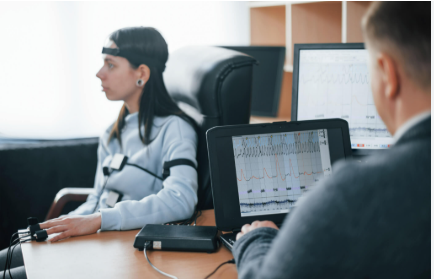
A polygraph test has this almost cinematic reputation. A quiet room. A steady ticking machine. Someone sweating under pressure while a needle jumps on a graph. It feels definitive—like truth itself is being printed out in real time.
But here’s the thing: a polygraph doesn’t actually detect lies.
That might sound surprising if you’ve only seen it in movies or heard about it in job screenings or criminal investigations. The truth is a bit more complicated, and honestly, more interesting. The polygraph measures physical reactions—things like heart rate, breathing, and skin conductivity. Then someone interprets those reactions and makes a judgment call.
That gap between measurement and meaning is where everything gets messy.
What a Polygraph Actually Measures
At its core, a polygraph is just a bundle of sensors hooked up to your body. It tracks a few key things:
- Your heart rate
- Your breathing patterns
- Your blood pressure
- The electrical activity of your skin (which changes with sweating)
Now imagine this: you’re sitting in a chair, wires attached, being asked questions you know matter. Even if you’re telling the truth, your body might react. Your pulse might rise. Your breathing might shift. That’s not deception—it’s stress.
And the machine can’t tell the difference.
The idea behind the polygraph is that lying creates a unique kind of stress response. But in reality, stress shows up for all kinds of reasons. Fear of being misunderstood. Anxiety about the situation. Even embarrassment.
So what the polygraph really records is arousal, not dishonesty.
Why People Still Believe in It
Let’s be honest—there’s something deeply appealing about the idea of a machine that can detect lies. It feels like a shortcut through uncertainty. No guessing, no ambiguity. Just truth.
That’s part of why polygraphs have stuck around, despite the controversy.
They’ve been used in criminal investigations, government security screenings, and even in personal disputes. Some couples have tried them during trust issues. Employers have used them in certain industries. It gives a sense of finality, even when that sense isn’t fully justified.
There’s also a psychological factor. If someone believes the machine will catch them, they might confess before the test even begins. In that way, the polygraph sometimes works not because of its accuracy, but because of its reputation.
The Human Factor Behind the Machine
Here’s where things get even more interesting. A polygraph test isn’t just about the machine—it’s heavily dependent on the examiner.
The person running the test decides:
- What questions to ask
- How to phrase them
- What counts as a “significant” reaction
- How to interpret the data afterward
That introduces a lot of subjectivity.
Two examiners could look at the same data and come to different conclusions. One might see deception. Another might see nervousness. There’s no universal standard that removes human judgment from the process.
And that’s a big deal.
Imagine being judged not just on your physiological responses, but on how someone else interprets them. It’s not hard to see how errors can happen.
False Positives and False Negatives
If you’ve ever been nervous during a test—even when you knew the answers—you already understand one of the biggest flaws of polygraphs.
False positives happen when truthful people are judged as deceptive. This can occur because:
- They’re naturally anxious
- They’re intimidated by the setting
- They overthink questions
- They’ve had bad experiences with authority
On the flip side, false negatives happen when someone is lying but appears truthful. Some people can stay remarkably calm under pressure. Others may use techniques to control their physiological responses.
That creates a strange situation where the outcome doesn’t necessarily reflect reality.
Think about it like this: the polygraph isn’t asking, “Are you lying?” It’s asking, “Is your body reacting in a way we associate with lying?” Those are very different questions.
Can You Beat a Polygraph?
This is where things tend to get a bit controversial.
There’s a long-standing debate about whether people can “beat” a polygraph. Some claim it’s possible by controlling breathing, inducing stress at specific moments, or staying unusually calm.
Without getting into tactics, the bigger point is this: if a test can be influenced by how someone manages their physical responses, it raises questions about reliability.
Even without deliberate manipulation, people vary widely in how their bodies react. One person’s mild stress looks like another person’s extreme reaction.
So while the idea of “beating the test” gets a lot of attention, the underlying issue is broader: the test itself isn’t as precise as people assume.
Where Polygraphs Are Used Today
Despite all the debate, polygraphs haven’t disappeared. They’re still used in certain contexts.
In the United States, for example, some government agencies use them during security clearance processes. Certain law enforcement investigations also rely on them, mainly as an investigative tool rather than definitive evidence.
But courts are a different story.
Most courts don’t accept polygraph results as evidence, or they do so only under very specific conditions. That says a lot. If something isn’t reliable enough for a courtroom, it’s worth questioning how much weight it should carry elsewhere.
Outside of legal settings, polygraphs sometimes show up in more personal or unusual situations—like reality TV or private disputes. In those cases, they often function more as drama than science.
What It Feels Like to Take One
Picture this: you’re brought into a quiet room. The examiner explains the process. You’re hooked up to sensors. There’s a short calibration phase where they establish a baseline.
Then the questions begin.
Some are neutral. Some are control questions designed to provoke a reaction. Others are directly relevant to the issue at hand.
The pressure builds slowly. Even if you’re completely honest, you might start second-guessing yourself. Did I answer that clearly enough? Was my tone off? Did my breathing change?
That internal spiral is part of why the experience can be stressful.
And that stress is exactly what the machine is picking up.
The Ethical Gray Areas
Polygraphs raise some uncomfortable questions.
Is it fair to judge someone based on physiological reactions they can’t fully control? Should a person’s nervous system be treated as evidence?
There’s also the issue of consent and understanding. Not everyone fully grasps the limitations of the test before agreeing to it. Some people walk in believing it’s almost infallible.
That belief alone can influence outcomes.
If you think the machine will expose you no matter what, you might react more strongly—even if you’ve done nothing wrong. That can create a self-fulfilling cycle where anxiety is mistaken for guilt.
Why the Debate Isn’t Going Away
Polygraphs sit in a strange space between science and psychology, between measurement and interpretation.
On one hand, they provide real data—heart rate, breathing, skin response. On the other hand, the meaning of that data isn’t fixed. It depends on context, assumptions, and human judgment.
That tension keeps the debate alive.
Some argue that polygraphs are useful as investigative tools when used carefully and alongside other evidence. Others believe they’re too unreliable to be trusted in any serious context.
Both sides have a point.
A More Grounded Way to Look at It
Instead of thinking of a polygraph as a “lie detector,” it helps to see it as a “stress detector.”
That shift in perspective changes everything.
Now, the results aren’t about truth versus deception. They’re about how your body reacted during a specific moment under specific conditions.
That’s useful information—but it’s not definitive.
If someone treats a polygraph result as the final word, they’re putting too much faith in something that was never designed to be absolute.
The Takeaway
Polygraph tests carry a certain mystique. They feel precise, almost authoritative. But beneath that surface, they’re far more uncertain than they appear.
They measure the body, not the truth. They rely on interpretation, not certainty. And they’re influenced by factors that have nothing to do with honesty.
That doesn’t make them useless—but it does mean they should be handled with care.
If you ever find yourself facing one, the most important thing to understand is this: the machine isn’t reading your mind. It’s reading your reactions.
And those two things aren’t the same.


