Best 2D CAD Conversion Services for UK Engineering Firms: What to Look for Before You Sign

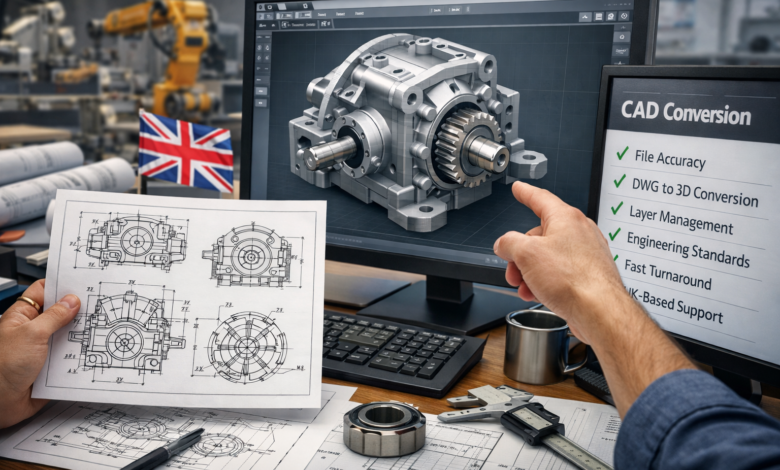
Picture this: you have a warehouse full of paper drawings, legacy TIFF scans, or outdated DWG files that your current BIM workflow simply cannot read. Your project deadline is three weeks away, your client is pushing for an as-built model, and your in-house draughtsmen are already stretched thin.
Sound familiar? If you run an engineering, architecture, or construction firm in the UK or manage technical projects anywhere globally, the challenge of converting legacy drawings into clean, standards-compliant 2D CAD files is one that quietly devours time, budget, and patience.
The good news is that the market for 2d cad conversion services has matured considerably. But not all providers are equal and signing the wrong contract can cost you far more than the conversion itself. This guide breaks down exactly what to look for, which questions to ask, and how to separate the true professionals from the crowd.
Why Is the Demand for CAD Conversion Services Growing So Fast Right Now?
The numbers are hard to ignore. According to Grand View Research, the global CAD software market was valued at over USD 9.5 billion in 2023 and is projected to expand at a compound annual growth rate (CAGR) of around 6.5% through 2030. A significant share of that growth is being driven not by new design work alone, but by the massive backlog of analogue and semi-digital drawings that organisations need to digitise.
In the UK specifically, the government’s mandate for BIM Level 2 compliance on publicly funded construction projects formalised through the UK BIM Framework has created enormous pressure on firms to bring their existing drawing archives into the digital fold. Meanwhile, infrastructure renewal schemes like HS2 and the ongoing expansion of the NHS estate have generated thousands of legacy drawings that require professional-grade conversion.
Across the Atlantic, the story is similar. The US Army Corps of Engineers and multiple state DOTs have published directives requiring contractors to deliver fully vectorised, layered DWG or DXF files for all infrastructure assets. This means that even firms working solely on domestic UK or US projects are increasingly expected to deliver CAD-ready documentation not just PDFs or scanned images.
What Exactly Is 2D CAD Conversion and What Does It Actually Involve?
At its core, 2D CAD conversion is the process of transforming non-editable source drawings paper originals, TIFF/PDF scans, raster images, or even hand-drawn sketches into clean, layered, editable vector files in formats such as DWG, DXF, DGN, or PDF vector.
A comprehensive conversion project typically involves:
- Raster-to-vector conversion (sometimes using intelligent scanning software, sometimes manual redrafting)
- Layer assignment and organisation according to BS EN ISO 19650 or AIA/NCS standards
- Geometry clean-up removing duplicate lines, correcting scale errors, fixing broken entities
- Title block recreation and compliance with client-specific or national CAD standards
- Annotation and dimensioning review
- File naming and metadata tagging for document management systems
- Quality assurance checks against original source documents
This is not a simple file-format conversion. It is a skilled draughting process, and the quality of the output depends almost entirely on the people and processes behind it.
What Should You Look for in a CAD Conversion Services Provider in the UK?

The market for cad conversion services in UK is competitive, but quality varies wildly. Here are the non-negotiable criteria you should evaluate before you commit to any provider.
1. Proven Accuracy and Quality Control Processes
The term “accurate cad conversion service” gets thrown around a lot in provider marketing. But accuracy is not a marketing slogan, it is a verifiable outcome. Ask any shortlisted provider to show you their QA workflow. Specifically, look for:
- A multi-stage review process with at least two independent checks before delivery
- Overlay comparison against source files as standard practice
- Dimensional tolerance standards most reputable providers work to ±1mm at original drawing scale
- Named QA managers on your account, not just anonymous production teams
2. Sector-Specific Experience
A firm that excels at converting architectural floor plans may struggle with mechanical engineering P&IDs or structural steelwork drawings. Always ask for sector-relevant samples and case studies. UK engineering disciplines where drawing complexity is particularly high include civil and structural engineering, MEP (mechanical, electrical, plumbing) coordination, highway and rail infrastructure, and oil, gas, and utilities.
3. Standards Compliance
UK engineering firms operate under specific CAD standards. Any best cad conversion service provider worth considering must demonstrate compliance with BS EN ISO 19650 for information management, PAS 1192 principles (now superseded but still referenced on legacy projects), client-specific CAD standards from major frameworks such as Highways England (now National Highways), Network Rail, and the NHS, as well as relevant international standards where cross-border project delivery is involved.
4. Data Security and IP Protection
Engineering drawings are sensitive intellectual property. Before signing any contract, verify that the provider operates under a signed NDA as standard, holds ISO 27001 certification or equivalent, uses encrypted file transfer (SFTP or equivalent), has clear data retention and deletion policies, and is GDPR-compliant where the scope involves any personal data embedded in drawings or project documentation.
According to the UK National Cyber Security Centre, supply chain cyber risk remains one of the highest-priority threats to UK businesses. Outsourcing your drawing archive to an insecure provider is not a theoretical risk, it is a live one.
5. Turnaround Time and Scalability
Project timelines in UK construction and engineering are notoriously tight. Your CAD conversion partner needs to demonstrate that they can scale resources quickly during peak periods, offer guaranteed turnaround times backed by SLAs (not just estimates), maintain quality under volume pressure, and handle batch uploads of hundreds or thousands of drawings without a degradation in output quality.
How Do You Evaluate an Accurate CAD Conversion Service Without Getting Burned?
The smartest procurement decision you can make is a paid pilot. Before committing to a large-volume contract, engage your shortlisted providers with a representative sample ideally 20 to 50 drawings that reflect your full range of complexity, from simple site plans to multi-discipline coordination sheets.
During evaluation, score providers against these criteria:
- Geometric accuracy: Does every line, arc, and annotation match the source at the correct scale?
- Layer compliance: Are layers named and structured per your CAD standards?
- File hygiene: Are there duplicate entities, zero-length lines, or corrupt block references?
- Communication: How proactively did they handle ambiguous or illegible source material?
- On-time delivery: Did the pilot batch arrive within the agreed window?
It is also worth asking for client references from firms of a comparable size and discipline to your own. Generic testimonials from unrelated sectors tell you very little about how a provider will perform on your specific project type.
What Are the Latest Trends in CAD Conversion for Engineering Firms in 2025 and 2026?
The industry is not standing still. Several significant shifts are reshaping what “conversion” actually means for forward-thinking engineering firms.
AI-Assisted Raster-to-Vector Conversion
Machine learning tools, particularly those based on convolutional neural networks have made significant inroads in automating the recognition of standard drawing symbols, hatching patterns, and dimension callouts. Tools from firms like Bluebeam and specialist providers are increasingly embedding AI pre-processing into their conversion pipelines. However, AI alone still cannot handle the interpretive decisions that a skilled draughtsman makes instinctively which is why leading providers use AI to accelerate, not replace, human review.
Point Cloud Integration
For retrofit and refurbishment projects, LiDAR point cloud surveys are increasingly being used as the source data for 2D drawing generation. Progressive CAD conversion firms now offer scan-to-CAD services that extract 2D plan, section, and elevation drawings directly from point cloud data, a significant time-saver on as-built documentation projects.
Cloud-Based Collaboration Platforms
The days of emailing ZIP files back and forth are giving way to cloud-native workflows. Platforms such as Autodesk Construction Cloud, BIM 360, and Procore now integrate directly with CAD conversion workflows, enabling converted drawings to flow straight into your project’s Common Data Environment (CDE) without a manual upload step.
Is It Better to Use a UK-Based CAD Conversion Firm or Offshore?
This is one of the most debated questions in the industry, and the answer is more nuanced than the price difference suggests.
Advantages of UK-based providers:
- Direct familiarity with UK standards, planning regulations, and typical drawing conventions
- Easier communication — same time zone, same industry terminology
- Stronger GDPR alignment and data residency controls
- Greater accountability under UK contract law
Advantages of offshore or hybrid providers:
- Lower unit costs on high-volume, lower-complexity work
- Around-the-clock production capacity for time-sensitive projects
- Access to large teams with rapid scale-up potential
For most UK engineering firms, the optimal solution is a hybrid model: a UK-based account manager and QA team working with an accredited offshore production resource. This combines standards expertise and client-facing accountability with the cost efficiency and volume capacity that offshore brings.
What Red Flags Should You Watch For When Choosing a CAD Conversion Partner?
Avoid any provider that:
- Cannot show you a documented QA process verbal reassurances are not sufficient
- Offers pricing that seems too good to be true (rates significantly below market average almost always mean unqualified production staff)
- Refuses to provide a pilot or trial on representative files
- Cannot name the CAD standards they will apply to your project
- Has no clearly stated data security policy or refuses to sign an NDA before seeing your drawings
- Provides generic testimonials with no named clients or verifiable references
- Cannot demonstrate experience in your specific discipline or drawing type
How Much Should You Expect to Pay for 2D CAD Conversion Services in the UK?
Pricing models vary considerably. The main structures you will encounter are:
- Per drawing sheet: Most common for defined-scope projects. Expect to pay £15–£80 per A1 sheet in the UK, depending on complexity. Highly complex P&IDs or multi-layer mechanical drawings can cost more.
- Per hour: Common for exploratory or audit work. UK market rates for qualified CAD draughtsmen typically range from £25–£65/hour.
- Volume-based tiered pricing: Better value for large archives. Most providers offer significant discounts at 500+ sheets.
- Fixed-price project: Suits clients with well-defined scopes. Requires detailed upfront assessment of source material quality.
A critical cost driver that many buyers overlook is source material quality. Crisp, high-resolution scans of well-maintained original drawings convert quickly and cheaply. Faded, torn, or poorly scanned documents take dramatically longer and if the provider hasn’t flagged this in their quote, you may face a nasty invoice surprise.
What Questions Should You Ask Before You Sign the Contract?
Here is a concise due-diligence checklist:
- Can you provide three references from UK engineering firms of a comparable size to ours?
- What CAD standards do you apply as default, and how do you handle client-specific standards?
- What is your QA process, and how many review stages does a drawing go through before delivery?
- What dimensional tolerance do you work to?
- Are you ISO 27001 certified? Can we sign an NDA before transferring any source files?
- Where are our files stored, and what is your data retention policy post-delivery?
- What happens if delivered drawings contain errors? What is your rework policy and SLA?
- Can you handle our peak volumes? What is your maximum sustainable throughput per week?
- Do you have experience with [your specific discipline structural / MEP / civil / etc.]?
- What file formats can you accept as source and deliver as output?
KEY INDUSTRY STATISTICS
Global CAD market size (2023): USD 9.5 billion, growing at ~6.5% CAGR through 2030 (Grand View Research)
UK BIM adoption: Over 73% of UK construction projects now require some form of BIM or digital drawing delivery (NBS National BIM Report)
Rework costs: Errors in construction documentation account for up to 30% of total project rework costs (McKinsey Global Institute)
Digitisation backlog: An estimated 60–70% of existing UK building stock has no digital drawing record (RICS Digital Built Environment report)
The Bottom Line:
Choosing the right 2d cad conversion services provider is not simply a procurement exercise, it is a decision that directly affects the accuracy of your project documentation, the efficiency of your downstream workflows, and ultimately, the quality and safety of the built environment your firm produces.
The best providers combine technical precision, robust QA, proven standards knowledge, and genuine sector experience. They are transparent about their processes, proactive in their communication, and contractually accountable for the quality of their output.
If you are based in the UK and looking for a partner that consistently delivers on all of these dimensions, it is worth exploring established CAD design companies with dedicated UK client teams and deep experience across engineering, architecture, and infrastructure sectors. Firms like The CAD Room have built strong reputations for accuracy and compliance precisely because they treat every drawing as a professional obligation not just a production unit.
Whatever provider you choose, use the framework in this article to hold them accountable. The engineering profession and the projects that depend on it deserves nothing less than precise, standards-compliant documentation.
FAQs
What is 2D CAD conversion and why do UK engineering firms need it?
2D CAD conversion is the process of transforming non-editable drawings such as paper originals, scanned PDFs, or TIFF images into clean, layered, editable vector files in formats like DWG or DXF. UK engineering firms need it because the government’s BIM Level 2 mandate, infrastructure renewal programmes like HS2, and major public sector clients such as National Highways and the NHS all require digitally deliverable, standards-compliant drawing documentation. Without accurate CAD files, firms cannot participate in modern collaborative workflows, Common Data Environments (CDEs), or BIM-integrated project delivery.
How do I choose the best CAD conversion service provider in the UK?
To choose the best CAD conversion service provider in the UK, evaluate five core criteria: (1) Accuracy and QA look for a multi-stage review process with overlay checks and stated dimensional tolerances. (2) Standards compliance the provider must work to BS EN ISO 19650 and any client-specific CAD standards relevant to your discipline. (3) Data security check for ISO 27001 certification, GDPR compliance, encrypted file transfer, and NDA signing as standard. (4) Sector experience requests samples and references from firms in your specific discipline, whether structural, MEP, civil, or another field. (5) Scalability confirms the provider can meet your peak volume requirements without compromising quality. Always run a paid pilot on representative drawings before committing to a full contract.
How much do 2D CAD conversion services cost in the UK?
The cost of 2D CAD conversion services in the UK varies by pricing model and drawing complexity. Per-sheet pricing typically ranges from £15 to £80 per A1 drawing sheet, with complex P&ID or multi-layer mechanical drawings at the higher end. Hourly rates for qualified CAD draughtsmen run from £25 to £65 per hour in the UK market. High-volume projects (500+ sheets) attract significant discounts through tiered pricing structures. Fixed-price project quotes are also available for well-defined scopes. The single biggest hidden cost driver is source material quality: degraded or poorly scanned originals can triple conversion time and cost. Always request a source material assessment before accepting any quote.
What CAD standards do UK engineering firms need to comply with for drawing conversion?
UK engineering firms must ensure their converted CAD drawings comply with BS EN ISO 19650 for information management across the built asset lifecycle, PAS 1192 principles (still referenced on many legacy and public sector projects), client-specific CAD standards from major framework clients including National Highways, Network Rail, the Environment Agency, and the NHS, and relevant discipline-specific standards such as BS 1192 conventions for layer naming, line weights, and sheet sizes. For internationally delivered projects, compliance with ISO 128 (technical drawing standards) or ASME Y14.5 (for US clients) may also be required. Always confirm which standards apply before work begins and verify compliance explicitly in your service contract.
Is it safe to send engineering drawings to an outsourced CAD conversion company?
Yes provided you conduct proper due diligence before engaging any provider. Engineering drawings are sensitive intellectual property, and the risks are real. Before transferring any files, ensure your provider is willing to sign a comprehensive NDA as standard practice, holds ISO 27001 certification or equivalent, uses encrypted file transfer protocols such as SFTP or a secure cloud portal, has a clear data retention and deletion policy in writing, and is fully GDPR-compliant where project documentation may contain personal data. The UK National Cyber Security Centre identifies supply chain cyber risk as a top-priority threat to UK businesses. Reputable CAD conversion companies will welcome your due diligence questions. Any reluctance to provide documentation is a clear red flag.
What is the difference between raster-to-vector conversion and manual CAD redrafting?
Raster-to-vector conversion uses software to automatically trace and convert pixel-based images (raster files like TIFF, JPG, or scanned PDFs) into vector geometry. It is faster and cost-effective for simple, clean drawings with good scan quality. However, it often produces unclean output broken lines, duplicate entities, and misidentified symbols that still requires significant manual clean-up. Manual CAD redrafting involves a qualified draughtsman recreating the drawing from scratch in CAD software, using the source image as a reference only. It is slower and more expensive, but delivers higher quality, correctly layered, and fully standards-compliant files. Most professional accurate CAD conversion service providers use a hybrid approach: AI or software-assisted raster-to-vector as a first pass, followed by thorough manual quality control.
How long does 2D CAD conversion take for a large drawing archive?
Turnaround time for 2D CAD conversion depends on three factors: volume, complexity, and source material quality. As a general benchmark, a reputable provider with adequate staffing can typically deliver 50 to 100 standard A1 drawing sheets per week at full quality. Large archives of 500 to 5,000 sheets are usually scoped as phased projects delivered in batches, with a typical programme of 4 to 16 weeks depending on complexity. Rush or priority delivery is available from most established providers, usually at a premium. For time-critical projects, confirm guaranteed SLA turnaround times in your contract not just estimates and ask specifically about the provider’s maximum sustainable weekly throughput and how they manage quality under volume pressure.
READ MORE: Building Culture: Why Totally Branded Company Branded Merchandise is Your Best Recruitment Tool