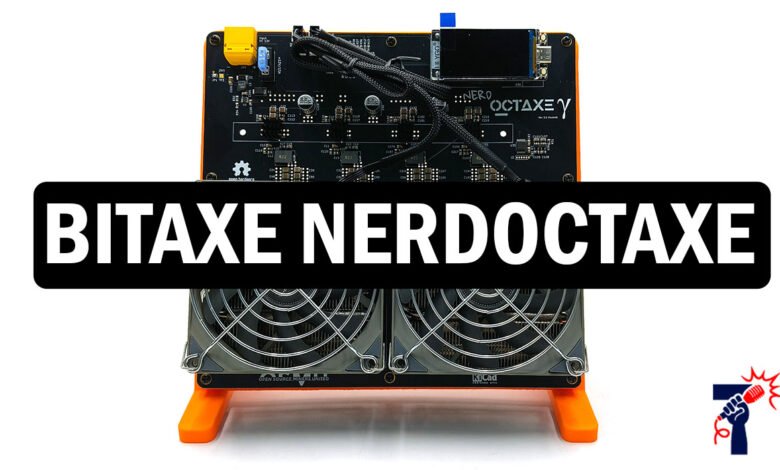
The Bitaxe NerdOctaxe is one of the most powerful open-source home Bitcoin miners available today. It gives regular people the ability to mine Bitcoin from their home or office without needing a large mining farm. If you have ever wanted to try solo Bitcoin mining but did not know where to start, the NerdOctaxe is a great place to look. This guide covers everything you need to know, from its specs and performance to setup tips and real solo mining results.
What Is the Bitaxe NerdOctaxe?
The NerdOctaxe was developed within the Open Source Miners United (OSMU) community, the same group of developers behind the Bitaxe and the entire Nerd-axe product family. This makes it a fully community-driven project, where all design files, schematics, and firmware are freely available on GitHub for anyone to use or improve.
The Bitaxe NerdOctaxe is an open-source SHA-256 algorithm miner designed for individuals and small hobbyists. It breaks the common idea that solo mining is only for professional mining farms, thanks to its balanced performance of high hashrate and low power consumption.
Key Specs at a Glance
Before diving deeper, here is a quick look at the main specifications of the standard NerdOctaxe:
| Spec | Details |
|---|---|
| Hashrate | 9.6 TH/s |
| Power Use | 160W |
| Chips | 8x BM1370 ASIC |
| Algorithm | SHA-256 |
| Connectivity | 2.4 GHz Wi-Fi |
| Display | OLED / LilyGo LCD |
| Firmware | AxeOS (open-source) |
The Bitaxe NerdOctaxe uses eight S21 Pro BM1370 ASIC chips, achieving a hash rate of 9.6 TH/s and a power consumption of 160W. These are the same chips used in industrial-grade Antminer S21 Pro machines, just packed into a compact home-friendly form.
Design and Build Quality
The NerdOctaxe is built to look good and work well on a desk. Eight high-performance S21 Pro BM1370 ASIC chips sit in a well-laid-out arrangement. A custom 3D-printed stand raises the unit to let air flow better. The front panel features an OLED display that shows up-to-the-minute mining stats like hashrate, temperatures, and IP address.
The open-source AxeOS software gives users full control of their mining operations. A smart design detail includes a standard 15 amp automotive fuse as a failsafe that is quick to replace if needed. This kind of thoughtful engineering makes the NerdOctaxe a great choice even for people who are new to hardware.
Cooling and Temperature Performance
Keeping an ASIC miner cool is very important for long-term performance. The NerdOctaxe handles this well. It uses dual low-profile 120x25mm cooling fans that keep air moving steadily across heat-generating parts. Real testing showed that ASIC temperatures stayed around 55 degrees Celsius while VRM temperatures held at 48 degrees Celsius.
The unit’s heatsinks sit on both ASIC chips and MOSFET sections to improve cooling. This reliable thermal setup helps maintain ideal temperatures during long mining sessions. For a home miner running 24 hours a day, these are very healthy numbers.
Power Supply and Connectivity
A 216W power supply comes with the NerdOctaxe, outputting 12V at 18 amps. The unit uses an XT30 connector, which creates a very secure connection that will not disconnect by accident during operation.
The NerdOctaxe has built-in Wi-Fi for seamless internet connectivity, supporting wireless setup and operation. Its compact size of 210x205x130mm makes it easy to place on a desk or carry around. Setup is simple and does not require any technical background.
How to Set Up the NerdOctaxe
Getting started with the NerdOctaxe is easier than most people expect. Connect the 12V power adapter to the miner’s power interface, then plug the other end into a suitable outlet. Once the screen shows information, setup can begin. The screen shows the miner’s network name, which you connect to using your phone or computer.
After a successful restart, reconnect to your 2.4 GHz network. In a web browser, enter the IP address shown on the miner’s LED screen and wait for the mining info interface to load. The top of the page shows real-time hashrate, efficiency, submitted shares, and mining difficulty. The whole process takes just a few minutes.
NerdOctaxe Rev 3.1: The Upgraded Version
If you want even more power, the newer revision is a big step up. The NerdOctaxe Rev 3.1 delivers up to 12 TH/s of hashrate. It features a new 6-phase VRM with TPS53667 controller for improved thermal stability and higher achievable frequencies. It also comes with an upgraded XT60 connector that supports higher power draw and safer long-term operation.
The Rev 3.1 is a fully open-source Bitcoin ASIC miner built with 8x BM1370 chips from the Antminer S21 Pro. It delivers up to 12 TH/s with high efficiency of around 15.8 W/TH, making it ideal for low-power Bitcoin solo mining at home. This revision is the best choice for people who want the highest performance the NerdOctaxe platform can offer.
Solo Mining: What Are Your Real Chances?
Solo mining means you mine Bitcoin on your own. If your miner finds a valid block, you keep the full reward. The NerdOctaxe runs the SHA-256 hashing algorithm and submits valid shares to solo mining pools like CKPool and Public Pool. If one of those shares meets the network difficulty target, the miner wins the full 3.125 BTC block reward.
Solo mining does not work on averages. It works on chance. Every hash is independent, so every second your miner runs, it has a real shot at the reward. Open-source mining hardware users have earned over one million dollars in aggregate block rewards, with verified wins from NerdQaxe++ clusters that are closely related to the NerdOctaxe. The odds are low, but the potential reward is very significant.
Electricity Cost and Efficiency
One of the best things about the NerdOctaxe is how little it costs to run daily. It draws only as much power as a gaming PC, which is very manageable at home. This means you can run it around the clock without worrying about a big increase in your electricity bill.
Running the NerdOctaxe at an average rate of $0.12 per kWh results in a very low monthly electricity cost. Even the most powerful models in the Bitaxe family cost just a few dollars per month to run. This makes it one of the most budget-friendly ways to participate in Bitcoin mining.
Who Should Buy the NerdOctaxe?
The NerdOctaxe is a good fit for a few types of people. For the serious solo miner who wants to maximize their lottery chances, the NerdOctaxe at 9.6 TH/s is one of the most powerful home miners available. Some enthusiasts even run multiple units in parallel to improve their odds further.
It is also great for people who love open-source technology. The Bitaxe is a fully transparent mining machine where you can customize the firmware, access advanced features, and be part of a growing community of developers and miners. Whether you are a hobbyist, a tech lover, or someone who just wants a small chance at a big Bitcoin reward, the NerdOctaxe is a solid choice.
Conclusion
The Bitaxe NerdOctaxe is a smart, compact, and energy-efficient Bitcoin miner built for home use. It delivers 9.6 TH/s using eight BM1370 ASIC chips, runs on just 160W of power, and connects easily over Wi-Fi. The open-source design means you always stay in control. While solo mining is never guaranteed to pay off, the NerdOctaxe gives you a real shot at the Bitcoin block reward with very low running costs. For anyone interested in home Bitcoin mining, it is one of the most exciting options available right now.
Frequently Asked Questions (FAQs)
1. What is the hashrate of the Bitaxe NerdOctaxe?
The standard NerdOctaxe delivers 9.6 TH/s. The newer Rev 3.1 version can reach up to 12 TH/s.
2. How much power does the NerdOctaxe use?
The standard model uses around 160W. The Rev 3.1 uses up to 200W depending on tuning and frequency settings.
3. Can a beginner set up the NerdOctaxe?
Yes. You just plug it in, connect it to your Wi-Fi, and use a web browser to configure your mining pool and wallet address. No technical skills are required.
See more amazing Information visit Fact News