Large language models can produce impressively fluent text, but “fluent” is not the same as “useful.” In real products—customer support bots, analytics assistants, content tools, or internal knowledge agents—you need output that is consistent, on-topic, and aligned with business rules. That is why controlling generation matters as much as model selection. If you are building practical skills in a gen AI course, understanding conditional generation and sampling strategies is one of the quickest ways to improve quality without changing the underlying model.
This article explains the two most common control levers: (1) conditioning the model with the right context and constraints, and (2) shaping randomness using top-k and top-p sampling. Together, they help you steer creativity and focus in a predictable way.
Why LLM Output “Drifts” Without Controls
Most modern LLMs generate text one token at a time. At each step, the model assigns probabilities to possible next tokens. If you always pick the single most probable token, responses can become repetitive or overly “safe.” If you allow too much randomness, responses may wander, invent details, or ignore instructions.
Output drift typically shows up as:
- Topic drift: the answer starts relevant, then shifts into unrelated commentary.
- Style drift: the tone changes mid-response (too casual, too salesy, too verbose).
- Constraint violation: the model ignores required structure, format, or boundaries.
- Creativity vs. accuracy imbalance: either bland responses or imaginative but incorrect ones.
To correct these, you can improve the model’s “direction” through conditional generation and tune its “randomness” through sampling.
Conditional Generation: Steering with Context, Examples, and Constraints
Conditional generation means you provide inputs that condition the output toward a goal—what to say, how to say it, and what not to say. In practice, conditioning is less about one magic prompt and more about layering signals.
1) Instruction hierarchy and role clarity
Most systems combine a system message (global rules), developer message (product rules), and user message (task). Keep instructions consistent and avoid conflicts. If you want a specific behaviour—like concise, structured answers—state it clearly and early.
2) Few-shot examples (show the shape of a good answer)
Examples reduce ambiguity. If you want a strict format (for instance, “Summary → Steps → Risks → Next actions”), provide a short example output. Few-shot prompting works especially well for classification, extraction, and templated content generation.
3) Structured output constraints
When your downstream system expects JSON, a table, or a checklist, explicitly define the schema:
- Required fields
- Allowed values
- How to handle missing data (“use null,” “use ‘unknown’,” etc.)
This is an effective technique in a gen AI course project because it highlights how reliability improves when the model cannot “free-write” its way out of your expectations.
4) Control tokens, tags, and separators
Even without special “control tokens,” you can create lightweight controls:
- Use tags like [STYLE: formal], [AUDIENCE: beginners]
- Add separators such as — to isolate context from the required response
- Use “Do/Don’t” lists to constrain behaviour
5) Retrieval and grounding as conditioning
If the task is factual, conditioning should include relevant source text (retrieval-augmented generation). When the model is grounded in the right passages, it is less likely to invent details and more likely to stay aligned to what you provided.
Sampling Controls: Top-k, Top-p, and Temperature in Plain Terms
Sampling decides how the model picks the next token from its probability distribution.
Temperature (randomness dial)
- Lower temperature (e.g., 0.1–0.4): more deterministic, less creative
- Higher temperature (e.g., 0.7–1.0): more diverse, more risk of drift
Temperature alone can be blunt. Top-k and top-p are sharper tools.
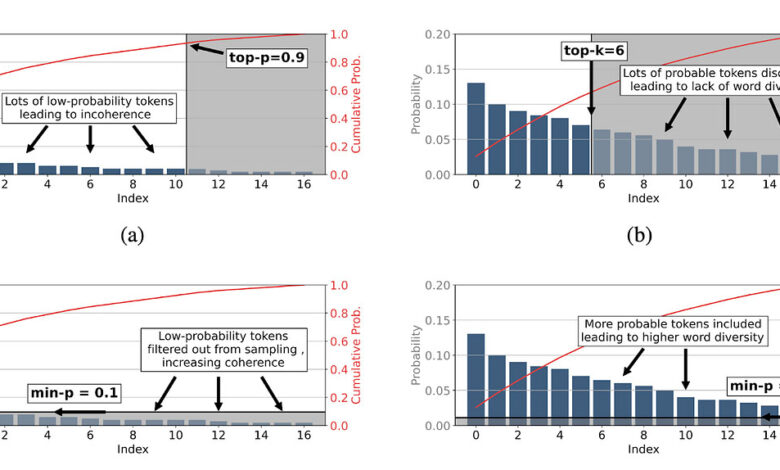
Top-k sampling (limit by count)
Top-k keeps only the k most likely tokens at each step, then samples from them.
- Example: top-k = 50 means “pick from the 50 most probable options.”
Pros: prevents extremely unlikely tokens from appearing.
Cons: a fixed k can be too restrictive in some contexts and too loose in others.
Top-p sampling (nucleus sampling, limit by probability mass)
Top-p keeps the smallest set of tokens whose cumulative probability is at least p.
- Example: top-p = 0.9 means “pick from the smallest set of tokens that together cover 90% probability.”
Pros: adapts to uncertainty. If the model is confident, the candidate set is small; if uncertain, it expands.
Cons: if set too high, creativity can become noise.
Practical parameter guidance
A simple starting point:
- Factual Q&A / summaries: temperature 0.2–0.4, top-p 0.8–0.9
- Brainstorming / ideation: temperature 0.7–0.9, top-p 0.9–0.95
- Balanced explainers: temperature 0.4–0.7, top-p 0.85–0.92
If you also use top-k, keep it moderate (e.g., 20–80). Avoid stacking extreme randomness (high temperature + very high top-p + high top-k) unless you explicitly want novelty.
Combining Both: A Repeatable “Control Stack” for Real Use Cases
The most reliable systems use multiple layers:
- Conditioning: clear instructions + schema + few-shot examples
- Sampling: temperature + top-p (and optionally top-k) tuned to the task
- Stop conditions: stop sequences to prevent rambling beyond scope
- Post-checks: validate format, enforce constraints, and rerun if needed
For instance, in a support chatbot, you might condition the model with policy rules and product documentation, set a lower temperature for consistency, and enforce a structured response with a final validation step. This is exactly the kind of end-to-end discipline that turns a gen AI course concept into production-ready output control.
Conclusion
Controlling generated output is not about eliminating creativity; it is about placing creativity where it helps and restricting it where it harms. Conditional generation steers the model with context, examples, and constraints. Top-k and top-p sampling shape how the model explores options, balancing diversity and reliability. When you combine these techniques with simple guardrails like schemas and stop sequences, you get responses that are clearer, safer, and easier to integrate into real systems—skills that matter in any applied gen AI course or practical LLM implementation.