Cooling Tower Freeze Protection: Avoiding Component Damage & Emergency Repairs

Think winterizing your cooling tower is just a simple checklist? Don’t be fooled. One tiny oversight, a stubborn valve, a partially drained pipe, or a hidden pocket of water is all it takes to trigger catastrophic failure. When water freezes, it expands by a powerful 9%, unleashing immense internal pressure.
The components of your cooling tower, from its fiberglass-reinforced polymer (FRP) structures to its steel pipes, are not designed to withstand this force. This expansion leads to cracks, deformations, and ruptures, resulting in costly failures that demand emergency Cooling Tower Repairs.
Proper Cooling Tower Freeze Protection is not just a seasonal chore; it is an essential engineering process. Understanding the physics of freeze damage is the first step in appreciating the critical nature of a thorough winterization protocol. This guide explores exactly how that happens and what you can do about it.
Table of Contents
- Introduction
- Component Catastrophe: Where Ice Causes the Most Damage
2.1 Critical Coil Damage in Closed-Circuit Towers
2.2 Basin and Sump Cracking in Open Towers
2.3 Piping, Spray Headers & Distribution System Failure - The Two Biggest Winterization Mistakes to Avoid
- Emergency Post-Thaw Response & Repair Process
4.1 The Critical Role of Comprehensive Diagnosis
4.2 Specialized Expertise for Effective Repairs - Conclusion
- FAQs
Component Catastrophe: Where Ice Causes the Most Damage
Ice does not discriminate. It will expand wherever water is present, but certain components are far more vulnerable and expensive to fix than others. The damage often remains hidden until the spring thaw, revealing itself through leaks, performance loss, or complete system failure. Knowing these failure points is crucial for both prevention and rapid diagnosis.
| Cooling Tower Component | Mechanism of Damage | Primary Impact |
| Cooling Coils | Internal ice expansion deforms or splits metal tubing. | Costly leaks and total system shutdown. |
| Basin / Sump | Ice expansion warps steel or cracks FRP walls. | Permanent structural leaks and wall failure. |
| Piping & Feed Lines | Pressure buildup ruptures pipe walls. | Burst pipes and massive water loss. |
| Spray Headers & Nozzles | Rapid freezing in small lines breaks components. | Clogged nozzles and poor water distribution. |
| Distribution System | Ice blockages disrupt spray patterns over fill. | Reduced heat transfer and system inefficiency. |
The Critical Coil Damage (Closed Circuit Towers)
What makes coil damage the most feared consequence of a failed winterization?
It’s costly to repair and can lead to significant downtime for your system. Proper winterization ensures your equipment stays protected, avoiding expensive replacements.
- High-Value Components: Coils are intricate and expensive, often constructed from galvanized or stainless steel. Their complex geometry makes them difficult to drain completely.
- Irreversible Damage: As ice expands inside the coil tubes, it exerts uniform pressure, causing the metal to deform, split, and crack. This damage is often irreparable.
- Operational Impact: A compromised coil immediately halts the tower’s function, leading to significant operational downtime.
The consequences of a frozen coil are severe. Replacement is a major undertaking that requires heavy machinery for lifting, specialized labor for installation, and often involves long lead times for the new component to arrive.
Basin and Sump Cracking (Open Towers)
The basin is the foundation of your tower, but it is highly susceptible to freeze damage, making cooling tower freeze protection essential. How does ice compromise this structural element? When water freezes, it expands with immense force. This expansion creates significant pressure against the basin walls.
- FRP Basins: When water freezes in the basin, the expanding ice pushes against the rigid fiberglass walls. This can cause everything from hairline fractures to large-scale cracks, leading to continuous and uncontrolled water leaks when the system restarts.
- Steel Basins: In steel basins, the immense pressure from ice can distort the metal, buckle panels, and compromise welded seams and joints. These deformations create leak paths that not only waste water and treatment chemicals but also accelerate corrosion at the compromised points.
Repairing a damaged basin is an intensive process. Depending on the material and the extent of the damage, repairs can include multi-layer FRP lamination, application of new waterproof coatings, or specialized welding and seam replacement.
Piping, Spray Headers, and Distribution System Failure
The water distribution system, located above the basin, is full of small-diameter pipes and nozzles that are difficult to drain fully. What happens when water freezes here? Water expands as it turns to ice. This expansion creates immense pressure within these confined spaces, leading to significant damage.
- Component Ruptures: Trapped water can easily crack PVC spray headers, rupture feed lines, and break individual spray nozzles.
- Performance Degradation: This damage severely disrupts the uniform distribution of water over the fill media. The result is “channeling,” where some areas of the fill receive too much water, and others receive none at all.
- System Inefficiency: This uneven flow leads to hot spots, a rapid loss of thermal performance, and puts the entire system under unnecessary strain upon startup.
The Two Biggest Winterization Mistakes
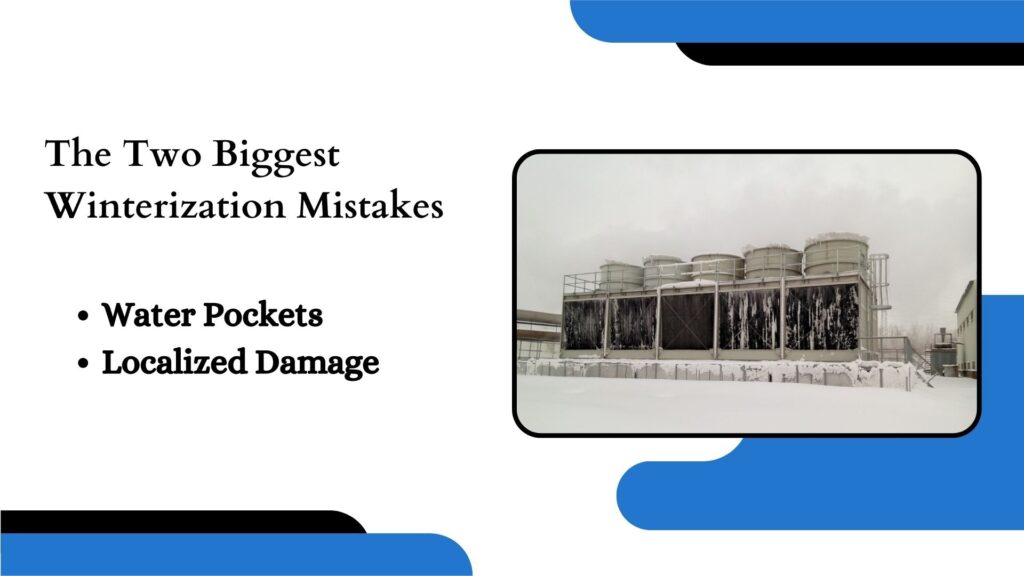
Most catastrophic freeze damage stems from human error. Two common mistakes account for the majority of failures that necessitate emergency cooling tower repairs.
The first major error is relying solely on manual draining. Simply opening drain valves is not enough to clear a complex system. Why does this method fail?
- Water Pockets: Low points in piping, undulations in coil tubes, and areas around valves can trap pockets of water.
- Localized Damage: Even a small amount of trapped water can freeze and cause a critical rupture in a coil or pipe section.
Solution:
- Go beyond manual draining to ensure a complete drain and avoid water pockets.
- After the initial gravity drain, purge the system with compressed air.
- This forces out all remaining water from low spots and coil tubes, preventing freezing and damage.
The second critical mistake involves towers that run intermittently or are only partially shut down. Insufficient heat tracing or a failure to maintain bypass flow is a recipe for disaster. According to industry standards for freeze protection, a minimum flow rate must be maintained to prevent water from stagnating and freezing.
The Emergency Post-Thaw Response and Repair Scope
What should you do when you discover signs of freeze damage after a thaw, such as the sound of running water, a rapidly dropping sump level, or visible external cracks? The first step is to shut the system down safely and resist the urge to start patching visible leaks.
The Critical Role of Comprehensive Diagnosis.
Before any repair, a comprehensive system assessment is mandatory. A simple visual inspection is insufficient; hidden cracks in coils and piping are common and can cause secondary failures if missed. Professional diagnosis involves pressure testing the coil and piping circuits and may include non-destructive testing (NDT) to identify stress fractures invisible to the naked eye.
Specialized Expertise for Effective Repairs
Winter freeze damage demands immediate, specialized expertise, extending far beyond typical maintenance. Tasks like repairing structural FRP cracks, replacing ruptured coil bundles, and welding compromised steel require specific certifications and tools. Engaging experts for comprehensive Tower Repairs is critical to minimize costly downtime and prevent permanent system degradation.
Conclusion
In summary, Cooling Tower Freeze Protection is essential to safeguard your equipment during harsh winter conditions. Freezing water can cause severe damage, from cracked FRP structures to coil failure, leading to costly repairs and unexpected downtime. Proper winterization is the best way to avoid these risks and ensure your cooling system remains reliable year-round.
Whether you’re planning with a certified winterization protocol or addressing freeze damage through critical repairs, effective cooling tower freeze protection is a must. Investing in preparation now will save you from expensive repairs and disruptions later. Don’t wait, secure your system’s integrity before the next freeze hits.
Frequently Asked Questions
Why do cooling towers freeze in winter?
Cooling towers freeze when water becomes stagnant in coils, basins, or pipes due to low flow, poor drainage, or cold temperatures. Even a small amount of trapped water expands as it freezes, causing cracks and ruptures
What damage can frozen cooling towers cause?
Freeze damage can crack coils, burst pipes, deform FRP basins, damage spray headers, and create severe leaks. These failures often require emergency repairs and cause major system downtime.
Do all cooling towers need basin heaters?
Any tower operating in sub-zero climates should have basin heaters. They keep water warm enough to prevent ice formation, especially during low-load hours or overnight temperature drops.
What is the biggest mistake in cooling tower winterization?
Relying only on manual draining. Gravity draining leaves water pockets behind. Always purge the system with compressed air to eliminate hidden water in coils and piping.