The AI Talking Avatar Generator That’s Quietly Replacing Traditional Video Production

There’s a specific moment every content creator, marketer, and educator recognizes: you have exactly what you want to say, a clear script, a defined audience — and then the production wall hits. Someone needs to be on camera. Or you need to hire someone. Or you need a studio. Or all three.
This is where most video ideas die. Not for lack of content, but for lack of infrastructure.
The AI talking avatar generator exists to remove that wall entirely. No actors. No filming. No editing timeline that stretches across weeks. Just a script, a character, and a finished video.
What an AI Talking Avatar Generator Actually Produces
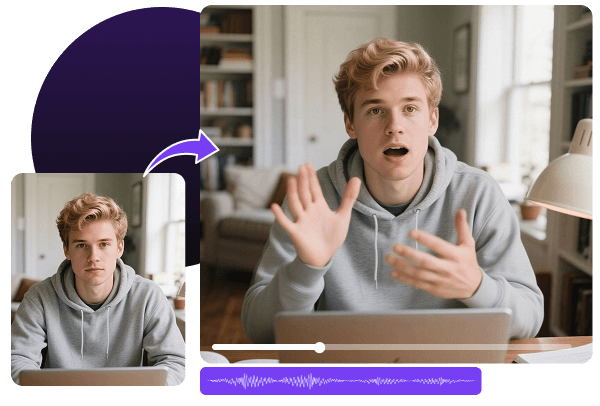
An AI talking avatar generator takes a static image — a photo, an illustration, a custom-designed character — and animates it to speak your script with synchronized lip movement, natural facial expression, and a realistic voice. The output is video: a character that appears to be genuinely speaking, in a format ready for social platforms, learning management systems, corporate intranets, or ad networks.
The key word is “appears.” Done well, viewers don’t spend time questioning whether the presenter is real. They watch the content. That perceptual threshold — where the avatar stops being a novelty and becomes a functional presenter — is what separates useful AI video tools from impressive demos.
A well-executed AI talking avatar generator reaches that threshold by solving three specific problems simultaneously: lip sync that matches audio at the phoneme level, voice quality that sounds like delivery rather than dictation, and visual consistency that holds up across the full length of the video.
Who Uses an AI Talking Avatar Generator — and What They’re Solving
The E-Learning Developer Under a Constant Deadline
An instructional designer at a mid-sized company produces compliance training videos on a rolling schedule — new regulations, updated policies, onboarding modules for new hires. Each module needs a presenter. Under the old system, that meant booking studio time, scheduling the company’s designated on-camera spokesperson, editing the footage, and syncing it with slide content. A single 8-minute module took two to three weeks from script to delivery.
After switching to an AI talking avatar workflow, the same module takes two to three days. The avatar is consistent across every module — same face, same voice, same visual register — which gives the training library a professional coherence it lacked when different human presenters recorded at different times. Learner completion rates improved, in part because the content moved faster and felt more intentional.
This scenario is common in L&D. The production bottleneck in corporate training isn’t content — organizations have subject matter experts. It’s the gap between knowing what to teach and having the production capacity to deliver it at scale.
The Marketing Team Running Multilingual Campaigns
A consumer electronics brand wanted to localize product explainer videos for seven regional markets — each needing a presenter delivering content in the local language, at the right pace, with the appropriate cultural register. Hiring local talent for each market and coordinating seven separate shoots was neither fast enough nor affordable enough for the campaign timeline.
Using an AI talking avatar platform with multilingual voice support, the team produced seven localized versions of each video from a single visual asset. The avatar’s visual identity stayed consistent across all markets — the script and voice changed, but the character remained the same recognizable face. Localization time dropped from weeks to days.
The ability to generate talking avatar videos across multiple languages from a single production workflow is increasingly the deciding factor for global marketing teams. It’s not about cutting corners — it’s about making global reach operationally feasible for teams that aren’t running a broadcast operation.
The Independent Creator Who Stays Off Camera
A financial education creator built a YouTube channel around investing concepts for young professionals. The content was well-researched and clearly written. The problem: she wasn’t comfortable on camera, and her attempts at on-screen recording consumed enormous time and produced results she wasn’t satisfied with.
She began using an AI talking avatar to deliver her scripts — a consistent virtual presenter with a professional appearance and a voice matched to her content’s tone. Her upload frequency doubled. Watch time per video increased because the pacing was tighter and the visual quality was consistent. The channel grew.
This use case is underappreciated. The assumption in content creation is that audiences want to see the real person behind the content. That’s true for some formats — personal vlogs, community-driven channels, creator brands built on personality. But for informational content, what viewers actually want is clarity and production quality. A well-executed talking avatar provides both, without requiring the creator to sacrifice their time or their comfort to achieve it.
The Technical Qualities That Make a Talking Avatar Generator Worth Using
Not all AI avatar tools produce the same output. Understanding what drives quality helps explain why results vary so significantly across platforms — and what to look for when the stakes are higher than a casual social post.
Lip Synchronization That Survives Close Viewing
Social video is consumed on mobile screens at close range, often with full attention. Any misalignment between mouth movement and audio is immediately visible — and once a viewer notices it, they can’t stop noticing it. Quality lip sync requires frame-level alignment between the audio signal and facial animation, with each phoneme mapped to the corresponding mouth shape.
When this is executed correctly, viewers stop looking at the mouth. They look at the eyes, the expression, the content — which is exactly what you want. The synchronization becomes invisible, and the character becomes a presenter.
Voice Quality That Sounds Like a Person, Not a Reader
The voice layer determines whether the avatar feels like a presenter or a text-to-speech demonstration. Natural-sounding delivery requires more than accurate pronunciation — it requires pacing variation, appropriate emphasis, and the subtle rhythmic patterns that signal a speaker who understands what they’re saying.
Access to a wide range of voice options matters here. A corporate training module and a product launch video for a youth brand require fundamentally different vocal registers. Platforms like LipSync Video support 300+ AI voices across styles, languages, and tones — which means the voice can actually match the content’s context rather than being a compromise.
Character Consistency Across Content
For channels and ongoing series, the avatar needs to look the same in every video. Character drift — subtle shifts in appearance from one generation to the next — breaks the brand coherence that makes a consistent presenter valuable. The best tools maintain stable visual identity across all outputs, which makes the avatar a reliable asset rather than a variable you have to manage.
A Note on Where This Fits
AI talking avatars work best as a production layer, not a brand identity shortcut. The strongest content strategies using this technology treat the avatar as a consistent, controllable presenter — one that handles the camera-facing work while the human team focuses on what they do best: research, scripting, strategy, and audience understanding.
The technology has reached a point where the output, in most viewing contexts, is indistinguishable from traditionally produced video. What that means practically is that the barrier between having something to say and saying it professionally — on video, at scale, in multiple languages — has effectively been removed.
Explore what’s possible with the talking avatar AI at LipSync Video — from uploading your first photo to producing campaign-ready video at scale.