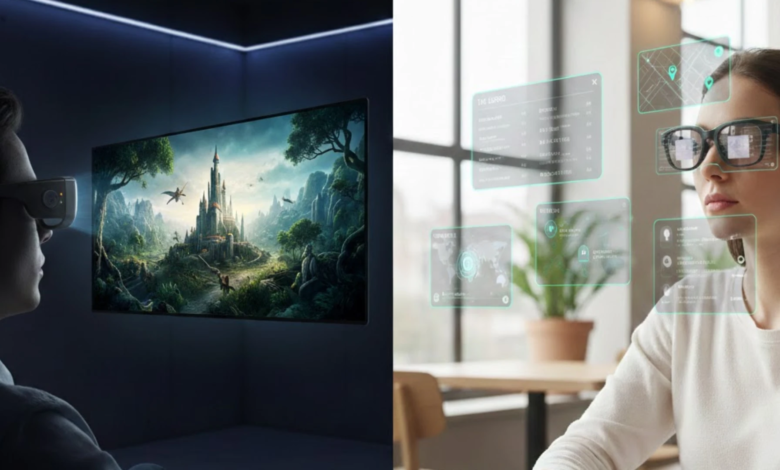
The display-class AR glasses market in 2026 has matured fast. HDR support, branded audio partnerships, and lighter frames now separate the top tier from the rest. Choosing the best AR glasses means weighing real specs across both productivity and entertainment use cases.
To identify the best performers in this rapidly evolving space, we cross-referenced technical specifications with expert insights from Tom’s Guide, The Verge, and ZDNET. By balancing official data with documented user experiences, we’ve built a guide that prioritizes real-world performance over paper-thin promises.
Here, we break down verified specifications, highlight where each model leads or falls short, and name our top picks for work, gaming, and travel.
What Shifted This Year
Two hardware developments define this generation and reshape which pairs deserve consideration among the best AR glasses 2026 has delivered. Both changes affect display technology and audio quality in ways previous generations did not meaningfully address.
HDR Arrives in Wearables
The RayNeo Air 4 Pro is, per the manufacturer, the first display-class AR glasses to support HDR10. Its Vision 4000 chip handles real-time SDR-to-HDR upscaling with a stated color depth of 10-bit and ΔE below 2. Standard display glasses still ship with SDR panels. The difference in shadow detail and color range is consistently noted in early third-party reviews.
The Audio Arms Race
Audio now helps determine which pairs rank among the best AR glasses for daily use. RayNeo partnered with Bang & Olufsen on quad-speaker tuning. Xreal tapped Bose for spatial audio with dedicated noise-cancellation algorithms. Viture chose Harman. Each collaboration produces a distinct sound profile that shapes extended sessions.
How We Evaluated
We compared each model using six criteria drawn from published reviews, official spec sheets, and documented user feedback. Cross-referencing multiple sources remains the most reliable way to identify the best AR glasses in a fast-moving category like this one.
- Display quality — brightness, contrast, HDR support, color accuracy
- Comfort and weight distribution over sessions of two hours or more
- Audio output, directional leakage, and spatial separation
- Gaming compatibility with Steam Deck, Switch 2, and ROG Ally
- Productivity — screen mirroring, virtual desktop, text readability
- Value relative to street price
Each criterion carried equal weight. No single spec — brightness, weight, or brand prestige — was allowed to override poor marks elsewhere. The model that scored most consistently across all six areas earned our top pick in its category.
Best AR Glasses 2026: Top Picks
We focused on three current display-first models and compared them across identical criteria. Meta Ray-Bans 2 and Even Realities G1 serve different purposes — lifestyle camera and text HUD — so they fall outside this display-focused comparison. All three compete within the best AR glasses 2026 display category.
RayNeo Air 4 Pro
RayNeo positions this as the HDR value leader. The HDR10-capable panel driven by the Vision 4000 chip offers wider color range than SDR competitors. Bang & Olufsen co-tuned the quad-speaker array; the manufacturer states roughly 80 percent reduced sound loss with the optional Sound Tube accessory. At 76 grams with a 46.7:53.3 weight ratio, published reviews note comfort over multi-hour sessions.
Xreal 1S
Tom’s Guide currently ranks the 1S as the top overall AR glasses pick. Its X1 chip enables stable 3DoF with Anchor Mode, locking the virtual screen in space as you move. Real 3D conversion, adaptive transparency dimming, and Bose-tuned spatial audio round out a mature feature set. It weighs 82 grams and lacks built-in diopter adjustment.
Viture Luma Pro
Viture’s current flagship ships at $499 with a 152-inch virtual screen at 1200p resolution and 1000-nit peak brightness. Built-in myopia dials go to negative 4.0D, removing the need for prescription inserts. Electrochromic film lenses offer adjustable transparency. Audio uses Harman tuning. SGS A+ eye care certification covers flicker and blue light.
Specs at a Glance
The table below lists manufacturer-stated specifications. Virtual screen sizes use each brand’s own measurement methodology and perceived viewing distance, so direct cross-brand comparison of those figures requires caution.
| Feature | RayNeo Air 4 Pro | Xreal 1S | Viture Luma Pro |
|---|---|---|---|
| Weight | 76g | 82g | 79g (Regular) |
| Virtual Screen | 201″ (brand-stated) | 500″ (brand-stated) | 152″ at 4m |
| Resolution | 1080p per eye | 1200p | 1200p |
| Refresh Rate | 120Hz | 120Hz | 120Hz |
| HDR10 | √ | × | × |
| Audio Partner | Bang & Olufsen | Bose | Harman |
| 3DoF Spatial | × | √ (X1 chip) | √ (SpaceWalker) |
| Myopia Support | Magnetic Rx frame | Rx lenses (separate) | Built-in dials (-4.0D) |
| Eye Protection | 3840Hz PWM, TÜV SÜD | Adaptive transparency | SGS A+ certified |
Real-World Use Cases
Specs tell only part of the story. Published reviews and documented user experiences reveal how each model handles the three most common daily scenarios. Below, we summarize findings from third-party sources and manufacturer documentation.
- Desk productivity with screen mirroring
- Handheld gaming via Steam Deck
- Movie streaming during flights
At the Desk
For productivity, the best AR glasses need sharp text and low eye strain over extended periods. The RayNeo Air 4 Pro’s 3840Hz PWM dimming and TÜV SÜD certification address flicker concerns. The Xreal 1S provides stable 3DoF Anchor Mode, which pins virtual screens in place — a notable advantage for multi-window workflows reviewers have highlighted.
Gaming on Steam Deck
All three connect to Steam Deck via USB-C. For Switch 2, no current AR glasses offer single-cable connection — RayNeo requires its $89 JoyDock, and Viture requires its Pro Mobile Dock. The Air 4 Pro’s HDR10 upscaling likely benefits dark-scene games with stronger shadow detail. Xreal’s Bose speakers and low-latency X1 processing may suit fast-paced titles.
Streaming Movies in Transit
For portable cinema, the best AR glasses need strong contrast and sound privacy. RayNeo’s HDR10 panel and AI-based 2D-to-3D conversion offer a cinema-oriented feature set. Viture’s electrochromic lenses block nearly all ambient light for deeper immersion. Xreal’s adaptive transparency auto-dims when content plays, then clears when you glance away.
Which Pair Fits Your Routine
Each model leads in a different area. The best AR glasses should match your primary use case, not just headline specs. These three priorities, weighed against your daily habits, point toward the right choice:
- HDR display quality and cinematic audio for streaming and movies
- Spatial stability and build quality for gaming and productivity
- Lens customization and portability for travel and convenience
Best AR Glasses for HDR Entertainment
The RayNeo Air 4 Pro leads on display technology. It is currently the only display-class pair with HDR10 support, and its B&O audio partnership targets cinema-quality sound. Tom’s Guide categorizes it as the best value pick in this segment, and its lower price point reinforces that positioning for buyers who prioritize visual quality per dollar.
For Spatial Features and Build Quality
The Xreal 1S offers the most mature spatial feature set, including 3DoF Anchor Mode, Real 3D conversion, and adaptive transparency. Bose-tuned audio and refined metal hardware earn it top overall marks from multiple publications. Users who value screen stability during movement and premium build may find the 1S the strongest all-around option.
Final Verdict
The best AR glasses 2026 has produced serve distinct priorities. For HDR entertainment and value, the RayNeo Air 4 Pro offers features no competitor currently matches at its price. For spatial stability and polished hardware, the Xreal 1S leads.
Viture Luma Pro fills a strong niche for travelers who want built-in myopia correction and electrochromic immersion control. Choosing the best AR glasses comes down to which strengths align with how you actually spend your screen time.
READ ALSO: Data-Driven Estimation: The Key to Smarter Construction Projects