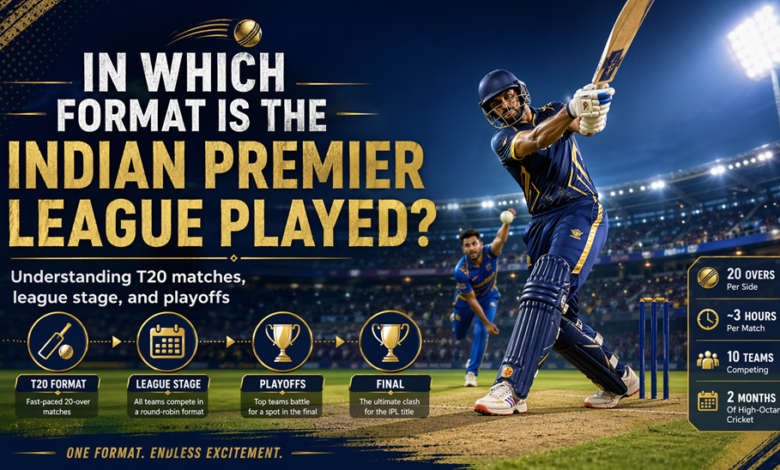
The short answer is simple. The Indian Premier League is played in the T20 format, which means each match has one innings per side and a maximum of 20 overs for each team. The tournament as a whole uses a league stage plus playoffs structure rather than a straight knockout bracket.
That distinction matters. Many new fans ask about the “format” of IPL and mean only the match format. In practice, IPL has two layers: the rules of each match, and the way the full season is organized from opening fixture to final.
For many cricket fans exploring the tournament for the first time—especially those coming from platforms like ipl satta app where match insights and stats are widely discussed—the Indian Premier League format can seem slightly confusing at first glance.
IPL 2026 follows the same broad model. The official season schedule and playoffs pages show a 70-match league stage, followed by the four-match playoff ladder of Qualifier 1, Eliminator, Qualifier 2, and Final.
IPL Format in One Clear Answer
If you want one clear sentence, it is this: IPL is a franchise T20 cricket league. Every game is a T20 match, but the championship is decided across a season table and then a playoff phase.
That is why two explanations are needed. One answer explains what happens on the field in a single match. The other explains how teams move through the season, collect points, and qualify for the last four.
What T20 Format Means in IPL Matches
In official IPL match playing conditions, “all matches will consist of one innings per side,” and each innings is “limited to a maximum of 20 overs.” If a side is bowled out earlier, its innings ends before the full 20 overs.
An over in IPL still means six legal balls. So, in a standard uninterrupted match, each team can face up to 120 legal deliveries. That is what makes T20 much faster than ODI cricket and far shorter than Test cricket.
The first six overs of each innings are the Powerplay. During that phase, no more than two fielders are allowed outside the fielding restriction area. After the Powerplay, that limit rises to five fielders outside the circle.
If a match is tied, IPL uses a Super Over. The 2026 playing conditions say that if the Super Over is also tied, further Super Overs are played until a winner is determined, subject to time and weather limits.
Key Match Rules New Fans Should Know
- Each side gets one innings.
- Each innings can last up to 20 overs.
- One over contains six legal balls.
- The first six overs are the Powerplay.
- A tied match goes to a Super Over if conditions allow.
- If a team is all out early, it does not keep batting to 20 overs.
IPL Match Format vs Tournament Format
The easiest way to avoid confusion is to separate the two meanings of “format.” The table below does that directly, using the official match rules and the official season structure pages.
| Element | Match Format | Tournament Format | Why It Matters |
| Basic type | T20 cricket | Franchise league season | Fans often confuse these two levels |
| Innings | One per side | Many matches across the season | A match answer is not the same as a season answer |
| Overs | 20 overs per team | Not relevant to the whole table | Overs explain pace, not qualification |
| Result | Win, loss, tie, no result | Points table plus playoffs | Season success depends on standings |
| End stage | Match ends after result or Super Over | Season ends with playoffs and final | The champion is decided after the table phase |
That is the core idea of the article. IPL is not only “short-format cricket.” It is short-format cricket inside a larger league-and-playoffs system.
How the IPL 2026 Season Is Structured
The official IPL 2026 schedule confirms a 70-match league stage. The BCCI first announced the opening 20 matches, then the remaining 50 league games, which together complete the regular season before the playoffs begin.
Ten franchises compete in that league stage. Each team plays across the schedule, builds points, and tries to finish in the top four. The official points table and playoffs pages then track how the season moves from league fixtures to the last-four stage.
This is where IPL feels different from a bilateral T20 series. A bilateral series is just a set of matches between two sides. IPL is a season-long competition in which teams rise or fall through a table before the knockout phase begins.
From League Stage to Final
- Teams play the league stage.
- Results earn points on the table.
- The top four teams move into the playoffs.
- The playoff ladder uses Qualifier 1, Eliminator, Qualifier 2, and Final.
- The winner of the final becomes IPL champion.
How Teams Qualify for the Playoffs
IPL awards 2 points for a win. A tied match or no-result match gives 1 point to each team if a Super Over cannot be completed, and a loss gives 0. The official playing conditions set out that system clearly.
When teams finish level on points, the first tiebreaker is the number of wins. If teams are still level, the next tiebreaker is net run rate. If they are still level after that, the higher number of wickets taken per fair balls bowled is used, and if equality still remains, lots are drawn.
That explains why league matches late in the season can matter even for teams with similar records. A side is not judged only by wins and losses. Margin and run rate can change the final table position as well.
Expert Tip 1: When someone asks about IPL format, answer in two parts: “T20 match rules” first, then “league table plus playoffs” second.
How IPL 2026 Progresses from League Stage to Final
The playoff names can sound technical at first, but the structure is easier once you read it as a path. The official playoffs page for 2026 already lists the four stages, while official IPL playoff articles explain how Qualifier 2 connects the loser of Qualifier 1 and the winner of the Eliminator.
| Stage | What Happens | Number of Teams | Outcome |
| League Stage | Teams play regular-season fixtures | 10 | Top four qualify |
| Qualifier 1 | First playoff match | 2 | Winner reaches Final |
| Eliminator | Knockout playoff match | 2 | Loser is out |
| Qualifier 2 | Loser of Qualifier 1 plays winner of Eliminator | 2 | Winner reaches Final |
| Final | Title match | 2 | Champion is decided |
If a playoff match is tied or ends in no result, the 2026 playing conditions call for a Super Over. If conditions do not allow the Super Over process to be completed, the team that finished higher in the regular-season table advances.
At this stage of the tournament, many fans also track odds and match lines, especially during high-stakes games like Qualifier 1 or the Final. For those interested in detailed match markets, you can explore live lines here: https://indian.1xbet.com/en/line/cricket/2542291-indian-premier-league
Rajasthan Royals in IPL 2026 as a Format Example
Rajasthan Royals are a useful example because they show how one franchise fits into the same league system as every other team. The official RR team page for 2026 lists the franchise in the tournament, along with its squad hub, fixtures, results, captain Riyan Parag, and coach Kumar Sangakkara.
So if someone searches for the IPL 2026 Rajasthan Royals team, the format answer does not change. RR still play T20 matches. They still collect points through the same league table. They still need a top-four finish to reach the playoff ladder.
This example helps because it keeps the article practical. Format is not an abstract rulebook. It shapes how fans follow one team across a full season.
What Fans Usually Get Wrong About IPL Format
The most common confusion is simple. People say “format” and mean three different things at once.
Here are the mistakes that come up most often:
- Thinking IPL format only means “20 overs.”
- Forgetting that the season also has a points table.
- Mixing up league stage and playoffs.
- Assuming the final comes right after league matches.
- Missing the role of net run rate in close qualification races.
Another common mistake is treating IPL as just a shorter version of cricket without its own competitive architecture. In reality, the match format is short, but the tournament design is layered and strategic.
The Devil’s Advocate: “Is IPL Just a Shorter Version of Cricket?”
That argument is partly true and partly misleading. It is true because every IPL match is a T20 match, so yes, the on-field format is the shortest major international-style format used in top franchise cricket.
It is misleading because IPL is not only a short match. It is also a season system with standings, qualification pressure, tiebreak rules, and a playoff bracket. That full structure changes how teams build squads, manage form, and target positions on the table.
So the best answer is balanced. IPL is a short-format match product and a complex season product at the same time.
Expert Tip 2: When you want the most reliable IPL format details, check the official playing conditions, fixtures page, points table, and playoffs page together.
FAQ
Is IPL played in T20 or ODI format?
IPL is played in T20 format. Official 2026 match conditions say each match has one innings per side, with each innings capped at 20 overs.
How many overs are there in one IPL match?
Each team can bat for up to 20 overs, so a standard uninterrupted IPL match has up to 40 overs in total, split into two innings.
How does a team reach the IPL final?
A team first has to finish in the top four of the league stage. After that, the playoffs use Qualifier 1, Eliminator, Qualifier 2, and Final. The winner of Qualifier 1 reaches the Final directly, while the winner of Qualifier 2 takes the second spot.
What happens if IPL teams finish level on points?
The official rules say teams are first separated by number of wins, then by net run rate, then by wickets taken per fair balls bowled, and finally by lots if still equal.
What is the Powerplay in IPL?
The Powerplay is the first six overs of each innings. During those overs, no more than two fielders can be outside the fielding restriction area at the moment of delivery.
See more amazing Information visit Fact News