Reflow Oven Selection Guide for EMS Companies: Key Factors for Quality and Efficiency

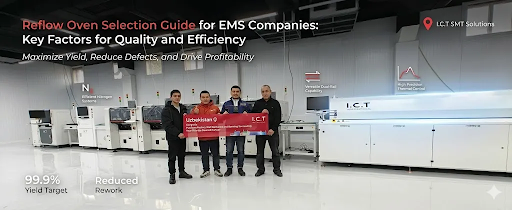
In the fast-paced world of Electronics Manufacturing Services (EMS), companies are under constant pressure to deliver flawless PCB assemblies—ensuring quality, maximizing yield, and minimizing defects—while maintaining tight control over costs and production efficiency. But amidst these challenges, one often-overlooked factor can make all the difference: the reflow oven. The right reflow oven doesn’t just affect soldering quality; it plays a pivotal role in enhancing yield rates, improving operational efficiency, and boosting long-term profitability. Whether it’s a standard air reflow oven, a high-precision nitrogen system, or a versatile dual-rail model, the choice of reflow oven can either streamline your operations or lead to costly defects and inefficiencies.
As leaders in the SMT line machine sector, companies like I.C.T. specialize in providing top-tier reflow ovens designed to help manufacturers not only meet industry standards but exceed them. In this guide, we’ll explore how EMS companies can select the right reflow oven to achieve reliable results, reduce operational headaches, and ultimately, drive business success. Let’s dive into the key factors you need to consider when making this critical investment.
1. Understanding Reflow Ovens in EMS Production
1.1 How Reflow Ovens Work to Achieve Reliable Solder Joints
Reflow ovens play a central role in surface mount technology by melting solder paste to create strong electrical and mechanical connections between components and the PCB. The process follows a carefully controlled temperature profile with four main stages: preheat, soak, reflow (peak), and cooling.
1.2 Air Reflow vs. Nitrogen Reflow: Impact on Soldering Quality
Traditional air reflow ovens use normal atmosphere, which is cost-effective but allows oxygen to cause oxidation on hot surfaces. This results in poorer wetting, duller joints, and higher rates of defects such as voids and non-wetting.
2. Matching Reflow Ovens to Production Scale and Volume
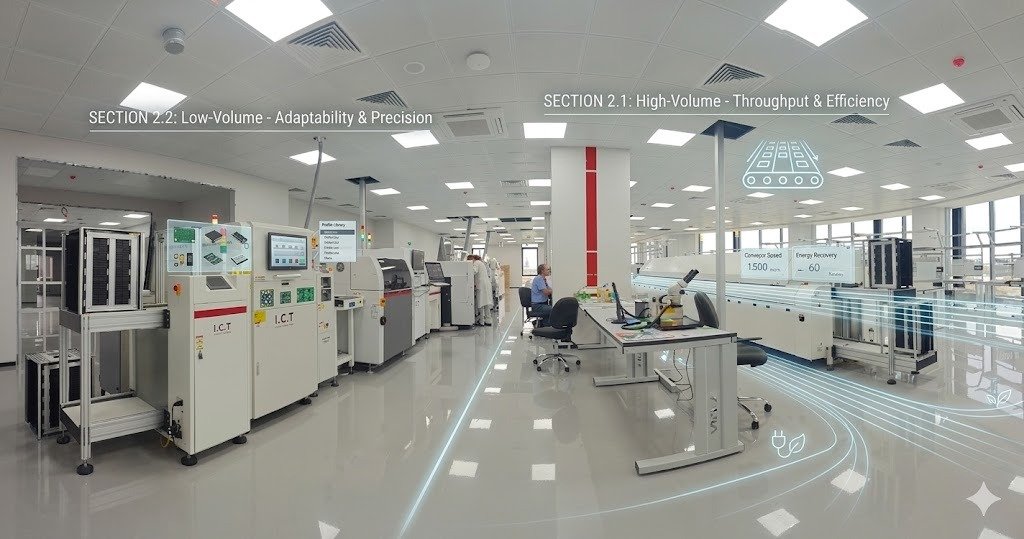
2.1 High-Volume Lines: Optimizing for Throughput and Efficiency
High-volume EMS operations need reflow ovens that deliver consistent performance at high speed. Longer ovens with 8–12 or more heating zones allow precise profile control and support faster conveyor speeds without sacrificing temperature uniformity. Features such as wide conveyors, advanced reflow oven solutions, and rapid thermal recovery help maintain high throughput while controlling energy use.
2.2 Low-Volume and Flexible Production: Focusing on Adaptability and Precision
Many EMS companies handle mixed or smaller batches, including prototypes and custom orders. In these cases, flexibility matters more than maximum speed. Shorter ovens with 6–10 zones offer quick profile changes and handle varied board sizes and component mixes effectively.
3. Key Technical Features for Optimal Soldering Performance
3.1 Temperature Control Precision and Profile Flexibility
Precise temperature control forms the foundation of defect-free soldering. Modern reflow ovens use multiple independently controlled zones, advanced sensors, and PID algorithms to keep temperature variation across the board very low — often under 5°C even on densely populated assemblies.
3.2 Energy Efficiency and Environmental Compliance
Energy consumption is a major operating expense for reflow ovens. High-quality insulation, heat recovery systems, and intelligent standby modes can reduce power use by 20–40% compared with older models. These features also help EMS companies meet tightening environmental regulations while lowering monthly utility costs.
4. Evaluating Long-Term Costs and Maintenance
4.1 Initial Investment vs. Total Cost of Ownership
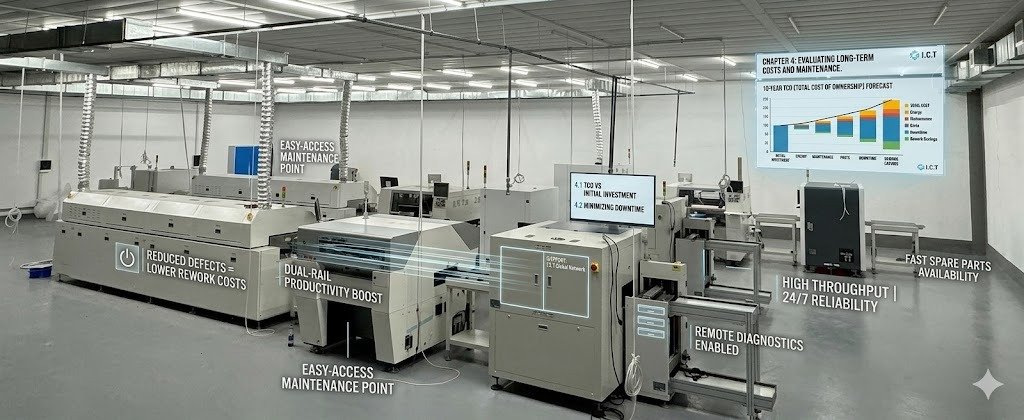
The purchase price is only the starting point. Total cost of ownership includes energy, maintenance, spare parts, downtime, and potential savings from reduced defects and rework. A higher-quality oven with better efficiency and reliability frequently delivers a much lower overall cost over 5–10 years of service.
4.2 Minimizing Downtime and Maximizing After-Sales Support
Unplanned stoppages in an SMT line are extremely expensive. Ovens backed by strong global service networks, fast spare parts availability, and remote diagnostics minimize disruptions. Professional installation, operator training, and extended warranties add significant long-term value.
5. Solving Common EMS Pain Points with the Right Reflow Oven
5.1 Reducing Common Defects (Voids, Bridging, Tombstoning)
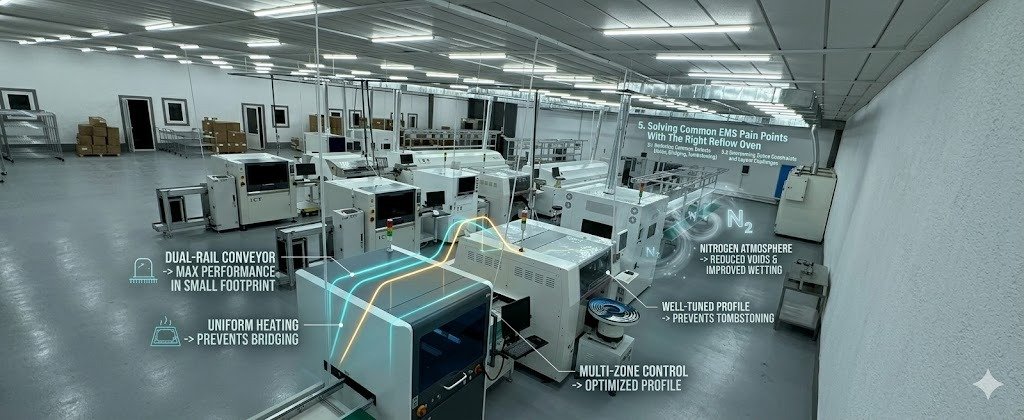
Defects such as voids in BGAs, solder bridging, and tombstoning on small components increase rework costs and damage customer trust. Excellent multi-zone control combined with nitrogen atmosphere directly addresses these issues by improving wetting and reducing oxidation. Uniform heating and well-tuned profiles prevent tombstoning and bridging, while nitrogen helps gases escape more easily during reflow, lowering void rates.
5.2 Overcoming Space Constraints and Layout Challenges
Factory floor space is often at a premium. Compact yet powerful reflow ovens with optimized zoning or dual-rail designs deliver full performance in smaller footprints. Flexible conveyor systems allow EMS companies to integrate advanced soldering capability without major line reconfiguration.
6. Summary of Key Points for Informed Reflow Oven Selection
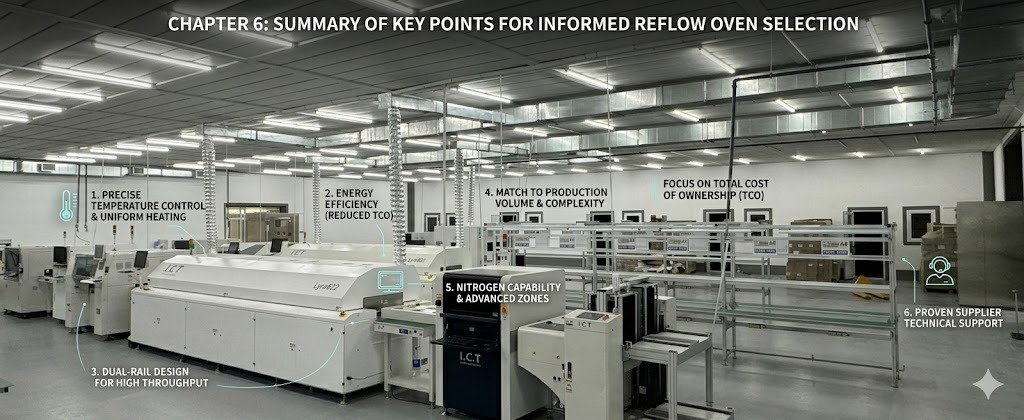
Choosing the right reflow oven is one of the most important decisions an EMS company makes. Success depends on matching the oven to production volume, board complexity, quality requirements, and long-term economics. Prioritize precise temperature control, uniform heating, energy efficiency, nitrogen capability when needed, and features such as dual-rail design. Focus on total cost of ownership rather than just purchase price, and select suppliers with proven technical support. The right reflow oven reduces defects, increases throughput, lowers operating costs, and positions the business for future growth in a demanding market.