

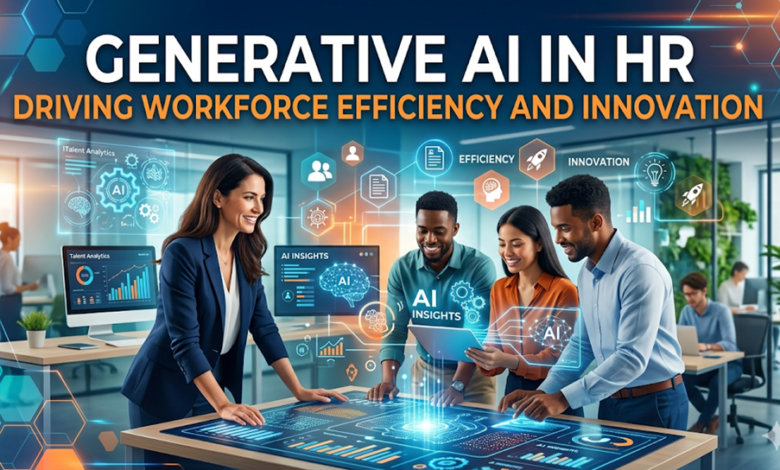
Organizations are under increasing pressure to modernize human resources while improving employee experience and controlling costs. As HR functions evolve from administrative support to strategic enablers, generative AI is emerging as a powerful tool to transform how HR operates, delivers insights and supports business outcomes.
Rather than simply automating tasks, generative AI enhances decision-making, accelerates talent processes and enables HR teams to focus on high-value initiatives such as workforce planning and employee engagement. Many organizations are now exploring how to scale these capabilities through structured adoption and expert-led generative AI consultancy support to ensure measurable impact.
Overview of generative AI in HR
Generative AI refers to advanced AI models that can create content, generate insights and automate knowledge-based tasks. In HR, these capabilities are applied across the employee lifecycle, from recruitment and onboarding to performance management and workforce analytics.
Public insights from The Hackett Group® indicate that leading organizations are leveraging generative AI to improve HR efficiency, reduce manual workloads and enhance service delivery. These tools enable HR teams to process large volumes of employee data, generate reports and provide real-time recommendations.
At a functional level, generative AI in HR can:
- Draft job descriptions and candidate communications
- Summarize employee feedback and survey data
- Generate performance reviews and development plans
- Assist in policy creation and compliance documentation
- Provide conversational support through HR chatbots
The adoption of generative AI in HR is most effective when integrated with HR systems, data governance frameworks and broader enterprise strategies. Organizations that align AI initiatives with business priorities are more likely to achieve sustainable results.
Benefits of generative AI in HR
Increased productivity and operational efficiency
Generative AI significantly reduces the time spent on repetitive administrative tasks. HR teams can automate document creation, candidate communication and reporting processes, allowing them to focus on strategic initiatives.
This shift improves overall efficiency and enables HR professionals to deliver greater value to the organization.
Enhanced employee experience
AI-powered tools can provide employees with instant access to information related to policies, benefits and career development. Conversational assistants offer personalized responses, improving accessibility and responsiveness.
A more responsive HR function contributes to higher employee satisfaction and engagement.
Improved talent acquisition outcomes
Generative AI helps streamline recruitment by generating job descriptions, screening resumes and drafting interview questions. It can also analyze candidate data to identify the best fit for specific roles.
This leads to faster hiring cycles and higher-quality hires.
Data-driven decision-making
HR leaders increasingly rely on data to guide workforce strategies. Generative AI can analyze large datasets and generate actionable insights, supporting better decisions related to talent management, compensation and workforce planning.
Cost optimization
By automating routine processes and improving accuracy, generative AI reduces operational costs. It also minimizes errors and rework, contributing to more efficient HR operations.
Use cases of generative AI in HR
Talent acquisition and recruitment
Automated job description creation
Generative AI can create tailored job descriptions based on role requirements, industry standards and organizational needs. This ensures consistency and reduces manual effort.
Resume screening and candidate matching
AI models can analyze resumes, identify relevant skills and match candidates to job requirements. This accelerates the screening process and improves hiring efficiency.
Employee onboarding and support
Personalized onboarding experiences
Generative AI can create customized onboarding plans, training materials and communication for new hires. This enhances the onboarding experience and accelerates productivity.
HR virtual assistants
AI-powered chatbots can handle employee queries related to policies, benefits and procedures. This reduces the workload on HR teams while providing employees with instant support.
Performance management
Automated performance reviews
Generative AI can draft performance evaluations based on predefined criteria and employee data. It ensures consistency and helps managers provide structured feedback.
Development and learning recommendations
AI can analyze employee performance and suggest personalized training and development opportunities, supporting continuous learning.
Workforce planning and analytics
Predictive workforce insights
Generative AI can analyze historical data and generate forecasts related to workforce trends, attrition and hiring needs. This supports proactive planning.
Reporting and dashboard generation
AI tools can create detailed HR reports and dashboards, enabling leaders to track key metrics and make informed decisions.
Compliance and policy management
Policy creation and updates
Generative AI can assist in drafting HR policies and updating them based on regulatory changes. This ensures compliance and consistency across the organization.
Audit and documentation support
AI can generate documentation required for audits and compliance reviews, reducing manual effort and improving accuracy.
Why choose The Hackett Group® for implementing generative AI in HR
Implementing generative AI in HR requires a structured, data-driven approach to ensure successful adoption and measurable outcomes. The Hackett Group® provides organizations with the expertise and benchmarking insights needed to achieve this.
Benchmark-driven insights
The Hackett Group® leverages extensive benchmarking data to help organizations identify performance gaps and prioritize high-impact AI use cases. This ensures that investments are aligned with business value.
Proven transformation frameworks
Organizations benefit from structured methodologies that integrate generative AI into broader HR transformation initiatives. This approach ensures alignment with business strategy and long-term goals.
Governance and risk management
Generative AI introduces challenges related to data privacy, compliance and ethical usage. A strong governance framework helps organizations manage these risks effectively.
End-to-end implementation support
From strategy development to execution and scaling, organizations receive practical guidance to ensure successful deployment. This includes change management, capability building and operating model alignment.
The Hackett AI XPLR™ platform supports organizations in identifying, evaluating and prioritizing AI opportunities across HR functions. It enables a structured and value-driven approach to generative AI adoption.
Conclusion
Generative AI is transforming HR into a more agile, data-driven and strategic function. By automating routine tasks, enhancing decision-making and improving employee experience, it enables HR teams to focus on initiatives that drive business value.
However, successful adoption requires careful planning, strong governance and alignment with organizational goals. Organizations that take a structured approach to implementation are better positioned to realize the full potential of generative AI.
As the technology continues to evolve, generative AI will play a central role in shaping the future of HR. With the right strategy and expert guidance, organizations can create more efficient, responsive and innovative HR functions that support long-term success.
See more amazing Information visit Fact News


