

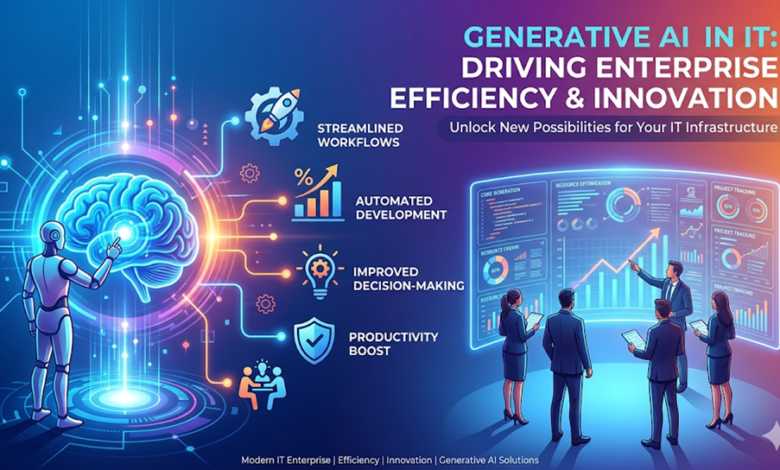
Generative AI is rapidly transforming the way IT organizations operate, innovate and deliver value to the business. What started as an emerging technology has quickly become a strategic priority for CIOs seeking to improve productivity, enhance decision-making and accelerate digital initiatives. As enterprise environments grow more complex, IT leaders are under increasing pressure to do more with less while maintaining high service quality and operational resilience.
Generative AI offers a compelling opportunity to address these challenges. By automating repetitive tasks, augmenting technical capabilities and enabling faster insights, it empowers IT teams to focus on strategic priorities. However, realizing its full potential requires a structured and disciplined approach aligned with enterprise goals.
Overview of Generative AI in IT
Generative AI refers to advanced artificial intelligence models that can create content, generate code, summarize data and provide contextual recommendations based on large datasets. Within IT, these capabilities are applied across software development, infrastructure management, service delivery and cybersecurity.
Organizations are increasingly adopting generative AI as part of broader digital transformation strategies. According to publicly available insights from The Hackett Group®, leading organizations are leveraging AI to enhance efficiency and improve performance across IT functions. These organizations integrate AI into their operating models rather than treating it as an isolated tool.
The adoption of Generative AI in IT is particularly impactful when supported by strong data governance, scalable architecture and clearly defined use cases. IT leaders must also ensure that AI initiatives align with business priorities and deliver measurable outcomes.
Benefits of Generative AI in IT
1. Increased productivity and efficiency
Generative AI significantly improves productivity by automating repetitive and time-consuming tasks. Developers can generate code, automate testing and streamline debugging processes. IT operations teams can automate documentation and knowledge management activities.
This reduction in manual effort allows IT professionals to focus on higher-value tasks such as innovation, architecture design and strategic planning.
2. Faster and data-driven decision-making
Generative AI enables IT leaders to analyze large volumes of data quickly and generate actionable insights. This supports faster decision-making in areas such as capacity planning, resource allocation and performance optimization.
By providing real-time recommendations, generative AI enhances IT teams’ ability to respond to changing business needs.
3. Improved service quality and user experience
AI-powered tools enhance IT service management by improving ticket categorization, response accuracy and resolution times. Virtual assistants can provide immediate support to users, reducing wait times and increasing satisfaction.
Consistent and accurate responses also improve overall service quality across the organization.
4. Cost optimization and resource management
Generative AI helps identify inefficiencies in IT operations, including underutilized resources and redundant processes. By automating routine tasks and improving accuracy, organizations can reduce operational costs and optimize resource utilization.
This contributes to more efficient budget allocation and improved return on investment.
5. Enhanced risk management and compliance
Generative AI supports risk management by analyzing logs, identifying anomalies and assisting in compliance documentation. It enables IT teams to detect potential issues early and respond proactively.
This strengthens governance and ensures alignment with regulatory requirements.
Use cases of Generative AI in IT
1. Software development and DevOps
1.1 Code generation and optimization
Generative AI tools assist developers by generating code snippets, suggesting improvements and identifying potential errors. This accelerates development cycles and improves code quality.
1.2 Automated testing and documentation
AI can create test cases and generate documentation from code repositories. This ensures consistency and reduces the manual effort required for maintaining documentation.
2. IT service management
2.1 Intelligent ticket management
Generative AI can analyze incoming tickets, categorize them accurately and recommend solutions based on historical data. This reduces resolution time and improves efficiency.
2.2 Knowledge management and support
AI-powered assistants provide contextual answers by leveraging knowledge bases. This enhances productivity and reduces dependency on senior experts for routine queries.
3. Infrastructure and cloud operations
3.1 Capacity planning and forecasting
Generative AI analyzes performance data to predict future resource needs. This helps IT teams optimize infrastructure usage and prevent system downtime.
3.2 Configuration and deployment automation
AI-generated scripts and templates ensure consistent deployment across environments. This reduces errors and improves operational efficiency.
4. Cybersecurity and risk management
4.1 Threat detection and analysis
Generative AI can analyze security logs and identify unusual patterns that may indicate threats. This improves response time and enhances security posture.
4.2 Policy and compliance documentation
AI assists in drafting and updating policies, ensuring that organizations remain compliant with regulatory standards.
5. Enterprise architecture and strategy
5.1 Scenario modeling and analysis
Generative AI helps IT leaders evaluate different technology scenarios and assess potential outcomes. This supports better strategic planning.
5.2 Application portfolio optimization
AI identifies redundant or underperforming applications and suggests optimization opportunities, enabling more efficient IT landscapes.
Why choose The Hackett Group® for implementing Generative AI in IT
Implementing generative AI at scale requires a structured approach that combines strategy, governance and execution. The Hackett Group® provides a research-driven methodology that helps organizations maximize the value of AI investments.
1. Benchmark-driven insights
The Hackett Group® leverages extensive benchmarking data to identify performance gaps and prioritize high-impact use cases. This ensures that AI initiatives are aligned with measurable business outcomes.
2. Strategic alignment and governance
Successful AI implementation requires strong governance frameworks to address risks related to data privacy, compliance and ethical use. A structured approach ensures responsible adoption across the enterprise.
Organizations can also benefit from expert-led AI consulting services to design and execute AI strategies that align with business objectives.
3. End-to-end transformation support
From identifying opportunities to scaling solutions, The Hackett Group® provides comprehensive support throughout the AI adoption journey. This includes change management, capability building and operating model design.
4. Accelerated value realization
The Hackett AI XPLR™ platform enables organizations to efficiently explore and prioritize AI use cases. It supports a disciplined approach to implementation, helping organizations move from experimentation to enterprisewide deployment.
Conclusion
Generative AI is transforming IT into a more intelligent, efficient and strategic function. By automating routine tasks, enhancing decision-making and improving service delivery, it enables IT organizations to deliver greater value to the business.
However, achieving these benefits requires more than technology adoption. Organizations must align AI initiatives with business strategy, establish governance frameworks and focus on measurable outcomes.
With a structured and research-driven approach, enterprises can successfully integrate generative AI into their IT operations and unlock long-term competitive advantage.
See more amazing Information visit Fact News


