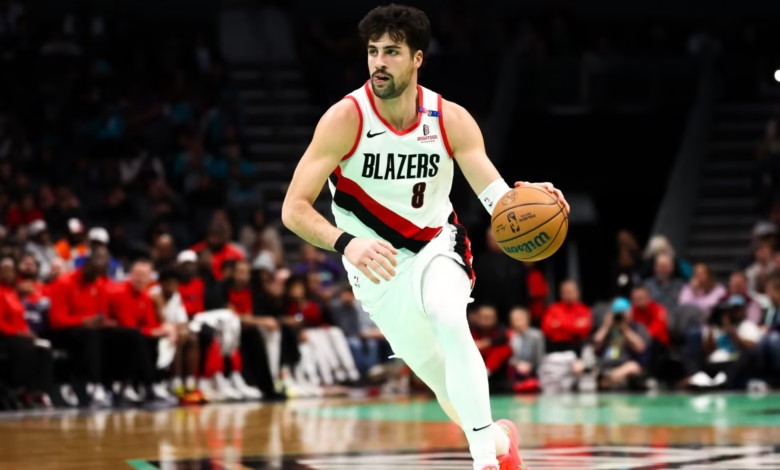
Deni Avdija’s rise has not followed the usual NBA script. He did not enter the league with the same noise as a number one pick, nor did he build his reputation through constant controversy, forced headlines, or a parade of viral moments. His public profile has grown in a steadier and more believable way. First came respect for his game. Then came curiosity about his personality. After that came attention to how he carries himself, how he dresses, how he speaks, and how naturally he seems to fit into a wider culture beyond basketball.
That difference matters. In modern sport, celebrity is no longer built only through points per game or highlight clips. It is built through recognisability, visual identity, control of image, and the ability to seem distinct in a league full of talent. Avdija has started to move into that space. He stands out not because he is the loudest player in the room, but because he offers something the NBA does not have in great supply. He has the look of a fashion model, the calm of a European professional, the credibility of a player who has earned his place, and the sort of image that can travel well across countries and audiences.
That is why the discussion around him has changed. He is no longer seen only as a promising international player or a useful all-round contributor. He is becoming the kind of figure people can discuss in terms of style, visibility, and wider cultural appeal. That does not mean he has become the league’s biggest basketball star. It means he is starting to occupy a different kind of space, one where sport, fashion, image, and celebrity overlap.
The interesting part is that his rise feels earned. He does not look manufactured. He does not seem as though he has been pushed into an image that does not suit him. Everything about the way he is being perceived now feels connected to traits that were already there, his background, his poise, his face, his frame, and his ability to look comfortable under attention without seeming hungry for it. That makes his celebrity appeal more convincing than many faster, louder rises.
The Background That Set Him Apart Early
Avdija entered the NBA with a type of preparation many American prospects do not have. Before he reached the league, he had already played meaningful professional basketball for Maccabi Tel Aviv, a club with real pressure, serious expectations, and a demanding environment. That experience shaped him. It taught him how to function within structure, how to handle scrutiny, and how to present himself like a professional before he ever played an NBA minute.
That matters because early image is often built on behaviour before it is built on branding. Some young players arrive in the league as raw talents who need years to learn how to speak publicly, carry themselves in interviews, and respond to larger attention. Avdija did not feel like that. He came in with a certain polish. He looked calm in public. He seemed used to pressure. He did not appear overwhelmed by cameras, audiences, or expectations. That gave him an edge in perception before the wider basketball public had fully worked out what kind of player he would become.
His identity also made him interesting from the start. He was not just another young prospect chasing a roster spot. He carried national significance as an Israeli player entering the NBA, and that instantly gave him a broader story. Players who represent something larger than themselves often gain public interest more quickly, especially when they seem comfortable holding that responsibility. Avdija never looked frightened by that role. He looked ready for it.
There was also a visual side to his appeal very early on. Some athletes grow into style relevance after years of success. Avdija had a camera-friendly presence before he became a finished NBA product. He had the height, facial structure, posture, and restraint that made people notice him. Even when the conversation was mostly about basketball potential, there were already signs that he could one day attract attention well beyond the court.
That combination, professional maturity, national identity, and visual presence, gave him a stronger starting point than many rookies ever have. He did not need a dramatic reinvention later. The foundation was already there. The public simply needed time to catch up to it.
Why His Celebrity Growth Feels More Real Than a Hype Cycle
Modern NBA fame often moves too fast. A player has a few big games, a social media clip explodes, and suddenly the league tries to sell him as a star before the public really understands who he is. That kind of exposure can disappear as quickly as it arrives. Avdija’s growth has felt more durable because it has been slower and more layered.
During his early years, he was not treated like the centre of a franchise marketing push. He had to earn his place, take on difficult defensive assignments, and develop in public. That may have helped him more than it hurt him. He was able to build credibility before becoming overexposed. Fans could notice him gradually and connect the image with real substance instead of seeing only a carefully managed brand.
That is one reason his rise now feels believable. Celebrity is stronger when it rests on something real. Fans do not need a player to be an MVP candidate in order to care about him, but they do need him to feel legitimate. Avdija has that legitimacy. He defends, rebounds, handles the ball, reads the game well, and competes with toughness. He is not famous because of one outfit or one interview. He is respected as a basketball professional first, and that makes everything else around his image feel earned rather than staged.
He also benefits from not looking desperate for attention. A lot of public figures weaken their image by appearing too eager to be seen. Avdija does not give that impression. He looks like someone whose visibility is growing because he has become harder to ignore, not because he is constantly pushing himself into the spotlight. That difference matters. One type of fame feels forced. The other feels natural. Natural fame usually lasts longer.
That is why his public image keeps strengthening. Each new moment adds to a story that already makes sense. The style works because it matches the personality. The celebrity appeal works because it sits on top of basketball credibility. The modelling potential works because it is supported by how he actually looks and moves. Nothing feels randomly attached to him. The parts connect.
The European Factor and Why It Matters in the NBA
The NBA has always had international players, but not all of them become style figures or wider celebrities. Some remain known almost entirely for skill. Others are framed only as competitors from abroad. Avdija is starting to move beyond that because his image fits a broader shift in what modern celebrity looks like. He brings a clean, restrained, European presentation into a league where visibility often comes through louder choices.
That contrast helps him. NBA fashion has become more visible than ever through tunnel walks, social media, and courtside coverage. Many players lean into excess, oversized fits, loud statements, or a deliberate clash of luxury and streetwear. That works for certain personalities. Avdija’s appeal comes from something more controlled. His style usually reads as cleaner, sharper, and more precise. He often looks less like someone trying to shock people and more like someone who already knows what works for him.
That matters because fashion is not only about standing out. It is also about knowing how to carry clothes. Avdija often gives the impression of control. The clothes do not wear him. His posture helps. So does his face. He photographs well because he does not need to overact. He has the kind of stillness that works in fashion imagery, where calm confidence is often more powerful than exaggerated posing.
This European quality also broadens his appeal. His style can translate across markets in a way that louder NBA fashion sometimes does not. Someone in London, Milan, Paris, or Berlin can understand his visual identity immediately. It does not require deep knowledge of basketball or American trend cycles. It reads as modern, polished, and recognisable.
That type of image travels well because it avoids extremes. He can look sharp in tailoring, natural in casual wear, and credible in sport-luxury combinations. He can appear serious without seeming cold, stylish without seeming forced, and athletic without seeming rough. Those are valuable qualities in any public figure trying to grow beyond one sport.
He Looks Like Someone Brands Can Use
Calling an athlete a model icon can sound exaggerated when the claim is based only on height and decent styling. In Avdija’s case, the idea has more substance than that. He has several qualities that genuinely fit fashion culture. First is proportion. He has the size associated with elite athletes, but also the balance that makes clothing photograph well. Second is restraint. He does not seem to be working too hard to prove he is stylish, which often makes someone appear more stylish. Third is face value, literally. His features are clear, structured, and camera-friendly.
These details matter because fashion depends on visual clarity. The camera needs to understand a person quickly. Avdija has the kind of look that reads at once. He appears sharp in formalwear, relaxed in simple casual clothing, and convincing in more editorial settings. That gives him a genuine crossover potential that goes beyond standard sports endorsement deals.
Movement also matters. Athletes often have an advantage in fashion because they understand their bodies well. Avdija carries himself properly. He does not collapse into clothing or disappear inside an outfit. He stands well, and that changes how everything looks on him. A person with strong posture and natural body awareness often seems more stylish than someone wearing more expensive clothes badly.
This is one reason the modelling conversation around him does not feel ridiculous. He does not need to abandon basketball or suddenly become a runway regular. In sport, a model icon is often a person whose look becomes part of the wider public story, someone who seems at home in campaigns, editorials, and brand imagery without needing to pretend. Avdija increasingly fits that description.
He also has range. A premium sportswear brand could use his athletic credibility. A menswear label could use his clean visual presence. A watch, fragrance, or eyewear campaign could use his calm face and strong frame. He is not stuck in one category. That makes him much more useful to brands than players whose image only works in one narrow setting.
Quiet Confidence Fits the Current Celebrity Mood
There has been a clear shift in the way celebrities work. Audiences still enjoy spectacle, but they are not as impressed as they once were by endless self-promotion. People increasingly respond to public figures who seem measured, controlled, and slightly elusive. Avdija benefits from that shift. He is not known for chaos, public feuds, or exhausting online behaviour. He does not look addicted to attention. That restraint makes him feel current.
There is a kind of luxury in understatement. The person who does less often signals more. Avdija’s public manner fits that principle well. He can appear confident without sounding arrogant. He can appear stylish without dressing like he is performing. He can appear famous without oversharing his life. That creates a cooler image than constant noise ever could.
This also protects him from one of the biggest risks in modern sports branding. Some athletes become known more for chasing an image than for their work, and audiences quickly grow sceptical. Avdija still seems anchored in basketball. His growing celebrity does not erase the fact that he is a serious player. Instead, basketball strengthens the image. That balance matters. It keeps him credible.
You can see that in how people talk about him. The conversation is not only about what he wears, but about how naturally the style fits him. It is not only about how he looks, but about how the look connects with the personality. That coherence is rare. Many public figures have teams, stylists, and carefully managed appearances, yet still look borrowed. Avdija usually looks like himself.
That authenticity matters more than people think. In an era full of content, the public is quick to sense when someone’s image is assembled from borrowed ideas. Avdija’s appeal is stronger because it does not seem copied. The calm, the styling, the visual identity, and the international quality all feel consistent with the person himself.
Basketball Substance Gives His Image Real Weight
None of the style conversation matters if the player cannot back it up on court. The reason Avdija’s rise has substance is that he has continued to grow as a basketball player. He does not survive on appearance. He contributes in ways that serious fans respect. He defends multiple positions, pushes the ball, creates secondary offence, rebounds aggressively, and plays with a competitiveness that prevents lazy attempts to reduce him to image alone.
That matters for two reasons. First, it keeps committed basketball audiences interested. Casual viewers may notice the face or the style, but real fans stay engaged because there is something to watch in the games. Second, it protects him from backlash. The NBA is not kind to players who seem overmarketed relative to their production. Avdija has avoided that problem because he looks like a real professional every time he steps on the floor.
There is also an interesting tension in his public persona. Off court, he can appear polished and elegant. On court, he often plays with bite. He fights for rebounds, defends hard, and brings an edge that contrasts with the smoothness of his off-court image. That contrast makes him more compelling. In celebrity culture, tension creates interest. The sharply dressed player who still competes physically is more memorable than someone who feels the same in every setting.
That dual identity also makes him easier to market. He can appeal to a sports audience that values toughness and to a style audience that values visual polish. A public figure who can bridge those worlds is more powerful than someone trapped in only one. Avdija is starting to show exactly that sort of range.
Because of this, his image carries more weight than surface-level style attention. He is not becoming visible by escaping basketball. He is becoming more visible because basketball has given him a strong base from which the image can grow. That is a much healthier path to fame.
Why He Connects Beyond Basketball Fans
One sign that a player is becoming a true celebrity is that people who do not follow every game still know who he is. Avdija is moving towards that point, especially in Israel and among international audiences who care about style, culture, or sport more broadly. His name is beginning to mean more than his stat line.
Part of that comes from representation. For Israeli fans, he carries importance beyond ordinary NBA success. He is not just another player on another roster. He is a national figure competing in one of the world’s most visible sports leagues while looking completely at ease in global celebrity spaces. That kind of connection creates loyalty, and strong home support often gives public figures a stronger base for wider fame.
At the same time, he is not limited to that audience. His appeal travels because his image is simple to read. Someone who knows very little about European basketball or Israeli sport can still understand why Avdija stands out. He looks modern. He looks controlled. He looks like someone who belongs in more than one world at once. That is a powerful quality.
He is also helped by timing. Sport and fashion are now much more closely linked than they once were. Athletes are no longer judged only by what they do in competition. Their visual identity, public behaviour, and cultural presence are part of the package. Avdija seems unusually well suited to that reality. He does not need to stretch himself into it. He already looks as though he belongs there.
That is why he is becoming interesting to more than one audience at once. Basketball fans see the player. Israeli audiences see the national symbol. Fashion-conscious viewers see the face, frame, and styling potential. Casual observers see someone who appears camera-ready and composed. When those groups begin to overlap, celebrity grows much faster.
The Ceiling Is Higher Than It First Appears
When people hear the word celebrity, they often think only of the loudest names, the highest scorers, or the players who dominate every debate show. But public prominence works in different ways. Some figures become huge because they are everywhere. Others become valuable because they feel aspirational and visually distinctive. Avdija may belong more to the second group.
He has the potential to become a player who sits at the intersection of basketball, fashion, and international identity. That does not require him to become the face of the entire NBA. It requires him to own a recognisable space inside it. In some ways that can be more valuable. A player with a clear niche often builds a stronger and more coherent image than someone trying to appeal to everyone.
He is also rising at the right moment. The old division between athlete and style figure has weakened. Audiences now expect public figures to move across different arenas. The NBA in particular has become a place where clothes, presence, and visual identity matter almost as much as post-game talking points. Avdija looks built for that world.
It would not be surprising to see him become one of the league’s most discussed off-court personalities without changing his core personality at all. That is what makes his trajectory so interesting. He does not need to become louder, more theatrical, or more controversial. He only needs to keep refining the same qualities that already work for him. In a culture that rewards consistency, that can take him far.
A few years from now, it would make perfect sense to see him featured in fashion editorials, brand films, magazine profiles, or campaigns that treat him as more than an athlete. It would also feel natural, not forced. The foundations are already visible. He has the sporting legitimacy, the face, the posture, the international identity, and the calm public presence. He looks like someone made for the modern attention economy, but not consumed by it.
Why Deni Avdija Feels Like a New Type of NBA Icon
The strongest argument for Avdija’s rise is not that he is already bigger than every established NBA celebrity. It is that he represents a newer kind of visibility. He does not rely on spectacle. He does not need constant noise. He is building recognition through shape, discipline, consistency, and a highly readable image. That may prove more durable than louder forms of fame.
He is becoming a celebrity because his image keeps widening. He is becoming a model icon because he genuinely looks and moves like someone who belongs in that space. The most important point is that these developments support each other. The better he becomes as a player, the more weight his image carries. The stronger his image becomes, the easier it is for brands, media, and wider audiences to invest in him.
That is why his rise no longer sounds far-fetched. He has the right combination of athletic credibility, visual appeal, international identity, and public restraint. He can speak to basketball fans, style followers, younger audiences, and national pride at the same time. Few players manage that without seeming artificial. Avdija does it with surprising ease.
His growth will probably continue through accumulation rather than one explosive event. A strong season, a sharp magazine feature, a memorable tunnel appearance, a bigger endorsement, a standout international performance, a well-cut campaign, a few more photos that spread online, these things build on each other. Celebrity often works that way. It gathers slowly, then starts to look obvious.
That is the stage he is approaching now. He already has the components. The public is only beginning to assemble them properly. He is tall, skilled, internationally recognisable, visually distinct, controlled in public, and easy to place in both sporting and fashion settings. Put those traits together and the result is powerful. He can move naturally from basketball coverage to style conversation, from game analysis to editorial photography, from athlete to wider public figure.
Even the smallest parts of his image now help that shift. A simple fitted look, a composed interview, a clean campaign photograph, or the right detail in a polished interior can all reinforce the same impression. He looks like someone who belongs in premium settings, whether that means an arena tunnel, a fashion shoot, or a private venue with low lighting and sleek restaurant booths in the background. That is how public image works when it is strong. The person seems to fit the setting at once.
Deni Avdija is not becoming interesting because he is trying to imitate someone else’s idea of fame. He is becoming interesting because his own identity is finally scaling up. That is a more powerful development. It lasts longer, feels more credible, and gives him room to become something larger than a very good NBA player. He is turning into a recognisable celebrity figure with real model-icon potential, and the signs suggest that this is still only the early part of the story.