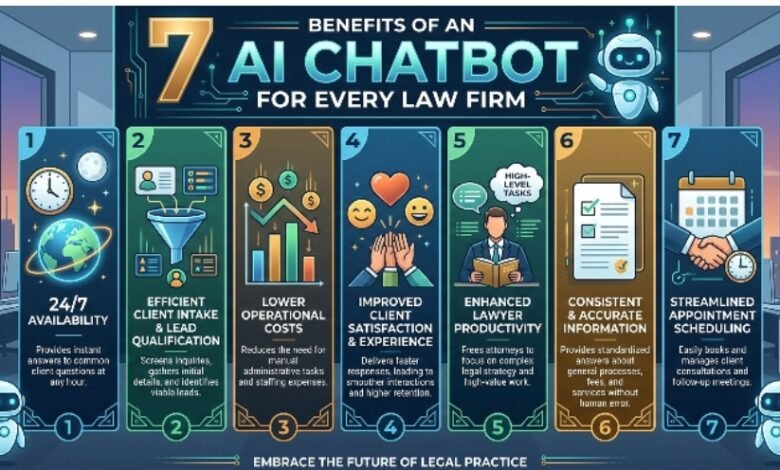
Missed calls, delayed email replies, and intake forms sitting untouched overnight. While your team is in court or focused on active matters, prospective clients are submitting enquiries and moving on if they do not receive a prompt response. In a market where comparison shopping is routine, slow follow-up quietly erodes conversion rates. Online reviews reflect responsiveness as much as legal skill, and first contact often determines who secures the retainer.
For firms that have not yet implemented an AI chatbot for law firms, the evaluation begins with a practical question: Will it materially improve intake performance without creating new risk? The interest is not novelty but measurable results. Faster lead response. Structured intake data. Fewer administrative interruptions. Stronger consultation booking rates.
1. Instant, 24/7 Lead Qualification
Legal consumers are now conditioned by other industries. They expect immediate acknowledgment. In personal injury, family law, immigration, and employment matters, prospects frequently contact multiple firms within minutes. The first firm to respond often secures the case.
A modern AI chatbot for law firms functions as a 24/7 client support chatbot for law firms, screening inquiries the moment they arrive. At 2:00 AM, it can ask targeted questions about jurisdiction, statute of limitations, type of injury, or contract dispute details. It can identify conflicts, determine whether the firm handles the relevant practice area, and gather enough structured data to determine fit.
The impact is measurable. Firms relying on next-day callbacks routinely lose high-intent prospects. Firms using real-time legal service enquiries automation are seeing materially higher consultation bookings and stronger conversion ratios.
From a management perspective, this is not about convenience. It is about revenue protection.
2. Automated “Where Is My Case?” Handling
Every law office knows the WISMC problem. Clients want updates. They call for reassurance. They emailed asking for progress. Much of this communication is non-billable but still essential to client satisfaction.
When a legal AI chatbot integrates with compatible platforms, it can safely access selected case information and provide clear updates inside the chat window. Rather than staff handling routine status questions, clients can view real-time updates about hearings, filings, shared documents, or settlement steps.
This form of legal AI automation reduces non-billable phone time significantly. More importantly, it reduces staff interruption. Attorneys regain focused time. Paralegals can prioritize substantive work.
The result is not just time saved. It is operationally calm.
3. Reduction in Low Value Intake
Not every inquiry should reach your intake team. Some prospects are outside your practice areas. Some are price shopping without intent. Others do not meet jurisdictional requirements.
An AI chatbot for legal services can filter these inquiries at the digital front door. It can disqualify cases outside the firm’s criteria and provide helpful referrals or educational resources instead of passing them into manual review.
By eliminating manual screening of non-viable cases, firms recover meaningful time. For many attorneys, this translates into hundreds of hours annually redirected toward billable activity or strategic client development.
This is where automation becomes a margin lever, not just a support tool.
4. Multilingual Accessibility Without Immediate Hiring
In many U.S. markets, a substantial percentage of potential clients prefer Spanish, Mandarin, or other languages. Hiring bilingual intake staff for every shift is not always economically practical.
Modern legal AI chatbot systems offer instant translation capabilities during intake. This allows firms to engage prospects in their preferred language from the first interaction.
This is not simply about convenience. It expands reachable markets while ensuring equitable access. Firms can capture diverse client segments without committing to immediate full-time multilingual staffing.
Over time, this improves local reputation and digital visibility among communities that may have previously felt underserved.
5. Instant Document Collection and CRM Sync
Intake does not end with a conversation. It involves gathering documentation: insurance cards, accident photos, identification documents, contracts, and medical records.
An advanced AI virtual assistant for consultancy services can request and securely receive these documents directly through chat. The information is then auto-populated into the firm’s CRM or case management system.
Manual data entry decreases. Transcription errors decline. Onboarding timelines compress from days to minutes.
For partners reviewing operational metrics, this shortens the time between inquiry and active representation. That acceleration often influences case momentum and client perception.
6. Elevated Client Experience Through Immediate Engagement
Legal matters are stressful. Prospects often arrive on a firm’s website during moments of uncertainty.
An AI-powered FAQ bot for legal services responds right away to typical client concerns. It walks users through what happens next, shares simple process timelines, and lets them know their inquiry is on record.
This type of instant online response helps raise client satisfaction scores and improves review trends over time. In crowded local markets, better reviews directly increase the number of new client enquiries.
Firms that automate client enquiries with an AI assistant are not replacing human empathy. They are ensuring that no inquiry goes unanswered.
In a market where digital reputation affects case flow, this matters.
7. Ethical Compliance and Data Security by Design
One of the most significant concerns in legal technology adoption has been confidentiality. Generic public AI tools create privilege risks. Data submitted into open systems may be retained or used in model training.
Legal-specific chatbot platforms in 2026 are built with dedicated compliance frameworks. SOC 2 certification, encrypted data silos, HIPAA compatibility where relevant, and safeguards aligned with ABA guidance are now standard in leading systems.
A properly configured AI chatbot for consulting customer support ensures that intake data is encrypted and not repurposed for public training. This protects attorney client privilege from the first click.
For firm leadership, this is the non-negotiable baseline. Efficiency cannot compromise ethics.
Direct Comparison: Human Only vs AI-Enabled Firms
Below is a practical comparison many managing partners now consider:
Traditional Human Intake
- Response speed: 30 minutes to 24 hours
- Availability: Business hours
- Data accuracy: Subject to manual entry errors
- Cost: Salary, benefits, training, turnover risk
- Appointment scheduling: Manual coordination
- FAQ handling: Staff time required
2026 AI Chatbot Agent
- Response speed: Under 10 seconds
- Availability: 24/7/365
- Data accuracy: Direct CRM sync
- Cost: Predictable SaaS subscription
- Appointment scheduling: Streamline appointment scheduling with an AI bot
- FAQ handling: AI-powered FAQ bot for legal services
The difference is not abstract. It shows up in signed retainers, staff workload, and online ratings.
Beyond Chat: Consultation Booking and Calendar Control
One of the most practical uses today is an AI chatbot for legal consultation booking. Instead of gathering contact details and waiting for a callback, the system links to firm calendars, shows open time slots, and confirms appointments right away.
This reduces no-show rates and eliminates scheduling back and forth. For firms that rely heavily on consultations as a conversion gateway, this capability alone can justify adoption.
Real-time legal service enquiries automation makes sure a client’s interest turns into a scheduled meeting before they move on.
Strategic Considerations for Law Firm Leaders
For decision makers, implementation should be deliberate. Key considerations include:
- Integration with existing case management systems
- Data security certifications and privacy architecture
- Customizable qualification workflows aligned to practice areas
- Reporting dashboards for conversion metrics
- Clear boundaries preventing unauthorized legal advice
Technology should reinforce your brand positioning, not dilute it.
Platforms like GetMyAI have been tailored specifically to professional service environments where confidentiality, structured intake, and CRM synchronization are essential. The objective is not novelty. It is an operational discipline.
A Decision for Managing Partners, Not Marketers
In 2026, responsiveness is revenue. Administrative drag is a cost. Client perception is public and persistent. An AI chatbot for law firms has moved from experimental to essential because it addresses all three variables simultaneously. It captures leads at the moment of intent. It reduces repetitive staff workload. It strengthens client experience without increasing headcount.
For firm leaders evaluating next year’s operational priorities, the question is straightforward: Are your intake systems aligned with how modern clients choose legal representation? If the answer is uncertain, that is where the opportunity lies.